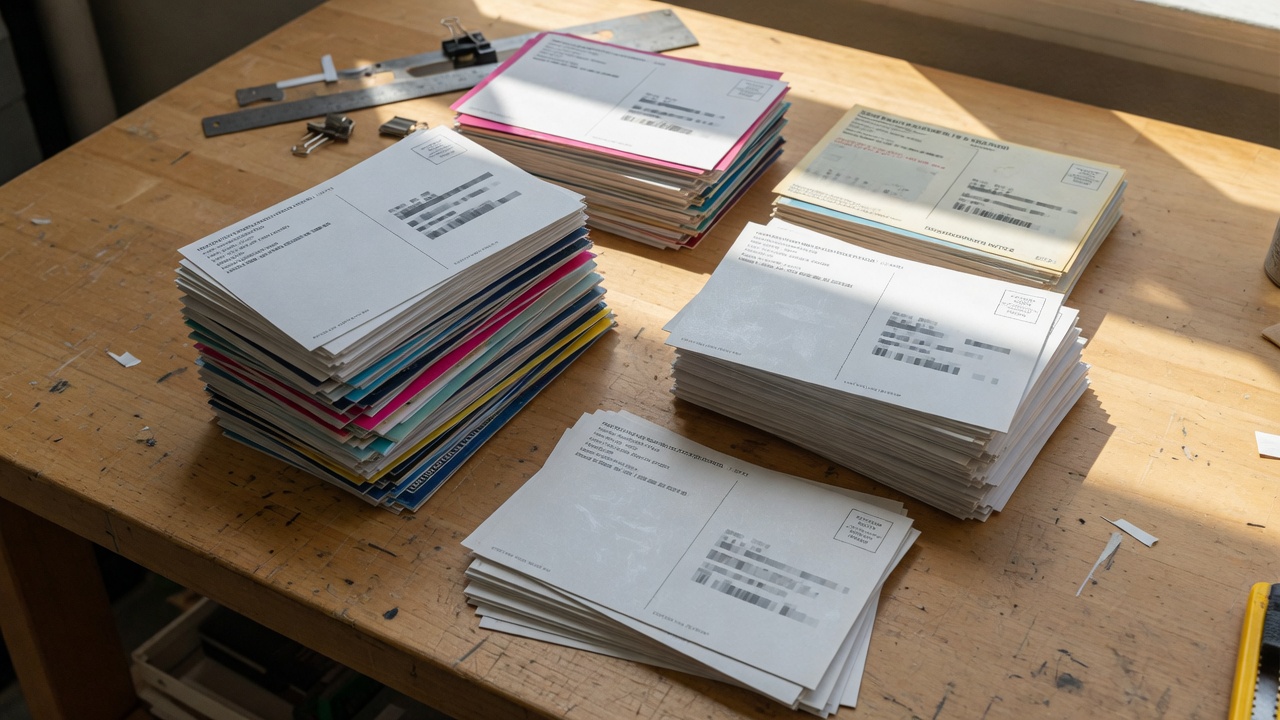
USPS postcard sizes for California direct mail start at 3.5 by 5 inches. Retail card stamps stop at 4.25 by 6 inches. Commercial First-Class card prices can reach 6 by 9 inches when the piece is rectangular, within caliper, and prepared as presort or automation mail. A 6 by 11 card mails as a letter.
That is the whole argument in four sentences. The rest of this page is how those numbers get you into trouble on press, at the address printer, and at the dock. Designers talk about 4×6, 6×9, and 6×11 as if they were three postcard products. The Postal Service talks about cards, letters, and flats. Those two vocabularies overlap only when the finished piece hits height, length, thickness, aspect ratio, and address-side layout at the same time.
I estimate jobs at Avanti Printing, 15321 Barranca Pkwy, Irvine, CA 92618. We print and prepare mail that originates here and travels across Orange County and the rest of California. If you are buying a campaign — not a box of cards for the front desk — you should spec the mailpiece the way a plant clerk will measure it, not the way a layout grid looks in InDesign. Call (949) 387-0787 if you already have a size and a drop date. Quotes still have to confirm size, material, quantity, finish, and date; postage is a separate USPS charge that moves when the Postal Service publishes a new price list.
Who this is for in Irvine, Orange County, and statewide California
This guide is for the person who signs a print and mail estimate: a marketing manager in Irvine Spectrum, a broker mailing listings from Newport Beach to Santa Ana, a restaurant group with locations down the 405, a medical office in Tustin, a dealer in Anaheim, or a statewide brand that wants one origin point in Orange County. It is not a souvenir-postcard spec. It is not a walk-in stamp lecture. And it is not a Laguna Hills ZIP product page. The plant is in Irvine. The mail is California mail that happens to start on Barranca Parkway.
If you are handing cards out at a booth, thickness is a tactile choice and USPS almost does not care. If those same cards go into trays, every thousandth of an inch and every eighth of an inch in the address block starts to cost money. A piece that looks like a postcard on the conference table can rate as a letter. A letter-size card that looks “oversized” can still be cheaper than a flat. The buyer who understands that difference controls the budget. The buyer who only picks a pretty size finds out at induction.
You should read this if any of the following is true. You are comparing a 4×6 drop to a 6×9 drop and the only number you have is print price. You were told 6×11 “is still a postcard.” You flooded UV on both sides and then asked for inkjet addresses. You set the address parallel to the short edge because the photo looked better that way. You used last year’s list. You need the mail to originate in Orange County so the in-home window matches a sale, an open house, or an enrollment deadline.
If the offer needs panels, maps, or a longer story, a card may be the wrong format. We print multi-panel brochures for California campaigns and bound catalogs when a mailer needs pages. Those jobs have their own folds, binding, and postage shape. Do not force a catalog’s worth of copy onto a 4×6 and then blame the Postal Service when nobody can read the address.
Card rate, letter rate, and flats: the decision that actually matters
USPS does not price pretty rectangles. It prices shape classes. For the pieces California mailers call postcards, you are almost always in one of three buckets: card, letter, or flat. Get the bucket wrong and two things happen. Postage jumps. The piece can also lose automation pricing, pick up a nonmachinable surcharge, or come back as undeliverable because the sortation equipment never got a clean read.
Retail (single-piece) First-Class cards are the strictest. On the public postage pages, a standard postcard stamp applies to a rectangular paper card roughly 5 to 6 inches long, 3-1/2 to 4-1/4 inches high, and 0.007 to 0.016 inch thick. As of the July 2026 USPS price change, that retail postcard stamp is listed at $0.65 and a 1-ounce letter stamp at $0.82. Those figures are USPS prices, not a print quote, and they move. Confirm them on the Postal Service site before you lock a campaign budget. Oversized cards need letter postage. See the current retail explanation on USPS First-Class Mail postage.
Commercial mail is a different rulebook. If you prepare First-Class Mail as presorted or automation cards, the card-price maximum grows to 6 inches high by 9 inches long by 0.016 inch thick. That is why a 6×9 can be a card in a permit mailing and a letter if you walk the same stack to a retail counter with stamps. USPS Marketing Mail does not publish a separate, lower postcard price. A 4×6 Marketing Mail piece is still priced as a letter (or a flat if you blow past letter dimensions). People miss that sentence and then argue with an invoice.
Letter-size maximums are 11-1/2 inches long, 6-1/8 inches high, and 1/4 inch thick. Go past any one of those and you are in flats. An 8.5×11 card is not a “big postcard.” It is a flat. Flats cost more, handle differently, and need their own design standards. Most of the 4×6 / 6×9 / 6×11 conversation never should reach flats. If your layout is drifting toward letter-size paper with no envelope, stop and re-measure height.
Physical standards for commercial letters and cards live in USPS Quick Service Guide 201: minimum 5 inches long by 3-1/2 inches high, card-price maximum 9 inches long by 6 inches high by 0.016 inch thick for First-Class card prices, and letter maximum 11-1/2 by 6-1/8 by 1/4 inch. Aspect ratio (length divided by height) must fall between 1.3 and 2.5 for automation. Length is the edge parallel to the address as read.
Read the numbers from the source, not from a vendor size chart that mixes retail and commercial rules. The Postal Service summary is here: USPS Quick Service Guide 201, physical standards for commercial letters and postcards. If a sales sheet on the internet disagrees with that guide, the guide wins.
Here is the working comparison I put in front of California buyers before anyone talks about coatings.
| Finished size (inches) | Aspect ratio (long edge / short edge) | Typical USPS shape if address runs parallel to the long edge | Card-rate path | Thickness notes |
|---|---|---|---|---|
| 4 x 6 | 1.50 | Card | Retail stamp or commercial First-Class card prices, if caliper and layout pass | 0.007 in min, 0.016 in max for card prices |
| 4.25 x 6 | 1.41 | Card (retail maximum height) | Same as 4×6; this is the retail height ceiling | Same 0.007–0.016 in card window |
| 5 x 7 | 1.40 | Letter | None. Height and length both miss retail card limits | 0.009 in minimum because the piece is more than 4-1/4 in high and more than 6 in long |
| 6 x 9 | 1.50 | Card only on commercial First-Class presort or automation; otherwise a letter | Commercial FCM card prices if 0.009–0.016 in thick and the mailing qualifies | Below 0.009 in, nonmachinable risk; above 0.016 in, card prices disappear |
| 6 x 11 | 1.83 | Letter | None. Length is past the 9 in commercial card maximum | 0.009 in minimum; letter thickness can go to 1/4 in if the piece still processes as a letter |
| 5 x 5 square | 1.00 | Nonmachinable letter | None | Aspect ratio is outside 1.3–2.5; budget a surcharge and slower handling |
| 8.5 x 11 | 1.29 | Flat | None | Height exceeds 6-1/8 in; do not treat this as a jumbo card |
Two footnotes belong under that table. First, “4×6” in print is a trim size. USPS measures the finished piece, including any round-corner radius, any attached magnet, and any laminated edge. Second, the address rotates the axes. If you set type on the 4-inch edge of a 4×6, you just told the Postal Service the length is 4 inches. Four inches is below the 5-inch minimum length. That is not a cute vertical postcard. That is a nonmailable or nonmachinable problem depending on how far you are into the rules.
The three sizes California mailers actually print: 4×6, 6×9, and 6×11
We print odd sizes when the job needs them. Daily commercial mail from this plant still clusters on three trims because they match presses, letter shops, and USPS buckets. Pick the size for the postage class you intend to buy, then design to that rectangle. Do not design a 6×11 hero image and then ask us to “make it a postcard rate.” If you already know the trim and only need production, start with our Irvine postcard printing sizes and mail prep and bring the USPS class with you.
4×6 — the retail card and the safest commercial card
A 4×6 that stays 4 inches high and 6 inches long, with the address parallel to the 6-inch edge, sits inside both the retail card window and the commercial card window. Aspect ratio is 1.50. That is comfortable. Minimum thickness is 0.007 inch. Maximum for card prices is 0.016 inch. This is why 14 pt C2S is the default conversation for a 4×6 mailer. It is stiff enough to run, thin enough to stay under the card-price ceiling on most coated stocks, and familiar to every addressing machine we see.
Use 4×6 when the offer is short: a date, a URL or QR, a phone number, one photo, one price, one deadline. Irvine dental recalls, service reminders, a single SKU promotion, a save-the-date that does not need a map — this size earns its keep. It also lets a small test mailing use stamps or a meter without forcing you into a full presort. If you later scale to commercial First-Class cards, you are not redesigning the trim.
Where 4×6 fails: bilingual legal copy, a six-item menu, a floor plan, or a “we also do these twelve other things” laundry list. Crowding the address side is how barcode clear zones die. If the back of the card is a solid photo with a dark panel where the address has to live, you are already in reprint territory. Keep a light, uncoated or knock-out panel. I would rather you drop a sentence of marketing copy than drop the IMb.
4.25×6 is the retail height limit, not a creative upgrade. If a designer adds a 1/4-inch bleed misunderstanding and the trim creeps to 4.3 inches high, you have left the retail card box. Commercial card height can go to 6 inches, but only when the mailing is prepared as commercial cards. A stamped 4.3×6 is a letter. Measure the trimmed dummy, not the artboard.
6×9 — the commercial First-Class jumbo card, not a universal postcard
6×9 is the size that creates the most expensive misunderstandings. Marketing departments like it because it feels like a mini flyer. Print buyers like it because it still trays with letters. Postage clerks like it only when you meet the commercial card rule that took effect for larger First-Class cards: maximum 6 inches high by 9 inches long, thickness 0.009 to 0.016 inch, and the mailing actually qualifies as commercial presorted or automation First-Class cards.
If you stamp 6×9 pieces at a retail counter, you are buying letter postage. If you drop 6×9 as USPS Marketing Mail, you are buying letter prices, not a magic postcard discount. If your 6×9 is 0.008 inch thick, you are under the 0.009 inch minimum that applies once a piece is more than 4-1/4 inches high or more than 6 inches long. Thin jumbo cards buckle in high-speed equipment. USPS wrote the 0.009 inch rule for that reason, not to annoy art directors.
6×9 aspect ratio is 1.50 if you address it as a landscape card. That passes. Turn it into a tall 9×6 with the address on the 6-inch edge and the ratio becomes 6 / 9 = 0.67, which is another way of saying you declared the short side to be length. Do not do that. Keep the delivery address parallel to the 9-inch dimension.
When is 6×9 worth the extra paper and the tighter caliper window? When the offer needs a larger photo, a short floor plan, three bullet benefits, and a reply panel, and you still want First-Class card prices on a qualified commercial mailing. Real estate postcards in Orange County often land here because a 4×6 cannot hold a listing photo and a readable agent block without eating the barcode zone. Restaurants use 6×9 for a limited menu. Civic and enrollment mailers use it when a 4×6 looks like junk and an envelope looks like a bill.
When is 6×9 a waste? When you do not have a commercial First-Class card plan. Paying letter postage on a 6×9 that could have been a 6×11 (more room, same letter bucket) is a common self-inflicted wound. If the piece is going to be a letter anyway, use the letter rectangle on purpose.
6×11 — a letter-size card, and that is not an insult
6×11 is 11 inches long and 6 inches high. Commercial card prices stop at 9 inches long. Letter-size maximum length is 11-1/2 inches and maximum height is 6-1/8 inches. A 6×11 with the address on the 11-inch edge is a letter. Aspect ratio is about 1.83, which sits inside 1.3 to 2.5. Minimum thickness is 0.009 inch. You can run 14 pt, 16 pt, even heavier cover as long as the piece stays flexible enough to process as a letter and does not exceed 1/4 inch.
Mailers choose 6×11 because it is the largest common card that still rides in letter equipment. That matters in California volume. Letters sort faster and usually price below flats. You get room for a map of Irvine Company villages, a QR that is not a speck, a calendar strip, or a before-and-after pair. You do not get card-rate postage. Price the job as a letter from the first estimate. If a vendor quotes “postcard postage” on 6×11, they are guessing or they are describing Marketing Mail letters with loose language.
Watch the 6-1/8 inch height ceiling. A 6.25×11 “for bleed safety” is how a letter becomes a flat. We trim to 6.00 inches high unless you have a documented reason to live at 6.125. Do not ask for a 1/8-inch round corner and a 6.125 height and a full-bleed dark footer. Corners, caliper, and the barcode zone all shrink that safety margin.
6×11 also tempts people to fill every pica. Resist that on the address side. A bigger card still has the same OCR read area relative to the bottom edge. The extra real estate should live in the image and the offer, not in a decorative band that collides with the IMb.
Thickness and caliper: the spec designers skip
USPS thickness is measured in inches, not in the marketing name of the stock. “14 pt” is a nominal caliper of fourteen thousandths of an inch. Coatings, films, and humidity change the number that a micrometer actually reads. Card prices die at 0.016 inch. Letter-size pieces that are more than 4-1/4 inches high or more than 6 inches long need at least 0.009 inch. Those two numbers explain most of the stock arguments I have in a given month.
Typical industry ranges — and they are ranges, not promises — look like this on coated cover:
- 80 lb coated cover often lands around 0.008 to 0.010 inch. Fine for some 4×6 cards. Risky as a 6×9 or 6×11 because you can fall under 0.009 inch.
- 100 lb coated cover often lands around 0.010 to 0.012 inch. A common floor for jumbo cards when you want stiffness without approaching 0.016 inch.
- 12 pt C2S is nominally 0.012 inch. Comfortable for 6×9 commercial cards if the coating does not pile on.
- 14 pt C2S is nominally 0.014 inch. The workhorse for 4×6 and 6×9 mailers that must stay under 0.016 inch.
- 16 pt C2S is nominally 0.016 inch. That is the card-price ceiling before UV, aqueous, or film. Measure the finished dummy. Do not assume the mill’s 16 pt still reads 0.016 after a flood UV on two sides.
- 18 pt and thicker are letter-stock choices, not card-price choices. They can be excellent 6×11 mailers if the piece still bends.
Uncoated cover is bulkier than coated cover at the same basis weight. An uncoated 80 lb cover can caliper like a thinner coated 100 lb, or thicker, depending on the mill. If you want an uncoated address side for inkjet, say so in the quote and we will pick a sheet that still clears 0.009 inch on jumbo sizes. Do not grab leftover letterhead stock and call it a postcard.
Rigidity is a separate failure. A board-stiff 24 pt letter-size card can exceed what letter machines want to wrap around their transport paths. USPS lists “too rigid” among nonmachinable characteristics. If you need a rigid piece, you may be buying a surcharge or you may need a different format. We would rather tell you that on the estimate than after a 25,000-piece run.
How we check: a finished, coated, trimmed dummy under a micrometer, not a mill swatch held up to a window. If the job is a 6×9 aiming at commercial First-Class card prices, I want the finished caliper in the 0.009 to 0.016 inch band with a little room on both sides. If a 16 pt plus two-sided UV reads 0.017 inch, that piece is not a card for postage. It can still mail as a letter. The estimate has to say so before you approve the proof.
Weight is rarely the limiter on a single card. First-Class commercial letters and cards top out at 3.5 ounces for machinable and automation prices. A 6×11 16 pt card is still a fraction of that. Do not use weight as an excuse to ignore caliper. The opposite problem is more common: a pretty, thin sheet that looks elegant and then fails the 0.009 inch rule on a 6×9.
Aspect ratio and which edge is length
Aspect ratio is length divided by height. For automation letters and cards, USPS wants that ratio between 1.3 and 2.5 inclusive. A 4×6 addressed as a landscape card is 6 / 4 = 1.5. A 6×9 landscape card is 9 / 6 = 1.5. A 6×11 landscape letter-card is 11 / 6 ≈ 1.83. Those are easy passes.
Squares fail. A 5×5 is 1.0. A 6×6 is 1.0. Retail clerks will still take them with a nonmachinable surcharge on First-Class letters. Commercial automation prices will not. If you want a square mailer in California, budget the surcharge, expect manual handling, and do not promise a First-Class card rate. I would rather you print a 4×6 with a square photo inside the live area.
Vertical designs fail in a quieter way. Length is the dimension parallel to the address as read. If the delivery address runs along the short side, that short side is length. A 4×6 “portrait postcard” with the address across the 4-inch edge is a 4-inch-long piece. Minimum length is 5 inches. That is not a style choice. That is a machinability problem. Keep the address block level with the long edge even if the photo is a tall portrait. Crop the photo. Do not rotate the mailpiece definition.
Round corners are allowed on cardstock letter-size and card-type pieces if the radius does not exceed 1/8 inch. Larger decorative corners change the effective rectangle and can catch in equipment. If a designer specifies a 3/8-inch radius because it looks “friendly,” we will push back. Friendly corners that stall a sorter are not friendly to your in-home date.
Nonrectangular die-cuts — circles, tickets with a bite out of the side, arrow-shaped mailers — are not automation cards. They can mail. They mail as odd pieces with odd prices. If the campaign depends on card or letter automation prices, stay rectangular with parallel opposite sides.
Address block, Intelligent Mail barcode, and the clear zone
Postage discounts on commercial letters and cards assume the piece can be read at speed. That is the job of the delivery address, the ZIP+4, and the Intelligent Mail barcode (IMb). You can print the IMb in the address block or in the lower-right barcode clear zone. Address-block barcodes are what we see on most California jobs because they travel with the variable data and they keep the lower right available as a safety margin.
USPS recommended address placement on a letter-size piece sits in the OCR read area: at least 1/2 inch from the left and right edges, at least 5/8 inch up from the bottom, and no higher than 2-3/4 inches from the bottom. That is a shallow band. On a 4×6, it is a large fraction of the address side. On a 6×11, you have more canvas above that band. You do not get to move the band. Designers who “need” the bottom inch for a color bar are designing a reject.
If the IMb lives in the address block, typical placement rules you should leave room for include:
- Rightmost bar at least 1/2 inch from the right edge.
- Leftmost bar at least 1/2 inch from the left edge, and not wildly far from the right on a jumbo letter.
- Bottom of the address block, including the barcode, at least 5/8 inch from the bottom edge.
- Top of the bars less than 4 inches from the bottom edge.
- Clearance around an IMb of about 1/8 inch left and right and a much tighter gap above and below (USPS publishes 0.028 inch above/below for IMb inside the block).
The lower-right barcode clear zone is a different rectangle: roughly the bottom 5/8 inch by the right 4-3/4 inches when the barcode is applied there instead of in the block. Either way, dark ink, busy photos, and heavy varnish in that neighborhood are how pieces skip automation. Hold background in the address area to a light tint. High contrast, dark type, light field. Sans serif, plenty of point size. No reversed type for the delivery address. No script font that looks like a wedding invite. California mail with bilingual lines still has to leave a clean English (or fully standardized) delivery address the machines can parse. Put the second language in the marketing panel, not between the name and the ZIP.
Return address belongs in the upper left. Postage indicia or meter imprint belongs in the upper right. Do not let a logo collide with the indicia. Do not put a QR code in the barcode clear zone and assume “it is a different barcode.” The sorter is not your brand guidelines.
Optional endorsement lines (OEL) and ancillary service endorsements — Address Service Requested, Return Service Requested, and the rest — have fixed locations above the address block. If you want undeliverable pieces back, say so on the quote. Returns cost postage and they need an endorsement. “Or current resident” changes the job of the piece: it is then an occupant-style delivery, not a named-person letter. That can be correct for a neighborhood offer. It is wrong for a patient recall with clinical information on the face.
IMb is not optional if you want automation prices. A pretty card with a handwritten look and no barcode can still mail at full retail. It will not get commercial automation discounts. For a 5,000-piece Irvine drop, that difference is real money. For 50,000 pieces into Los Angeles and San Diego, it is the campaign. We generate or receive IMbs as part of the mail prep. Do not have a designer draw a fake barcode “for the mockup” and then forget to replace it. Fake bars in the live file are how mail gets rejected at verification.
Apartment, suite, and unit designators matter more in Orange County than buyers from rural ZIPs expect. Irvine Company communities, high-rises around the Spectrum, UCI-adjacent housing, and mixed-use buildings in Santa Ana all depend on secondary address lines. A CASS-certified list that still drops unit numbers will generate returns. The print file cannot fix a list that never had Unit 2B. Budget time for list hygiene before we lock the variable data.
Coating, varnish, and inkjet addressing
This is the production collision that ruins otherwise legal sizes. Flood UV, heavy aqueous, and some silk coatings on the address side are there to make the photo pop. Inkjet addressing needs a receptive surface. Those two goals fight. If the address side is a skating rink, droplets sit on top, smear in the transport, or never reach the reflectance USPS wants for the IMb.
Choose one addressing method and one finish stack, then build the sheet around that pair:
- Inkjet on press or at the letter shop: leave an uncoated window large enough for the address block and barcode. A knock-out in the coating is not a 2-inch postage-stamp hole. It is a panel that includes the quiet space around the IMb. If the window is too small, the heads still print on varnish at the edges and the bars fail.
- Laser addressing: some coated sheets toner-fuse, some do not. We test. Do not assume office-laser paper behavior on 14 pt C2S.
- Labels: ugly if you designed a full-bleed photo, reliable if you already coated both sides. A white label on a dark UV card is honest. A smudged inkjet on UV is not “edgy.”
- Preprint the addresses with the rest of the job (true variable data on digital or a combined pass): you can coat after the addresses only if the coating does not bury contrast and does not fill the barcode. Most UV floods after inkjet are a bad idea. Spot UV on the image side only is usually the adult compromise.
Gloss UV on the mail face also scuffs in trays and can block in heat. Orange County trucks and Southern California summer yards are not laboratory conditions. If cards sit in a hot gaylord, flood UV on flood UV will offset. Aqueous on the address side and UV on the image side is a common split. Uncoated address side and coated image side is even safer for inkjet. We will argue for the split even if the mockup was “high gloss both sides like a magazine.” Magazines do not get IMbs sprayed at 20,000 pieces an hour.
Metallic inks, foil, and dark floods in the address band create reflectance failures. USPS barcode standards care about print contrast and background reflectance. A navy field with black type looks premium in a PDF and looks like mud to an optical reader. If the brand color is navy, keep it on the front. The address side can carry a small logo in color and a large, pale panel for the variable data.
Coatings also add caliper. A 16 pt sheet that was already hugging 0.016 inch can step over the card-price limit after two-sided UV. If the job must stay a 4×6 or 6×9 at card prices, we would rather drop to 14 pt with a controlled finish than “upgrade” the stock and accidentally buy letter postage on 20,000 pieces. That upgrade is a downgrade of the budget.
If you want a deeper finish conversation for mailers — gloss versus silk versus uncoated as a tactile choice — that is a separate spec. For this page, the only finish question that matters is: will the address and IMb print cleanly, stay readable, and keep the finished thickness inside the postage bucket you are buying?
Files, bleeds, and the dummy we want before a long run
Send a print-ready PDF with fonts outlined or embedded, images at a reasonable production resolution, 0.125 inch bleed on all sides, and live matter pulled back from trim. For mail, also send a second PDF of the address side that shows the OCR band, the coating knock-out, the indicia, and a dummy address in the correct position. If variable fields exist, mark them. If they do not exist yet, still show the empty panel at final size. A pretty front with “address TBD” in the middle of a photo is not a mail file.
Color: CMYK. Do not build the address in RGB gray that converts to a warm muddy black. Use a solid black for the delivery address and barcode unless we are printing the addresses in a later inkjet pass. Inkjet has its own black. Do not put a 5% yellow cast in the address panel to “match the brand warmth.” That cast is how contrast dies.
Trim: if the creative is 6×9, the bleed file is 6.25 x 9.25 with 0.125 inch bleed, and the finished mailpiece must still measure 6.00 x 9.00 after bindery. People add “a little extra” for safety and then the piece is 6.12 x 9.06. On a 6×9 aiming at the commercial card ceiling, that extra is how you leave the card box on height or length. We would rather you have a clean 0.125 inch bleed and a hard trim than a nervous oversize.
Proofs: a press proof or a contract-quality digital proof of the static art, plus a data proof of the first and last records, plus a physical dummy on the actual stock with the actual coating. The dummy is the only way to check caliper, curl, and inkjet holdout together. A PDF cannot tell you that the 16 pt UV sandwich is 0.017 inch thick. For a California drop with a hard in-home window, build dummy time into the schedule. Do not squeeze it the afternoon before we are supposed to be in trays.
If the same campaign also needs a leave-behind that is not mailed, say so. Handouts can flood UV both sides with no knock-out. Mailed cards cannot always. Mixing those two specs on one purchase order is how the wrong pile gets addressed.
Request a postcard mailing quote
Why pieces come back or get billed as letters
Returns and re-rates are different failures. A re-rate means USPS accepted the mailing but not at the price you claimed. A return means a piece went toward a delivery address and could not be delivered as addressed. Both show up as “the post office hated our postcards.” They are not the same repair.
Rated as a letter (or worse) after you planned a card
- The trimmed size exceeded card dimensions. Retail cards stop at 4-1/4 x 6. Commercial First-Class cards stop at 6 x 9. 6×11 is a letter on purpose. 6.1 x 9.1 is a letter by accident.
- Caliper exceeded 0.016 inch. Two-sided UV on 16 pt is the usual suspect. Laminate and magnets are even more obvious.
- Caliper fell under 0.009 inch on a jumbo size. The 6×9 on 80 lb coated cover that felt “nice and thin” is the usual suspect.
- The mailing was USPS Marketing Mail. There is no separate postcard price. You bought letters even if the piece is 4×6.
- The mailing was retail single-piece on a 6×9. Stamps do not get the commercial jumbo-card exception.
- Aspect ratio or orientation failed. Address on the short side, square trim, or a vertical that redefined length.
- Nonmachinable traits: too rigid, clasps, odd cuts, nonpaper faces, lumpy attachments. A plastic card stuck to a paper card is not a postcard. It is a problem.
- The piece was actually a flat. Height over 6-1/8 inches, length over 11-1/2 inches, or thickness over 1/4 inch.
Re-rates at verification are ugly because the print is already done. You cannot trim 20,000 finished 6.25-inch-high cards down to 6.00 inches after they are coated and addressed without a bindery rescue, and even then the layout may kill the barcode zone. The cheap time to fix this is at estimate, with a dummy.
Returned or treated as undeliverable
- The list failed move-update. People in Irvine, Costa Mesa, and student housing around UCI move. Commercial First-Class and Marketing Mail have move-update requirements on a USPS clock. A list you mailed last fall is not automatically legal this spring. We check dates. Bring a current file.
- Missing or wrong secondary designators. “200 Spectrum Center Dr” without a suite is a guess. Orange County has too many suites for guesses.
- Illegible addresses: inkjet on UV, pale gray type, script, or a photo behind the lines.
- Barcode unreadable: skew, wrong quiet zone, varnish, or a designer-drawn barcode that is not a real IMb.
- Insufficient address, vacant, no such number, attempted not known — these are list and USPS data issues. Print cannot invent a deliverable line.
- No endorsement when you expected pieces back, or the wrong endorsement for the class. Ancillary service language is not decoration. It is an instruction with a postage consequence.
- Gated communities and cluster boxes do not make a piece undeliverable by themselves, but a bad rural-style address format on a South County condo does. Use USPS standardized address format, not the gate code the driver uses.
Forwarding depends on class and endorsement. First-Class has a different UAA treatment than Marketing Mail. If the campaign is a time-sensitive offer, First-Class card or letter postage can be the right buy even when Marketing Mail looks cheaper per piece, because a forwarded First-Class piece can still arrive. I will not pretend there is one correct class for every California drop. I will insist that you pick the class before you pick the finish.
Pieces also “come back” internally when the letter shop rejects them before induction: curl that will not feed, stacked UV that blocks, addresses that smear on the first 200 cards, or a permit imprint that does not match the paperwork. That is not USPS being difficult. That is the job stopping while we still own it. Better here than in Santa Ana on a Friday.
California and Orange County origination, not a ZIP gimmick
Mail we produce for this site originates at Avanti Printing in Irvine, not from a fictional storefront in every ZIP a search engine likes. The plant address is 15321 Barranca Pkwy, Irvine, CA 92618. Phone (949) 387-0787. From here, trays typically enter the Orange County processing network. That origination is useful when your in-home window is built around Orange County carrier routes — Irvine, Tustin, Costa Mesa, Newport Beach, Santa Ana, Anaheim, Lake Forest, Mission Viejo — and still valid when the same job continues to San Diego, Los Angeles, the Inland Empire, or statewide.
Local conditions that actually change a postcard spec:
- Apartment-heavy ZIPs. Secondary address lines and CASS work are not optional. A beautiful 6×9 with a missing unit number is a beautiful return.
- High turnover. UCI-adjacent rentals, hospital staff housing, and new villages in Irvine change occupants. Move-update is part of the mail spec, not a nice-to-have.
- Business parks. Spectrum, the Irvine business complex, and similar parks have receiving rooms and suite maps that do not match how a user typed the address in a form. Standardize before we print names 8-point tall.
- Heat and transport. Summer trays cook. Design the coating stack for Orange County logistics, not for a refrigerated studio.
- Bilingual creative. Common and useful in California. Still keep one clean, standardized delivery address. Do not interleave lines the OCR will read as a broken city-state-ZIP.
- HOA and municipal rules. Those affect signs and door hangers more than stamped cards. For mail, the constraint is USPS, not an HOA board. Do not confuse the two projects.
Entry discounts and SCF versus local entry are real for some Marketing Mail and some First-Class jobs. They depend on how the mailing is sorted, where it is accepted, and the current USPS price list. I will not quote a made-up per-piece postage here. Bring the ZIP histogram and the class, and we will price entry as part of the mailing plan. Printing 50,000 identical 6×9 cards without a ZIP density report is how you leave money on the dock.
If you need commercial postcard printing from our Irvine plant, we will ask origin, destination ZIPs, class, and whether we are only printing or also prepping the mail. Print-only jobs still have to meet the size and caliper rules if you are taking the cartons to your own permit. We will not silently build a 6×11 and label the carton “postcards” as if that word controlled postage.
Mistakes that force a reprint (or a silent postage upgrade)
These are the repeats. I see them on files from good agencies, not just on files from someone who drew a card in a word processor.
- Designing at 6×9, then dropping stamps because the quantity shrank. The trim did not become a retail card when the quantity fell below a presort minimum.
- Building the front as a 4×6 and the back as a 6×4 vertical address. One piece, two orientations, zero automation.
- Putting a dark full-bleed photo on the address side with white type. Contrast fails, inkjet fails, IMb fails.
- Spotting UV “everywhere except the address” and then drawing the knock-out 1/8 inch too small. The barcode bars print half on varnish.
- Rounding corners to a 1/4-inch radius because the business cards used that radius. Cards in wallets are not cards in sorting machines.
- Adding a 1/4-inch safety trim that turns a 6.00-inch-high letter into a 6.25-inch-high flat.
- Specifying 16 pt plus two-sided UV on a job that must stay under 0.016 inch.
- Using 80 lb cover on a 6×9 because it felt cheaper, then missing 0.009 inch.
- Drawing a barcode in Illustrator. It is not an IMb. It is clip art.
- Omitting ZIP+4 because the layout was tight. Tight layouts do not get discounts.
- Locking a drop date before anyone measured a dummy. Paper, coating, and addressing each take calendar time. So does USPS acceptance.
- Copying a competitor’s 6×11 and calling the postage a postcard rate in the client deck. The client will remember the deck when the invoice arrives.
Reprints are worse than a stock upgrade on the first pass. Once inkjet hits a flood UV sheet, that sheet is scrap. Once you have 15,000 6.2-inch-high cards, you do not have a letter mailing, you have a bindery problem. Send the dummy. Send the list sample. Send the class. That is slower than clicking “approve” on a PDF. It is faster than reprinting.
What to send for a quote
Write one email or use the quote form with the facts a plant actually estimates from. Pretty adjectives do not change caliper.
- Finished size: 4×6, 6×9, 6×11, or a measured custom trim. Height and length labeled, not “postcard.”
- Quantity and whether this is a test or the full drop.
- Stock: 14 pt C2S, 16 pt, 100 lb uncoated cover, or “recommend for card rate.”
- Finish: aqueous, UV, silk, uncoated address panel. Say which sides.
- Addressing method: inkjet, labels, imaged with the job, or print only.
- Mail class you want to buy: retail First-Class, commercial First-Class cards or letters, USPS Marketing Mail letters. If you do not know, say where the list lives and whether named recipients matter.
- List status: how many records, last CASS/move-update date if you have it, in-state versus national mix.
- In-home or drop date, and whether that date is a wish or a contract.
- Files: PDF of both sides, or a note that design is still open.
- Anything attached: magnets, stickers, seed packets — these change shape class.
We confirm size, material, quantity, finish, and date on every quote. If postage is included, it is shown as postage, not hidden in a “per card” blend that pretends USPS does not change prices. If postage is yours, we still need the size to be legal for the class you claim. Avanti Printing is at 15321 Barranca Pkwy, Irvine, CA 92618. (949) 387-0787. The quote link at the bottom of this page is the same form we use for commercial printing work across California.
FAQ: USPS postcard sizes for California mailings
Does a 6×9 postcard always get postcard postage in California?
No. A 6×9 can qualify for commercial First-Class card prices when it is rectangular, 0.009 to 0.016 inch thick, addressed as a landscape card, and prepared as presorted or automation First-Class Mail. The same 6×9 with stamps at a retail counter is a letter. The same 6×9 in USPS Marketing Mail is priced as a letter because Marketing Mail has no separate postcard price. Originating the trays in Irvine does not change those national standards.
Can I mail a 6×11 at postcard postage if I print it on 14 pt?
No. Stock does not override length. Commercial card prices stop at 9 inches long. A 6×11 is a letter-size card if it stays at or under 6-1/8 inches high and 11-1/2 inches long. 14 pt is a sensible letter-card stock. It is not a passport back into card-rate postage. Budget letter postage and use the extra two inches for the offer.
What thickness should I spec for a 4×6 that must stay at card prices?
Stay inside 0.007 to 0.016 inch on the finished piece. For most coated 4×6 mailers, 14 pt C2S with aqueous or a one-sided UV (image side) is the boring, correct answer. 16 pt can work if the finished micrometer reading still does not exceed 0.016 inch after coating. Ask for a dummy reading on the actual sheet. “16 pt” on a swatch book is not a USPS measurement.
Why did the inkjet addresses smear on a gloss card?
The address printed on a non-receptive coating. Flood UV and some heavy aqueous and silk finishes will not take inkjet cleanly. Knock out a large uncoated (or at least inkjet-receptive) panel that includes the barcode quiet space, switch to labels, or image the addresses before a compatible coating. Southern California heat makes a marginal inkjet worse in the tray, but heat is not the root cause. The root cause is varnish under the heads.
Do I need an Intelligent Mail barcode on every postcard?
You need a correct IMb if you want automation prices on commercial letters and cards. Retail stamped cards can mail without one. Most California campaigns that are large enough to care about this article are trying to buy commercial prices. In that world the IMb is part of the spec, placed in the address block or the barcode clear zone, with real data, not a drawn decoration.
What happens if the designer puts the address on the short side?
Length becomes the short side. On a 4×6, that can drop you under the 5-inch minimum length. On any size, a vertical address can throw aspect ratio outside 1.3 to 2.5 or create a nonmachinable “address parallel to the shorter side” characteristic. Keep the delivery address parallel to the long edge. Crop the photograph instead of rotating the mailpiece.
Will two-sided UV void card-rate postage?
UV does not void postage by brand name. Thickness and machinability do. Two-sided UV can push a 16 pt sheet over 0.016 inch, kill inkjet, and make a piece too slick or too stiff. If a 14 pt sheet with UV on the image side still measures in the card window and still takes a readable IMb, it can remain a card. Measure. Do not argue from the coating product sheet.
How do I get a quote from Avanti for a California mailing?
Send finished size, stock, quantity, finish, addressing method, mail class, list count, and date. Use the quote form or call (949) 387-0787. We will confirm size, material, quantity, finish, and date in writing. Postage is quoted from current USPS prices for the class you choose, or omitted if you are using your own permit. Walk-in stamp jobs and 25,000-piece permit jobs are not the same estimate.
Print the size you can mail
USPS postcard sizes for California direct mail are a measurement problem, not a catalog of pretty trims. 4×6 is the size that still behaves like a card at retail and in commercial First-Class. 6×9 is a card only when you meet the commercial First-Class jumbo-card rules. 6×11 is a letter, and a good one if you admit that up front. Thickness, aspect ratio, address block, IMb, and coating sit on top of those rectangles. Miss any one of them and you reprint, or you pay letter postage with a smile you did not budget.
Khalid, Avanti Printing, Irvine. Bring a dummy if you have one. Bring a list date if you have that. We will tell you whether the piece is a card, a letter, or a future complaint. Then we will print the version that actually leaves the dock.
Send your size and stock for a quote