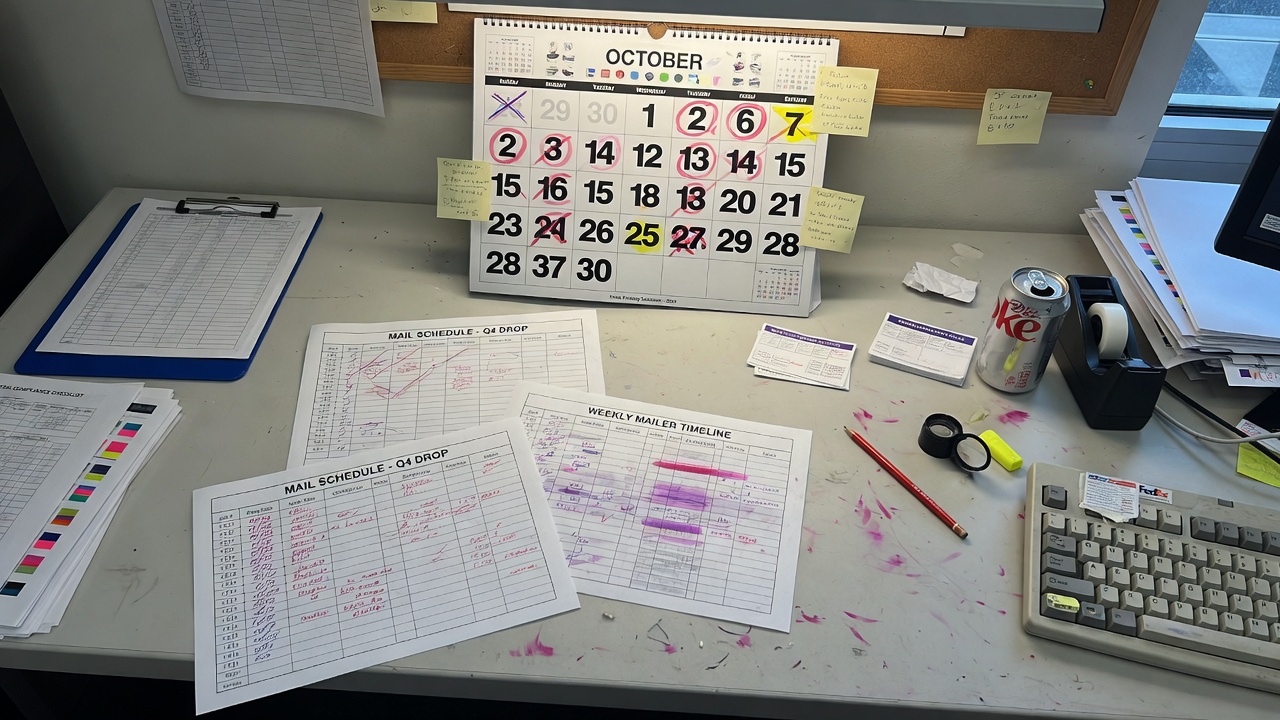
Work a print and mail timeline California campaign backward from the in-home date. Subtract USPS processing after induction, then inkjet and trays, then print and coating dry time, then proof rounds. The press slot is not day one. Lock size, material, quantity, finish, and date in writing.
I estimate these jobs at Avanti Printing, 15321 Barranca Pkwy, Irvine, CA 92618. Mail we produce for this site originates here and travels Orange County, Los Angeles, San Diego, and the rest of California. If you already have an in-home window, call (949) 387-0787. Quotes still confirm size, material, quantity, finish, and date. Postage is a separate USPS charge. The calendar sits on top of those five facts. It does not replace them.
People say “we need it in homes on the 12th” and mean four different mornings. The morning the carrier puts a piece in a box. The morning a clerk accepts the trays. The morning inkjet finishes. The morning someone approved a JPEG. Those are not the same date. This page is the estimator’s version of that split. It is not a ZIP catalog of postcard SKUs. It is not a saturation-route lecture. It is not a fold-style comparison. If the piece is named mail, the Business Mail Entry Unit still has hours. If the piece is simplified-address saturation, the delivering office still has a clock. Either way you start at the door and walk back to Barranca Parkway.
Who this is for in Irvine, Orange County, and statewide California
This guide is for the person who signs a print-and-mail estimate and also owns a calendar: a marketing manager in Irvine Spectrum, a medical group mailing recalls from Tustin, a multi-location restaurant along the 405, a dealer in Anaheim, a broker with listings from Newport Beach to Santa Ana, a campus office near UCI, a B2B firm in the Irvine Business Complex, or a statewide brand that wants one origin in Orange County. You have a sale, an enrollment, a grand opening, an earnings blackout, or a board meeting. You want the piece in the box before that event, not in a gaylord on our dock the morning of.
It is not a walk-in counter stack. It is not a lecture on folding panels. It is not a Laguna Woods or Laguna Hills ZIP product page. The plant is in Irvine, 92618. The mail is California mail that happens to start here. If the only instruction you have is “ASAP,” you do not have a timeline. You have a hope.
You should read this if any of the following is true. An agency locked a Tuesday in-home before the list was CASS’d. Someone treated the press slot as day one. You planned a Friday drop for a Monday sale. You flooded UV and then asked for inkjet the same afternoon. The NCOA date will age out if the job slips a week. You need Orange County in-home first and Northern California later from one ticket. You keep calling the drop date the in-home date in the client deck. The legal team still has a round after “final” art.
If the piece is a card that will be addressed, start from postcard printing and mail prep from Irvine and bring the in-home window with you. If the story needs panels and the address lives on an envelope, we print brochures that mail as inserts from the same plant. If the stack is a counter handout that never sees a sorter, versioned flyers for locations that never see a tray are a different clock: no USPS, still a proof, still dry time. Do not mix those two clocks on one purchase order and then blame the dock when the mailed pile is waiting on the handout pile.
B2B readers in Spectrum towers should stay here too. A named letter with a suite and a drop tied to a conference is still a timeline job. Saturating a building with LOCAL POSTAL CUSTOMER is still a timeline job. The difference is which office takes the mail and how many days you subtract after that office stamps it. The plant calendar in front of that stamp is the same problem: files, proof, print, inkjet, trays.
Work the calendar backward, not forward from “when can you print”
Forward planning is how campaigns miss. You get a press slot, you add “a few days for the post office,” and you call the result an in-home date. Backward planning starts with the door. You name the first day you need a piece in a box, and the last day you will still honor the offer. Then you subtract USPS, then plant mail prep, then inkjet, then print and dry, then proof, then list hygiene. What is left is the latest morning you can still send a print-ready file. If that morning is already yesterday, you change class, change quantity, change the window, or you stop pretending.
Use this as the decision frame before anyone books a press. The day counts are typical industry planning ranges, not a promise and not a Postal Service guarantee. Marketing Mail in particular may receive deferred handling. Confirm live service standards before you lock a deck.
| Clock, working backward | What it actually is | Who owns it | Typical planning range (say so: range, not SLA) | How it dies |
|---|---|---|---|---|
| In-home window | First and last day you will accept delivery into the box | You. Not the plant. Not USPS. | A window, not a Tuesday. Two to four calendar days is a grown-up window for Marketing Mail. | One calendar date treated as a carrier appointment |
| USPS processing after induction | Days from acceptance to delivery under the class and entry you bought | USPS. You choose class and entry. You do not run the network. | First-Class end-to-end in the contiguous 48 is commonly planned at 1–5 days. Marketing Mail end-to-end is a 4–7 day service-standard band. Destination entry is shorter. Deferred handling still exists. | Calling a service standard a guarantee; dropping Friday for Monday |
| Induction / drop | The day a BMEU or delivering office accepts the mailing | Plant plus USPS clerk. Hours, Critical Entry Time, paperwork. | One business day you actually make, not the day on the slide | Closed BMEU, missed CET, failed verification, wrong office |
| Mail prep | Trays, sacks, pallets, facing slips, postage statement, sampling | Plant / lettershop | Hours to one business day after inkjet, longer if pallets and destination entry | Wrong scheme, missing paperwork, mixed versions in one tray |
| Inkjet / addressing | Names, IMb, indicia as required, sequence that matches the file | Plant / lettershop | Same day to three days after print is dry and the list is locked, quantity and coating decide | Flood UV under the heads; unlocked file; wet sheets |
| Print, coating, dry, bindery | Ink on paper, finish, tabs or folds, a dummy that matches the mailpiece | Plant | One to three days on a straightforward digital card after approval; several more if you need plates, UV dry, or a mill sheet | Approval at 4 p.m. treated as ink at 4:15 p.m. |
| Proofs | Static art, data records, coating knock-out, physical dummy | You and the plant, in that order | One business day for a clean first round; each revision is another day you chose | “PDF looks fine” with no dummy and no longest-name record |
| Files and list hygiene | Print-ready PDF, CASS, Move Update, suppressions, locked quantity | You, then the plant | One to three days if the file is honest; a week if it is not | NCOA from last season; RGB; “address TBD” |
Two footnotes belong under that table. First, those plant days are sequential, not parallel, unless we have already staged paper and the list is already clean. Proofing while the press waits is not the same as printing while you still argue about the headline. Second, USPS days start after acceptance, not after we load a truck at Barranca Parkway. If the clerk does not accept the mailing, you do not have a drop date. You have a conversation in a lobby.
Typical industry pattern — and it is a pattern, not a promise — is that a simple named card to Orange County, files locked, one proof round, digital print, inkjet, origin entry as Marketing Mail, wants about two weeks on the wall from locked files to the start of in-home if you want a buffer. First-Class can compress the USPS slice. It does not compress dry time, and it does not compress a legal review. I will not invent a day count for your 80,000-piece statewide pallet program from a blog post. I will insist you name the in-home window before we name a press slot.
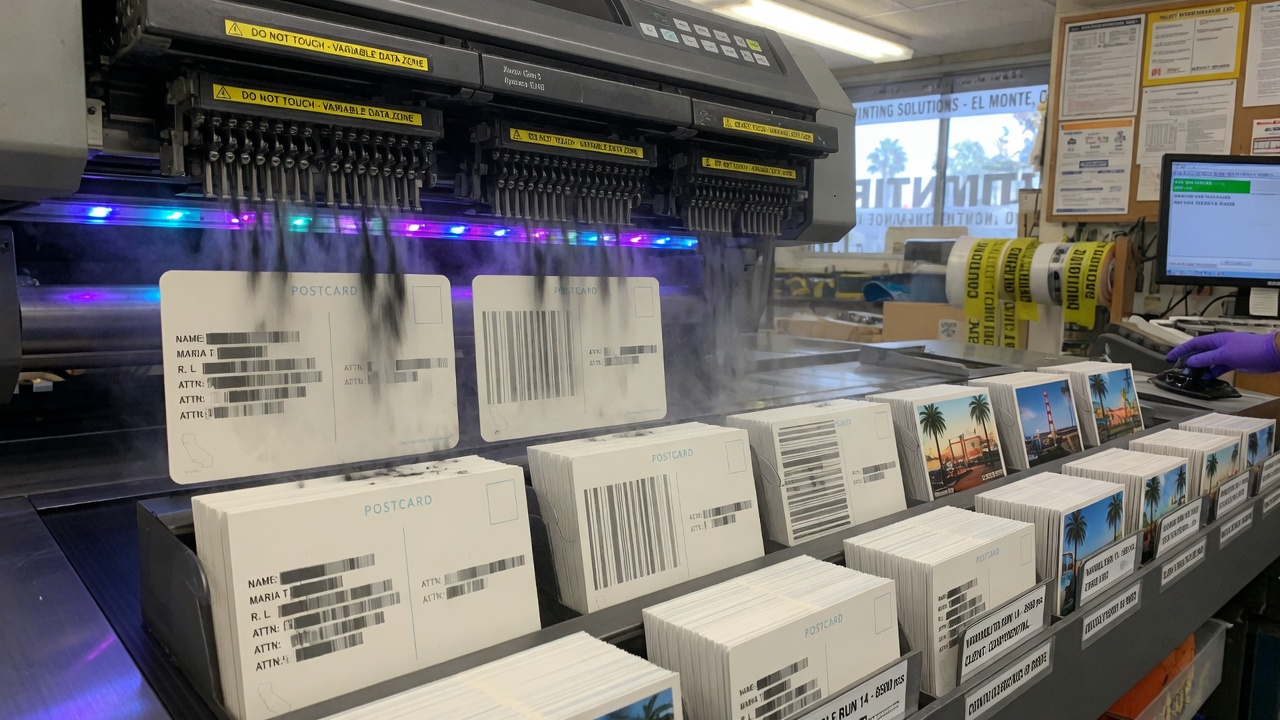
In-home, drop, induction, and Critical Entry Time are four different clocks
Language is how timelines explode. Agencies say drop. Clients say in-home. Plants say induction. Clerks say accepted. If those four words share one cell in a spreadsheet, the campaign is already late and nobody knows it yet.
In-home is a window, not a carrier appointment
In-home is the days you will accept the piece sitting in a box, a cluster unit, or a Spectrum receiving room. It is not a 10 a.m. appointment with a specific carrier. Marketing Mail does not arrive as a single thump on a single morning across a ZIP. It arrives as a curve. Some pieces on day three, more on day four, a tail after that. First-Class is tighter. It is still a spread, not a conference call.
Write the window as first day and last day. “In-home Tuesday” is a wish. “In-home Tuesday through Thursday, offer expires Saturday” is a spec. If the offer dies at midnight on the first in-home day, you bought the wrong class or the wrong window. Seeds at real California addresses — including one in the destination SCF and one at the plant — are how you see the curve. A seed that is a P.O. Box nobody checks is theater.
Informed Delivery can show a scan before the physical piece lands. That is useful. It is not delivery. Do not start the response clock from a thumbnail in an email and then complain that the card is “late” when the carrier is still walking the loop.
Drop date is not induction unless a clerk said yes
Drop date, used loosely, is the day trays leave the plant. Induction is the day USPS accepts them as a mailing. Those can be the same afternoon. They are not automatically. A truck that sits until morning because the BMEU is closed, the dock is backed up, or the paperwork is wrong, is not a drop. It is inventory on wheels. The postage statement date is the date that matters for Move Update math and for the service-standard clock. Plan to the acceptance date.
Critical Entry Time is a cutoff, not a vibe
Facilities publish Critical Entry Times. Mail accepted after that cutoff is not that day’s mail for processing purposes. I will not invent Santa Ana’s current CET in a blog post, because the number you need is the one on the phone the week you enter. Call. If you miss CET on Thursday, you did not get Thursday. You got Friday’s network, and on a Friday that can mean Monday’s network. That single miss is how a “three-day” plan becomes a five-day plan without anyone changing class.
BMEU hours are business hours. Santa Ana’s Business Mail Entry Unit has historically sat at the processing plant on West Sunflower Avenue and run roughly weekday business hours, not Saturday retail. Confirm hours the week of the drop. Do not assume the Barranca Parkway plant is a substitute counter. We can print in Irvine and still have to make a clerk’s cutoff in Santa Ana, or a destination dock in Los Angeles, Industry, San Diego, or San Bernardino, depending on how you bought entry.
Commercial permit mail is not a carrier pickup and it is not a blue collection box. The Postal Service’s own primer is blunt: take business mail to a Business Mail Entry Unit, at the office where the permit lives, unless you have a documented destination-entry plan after verification. Read USPS Business Mail 101, Where to Go. If a slide deck disagrees with that page, the page wins.
Class decides how much calendar you buy after the stamp
First-Class Mail, including commercial cards and letters, is the faster market-dominant product. End-to-end service-standard bands for the contiguous 48 currently sit in a 0–5 day table in the Postal Service’s own service-standard appendix, with local Orange County work on the short end and long cross-country pairs on the long end. Use it when the record is valuable, when forwarding matters, when the offer is short, or when the in-home window is tight. You still need print time. You still need a proof.
USPS Marketing Mail is the workhorse for campaigns. The Domestic Mail Manual still says it may receive deferred handling and that the Postal Service does not guarantee delivery within a specified time. Service standards still exist so the network has a target. For end-to-end Marketing Mail in the contiguous 48, the current band in 39 CFR 121.3 is 4 to 7 days. Destination Delivery Unit entry is a 2-day standard. Destination Local Processing Center (legacy SCF-style) entry is 3 days when accepted Sunday through Thursday and 4 days when accepted Friday or Saturday. Destination Regional Processing and Distribution Center entry is a 5-day standard when both origin and destination are in the contiguous 48. Those are the federal planning numbers as of this writing. They move. Confirm them on the live rule before you lock a sale date. Start here: 39 CFR 121.3, USPS Marketing Mail service standards.
A service standard is not a refund policy. Late Marketing Mail does not come with a postage rebate that saves your weekend sale. That is why a buffer belongs on the calendar even when the table says three days. I would rather enter Tuesday for a Thursday–Saturday window than enter Thursday and write an apology on Friday.
USPS induction from Irvine and the Los Angeles area
Mail we produce for this site originates at Avanti Printing, 15321 Barranca Pkwy, Irvine, CA 92618. Phone (949) 387-0787. Origination is useful. It is not magic. Trays still have to enter the network the way the product you bought requires.
Origin entry: the local processing story
Irvine 92618 sits in the Santa Ana sectional area (three-digit 926). Anaheim’s 928 is next door. Los Angeles, Industry, Santa Clarita, San Diego, and San Bernardino are different processing geographies. Origin entry means we prepare the mailing, pay at the permit office, and accept at the local BMEU. The network then moves the mail toward destination plants. For an Orange County house file, origin entry is often enough. For a statewide file, origin entry is how you buy the long end of the Marketing Mail band unless you also buy destination entry.
Origin entry is not “the Irvine Post Office lobby on Barranca.” Commercial mail goes to a Business Mail Entry Unit. We will tell you which one we are using on the job ticket. You should care, because hours and CET live there, not on our front door.
Destination entry: you pay for miles in order to buy days
Destination discounts exist because you take mail closer to the delivering plant. DSCF / DLPC-style entry, DNDC / DRPDC-style entry, and DDU entry are different docks, different paperwork, and different service-standard bands. They also require density. You cannot honestly claim a destination SCF discount on five pieces in Sacramento mixed into an Orange County tray. The ZIP histogram is the estimate. Printing 40,000 pieces “for California” without a density report is how you leave money on the dock and still miss Northern California in-home.
From Irvine, destination entry is a trucking plan. Los Angeles, City of Industry, San Diego, San Bernardino, and further plants are real drives with real appointment cultures. A pallet that misses a destination appointment sits. Sitting is not in-home. If the campaign needs Bay Area in-home in the same window as Irvine, say so on day one. We will split entry or we will split the in-home window. We will not pretend one origin drop is eight destination docks.
DDU entry is the tightest Marketing Mail standard and the most operationally fussy: by delivery unit, often with appointments, not a heroic stack in a retail lobby. EDDM Retail is a cousin of that idea and still belongs at the delivering office for those routes, not at the plant’s nearest window because we are in 92618. If you planned one drop for six cities, you planned a refusal.
What the clerk can still stop
Acceptance is not a courtesy stamp. Verification can fail on postage, on presort, on piece counts, on markings, on a sample that does not match the statement. A mailing that fails at 4 p.m. on Thursday is not “almost dropped.” It is still in our custody or sitting in a bay. Build time to correct a paperwork problem, especially on a first-time permit or a first-time format. Do not schedule induction as the last hour of the last day before the USPS clock has to start.
Holidays matter more than designers think. USPS plants run some holiday networks and close others. BMEU counters follow posted hours. A drop planned for the Wednesday before Thanksgiving is a conversation, not a default. December volume is a conversation. A statewide political week is a conversation. I cannot control the network. I can refuse to pretend those weeks behave like a quiet Tuesday in March.
Permit geography matters. The permit imprint on the piece has to match a permit that can live at the entry office. Using our permit, your permit, or a broker permit are three different paperwork paths. Pick one when you quote, not at the dock. A pretty card with the wrong indicia is how Friday dies.
Inkjet, trays, and the day before the dock
Addressing is not decoration at the end. It is a production day with its own rejects. Plan it as a step that cannot start until the sheet is dry, the coating is honest, and the list is locked.
The sheet has to be ready for a head or a toner engine
Inkjet on a skating-rink UV face smears, beads, or fails reflectance. That is not a timeline surprise. That is a finish spec you should have made at estimate. Leave a knock-out large enough for name, address, Intelligent Mail barcode, and quiet space. Aqueous on the address face and a harder coating on the image face is a common split because it lets us address after print without waiting for a miracle. Labels exist for the job you already flooded. Labels add a day you did not want, and they look like labels. Budget the knock-out instead.
Production inkjet as the whole press is a different machine than a lettershop base that sprays black names onto an offset shell. Say which one you are buying. The whole-page inkjet path can image address and art together, which can remove a second pass — and can still need dry time and a stock that likes water-based ink. The second-pass base needs shells in the same sequence as the file. If you sort the spreadsheet after we print the shells, you shuffled 20,000 names onto the wrong photographs. Lock the file. Version the filename. Stop “just cleaning a few rows” by email after approval.
Sequence, seeds, and trays
Presort is a calendar object. CASS, ZIP+4, walk sequence or tray scheme, pallet construction if any — those steps happen on a locked file. Changing three hundred records after trays are tagged is not a merge. It is a rebuild. If you must have a late add, isolate it as a second mailing or as First-Class residual and pay for the honesty.
Seeds go in the file before inkjet, not as a handful of extras on a desk. Unique offer codes on seeds let you test the landing page the same day the first trays leave. If the seed PURL 404s, you found the bug while we can still stop. Stopping after induction is a different conversation with a clerk who already accepted the statement.
Tray and sack prep is usually same-day or next-morning work once inkjet is clean. Destination pallets take longer. Wafer tabs, polywrap, and folded self-mailers add bindery before any of that starts. A tab that is required for automation is not optional because the photo looked better without it. Missing tabs are how a letter becomes a reject at verification, which is how your induction day becomes tomorrow.
Postage payment sits here too. Permit imprint, meter, stamps — pick one. A mixed method because someone grabbed a stamp roll for the leftovers is how a clerk starts asking questions you did not budget time to answer. If postage is billed through us, it is shown as postage. If postage is yours, the statement is still our afternoon.
Print, coating, dry, and bindery eat days you cannot RIP
Once proofs are signed, the plant still has to make a physical object that can take an address. Buyers skip this slice because ink looks instant in a PDF. Paper is not a PDF.
Path is a time choice, not a brand lecture
A toner or liquid-toner digital press is often the fastest honest path for hundreds to low tens of thousands of cards that must match other collaterals. After approval, a straightforward 6×9 or letter-size card on a house sheet can be in bindery within one to three plant days. That is a typical range, not a coupon. Heavy coverage, odd sizes, and special stocks slide to the long end.
An offset shell plus inkjet imprint is how a lot of volume is still built when the photograph is static. Plates, makeready, and dry time are real. Plan several plant days, not an overnight, unless we already have the sheet on the floor and the job is a repeat with no changes. Version changes mean plates. If you will still be swapping the hero after the “final” date, do not buy shells.
A production inkjet press that prints the whole page can be fast at quantity once color is signed off. It is not a shortcut around stock testing. Some coated covers want primer. A dummy through the actual device belongs on the calendar before you promise an in-home to a VP.
I am not going to drag a catalog binding argument onto a mail timeline. Bound books have their own dry and trim clocks. If this ticket is a mailed card, a letter, a self-mailer, or a brochure in an envelope, say that. Do not hide a 32-page book inside a “mailer” label and keep the same two-week wall calendar.
Coating and dry time are not the same afternoon
Aqueous usually lets us move sooner than UV. UV looks expensive and then offsets in a hot Orange County gaylord if you stack it too soon or flood both faces. Build overnight dry time into UV jobs. Build more if the piece will sit in July heat on a truck to a destination plant. Soft-touch and film laminate add process and add curl risk; they also fight some inkjet. If the mailer must be addressed after film, you are in label territory or you are in a reprint.
Caliper and shape still have to match the postage bucket you claimed. A 16 pt plus two-sided UV that creeps over a card-price ceiling is not a coating win. It is a letter you did not budget. Measure a dummy. Dummy time is calendar time. A PDF cannot read a micrometer.
Paper on the floor versus paper on a mill
House 14 pt and 16 pt C2S, common uncoated covers, and everyday text weights are why local plants beat a national queue when the window is tight. A mill-order specialty sheet is a different timeline. If the brand deck requires a named mill sheet we do not stock, say so at quote, not after the first proof. Substituting a house sheet to hit a date is allowed when you approve it in writing. Silent substitution is not how we work. Silent delay because nobody asked is how in-home windows die.
Quantity changes after we cut a mill lift are not free in days. A 10 percent overrun you decide on Thursday is either a second make-ready or a no. Decide quantity when you lock the list.
Bindery is still the mailpiece
Score and fold a brochure insert before it goes in an envelope. Tab a self-mailer. Trim to the height you claimed, not to a nervous “safety” that turns a letter into a flat. Each of those steps is hours to a day. Parallelize them only when we have the people and the machine. Do not assume bindery is a rounding error on the inkjet date.
Envelopes are their own print and their own inserting clock. A letter package — printed letter, printed envelope, maybe a reply card — is a three-object timeline. Inserting cannot start until every object exists. If the envelope is late, the letter sits. Order them as one ticket.
Request a print-and-mail schedule quote
Proofs, files, and the list clock you cannot reprint away
Most missed in-homes I see did not die on press. They died in proof rounds and in a list that was not mail-ready. Working backward, this is the slice you still control after USPS hours are fixed.
A JPEG is not a mail proof
Proofs for a print-and-mail job are a set:
- Contract-quality proof of the static art, both sides, with the address panel shown empty and occupied.
- Data proof: first record, last record, longest name, missing-name fallback, bilingual if any, each version, every seed.
- Address-block and barcode inspection at print size, not at 400 percent on a laptop in daylight that is not Orange County noon.
- Physical dummy on the actual stock with the actual coating, through the actual inkjet or toner path when the quantity justifies it.
- A landing-page check of live tokens from a phone, outdoors, because that is how recipients scan.
Each revision is a day if the change is copy. It is more than a day if the change moves the barcode, the knock-out, the trim, or the stock. “One more small change” after you already approved the dummy is how you buy a second dummy. I would rather you take Tuesday to finish legal than take Thursday to reprint.
Sign the rules, not a vibe. Fallback for blank first names. Maximum point-size shrink. Which records drop. Which version maps to which ZIP. If you only sign a pretty front, you did not approve the mailpiece.
Print-ready files have a clock of their own
Send a print-ready PDF: fonts embedded or outlined on static art, 0.125 inch bleed, live matter off trim, CMYK, address panel drawn at final size on a light field. Variable frames marked. Dummy token at final size. A pretty front with “address TBD” in the middle of a photo is not a mail file. It is a reason we cannot start the dummy.
RGB black in the address, 72 ppi photos, and a letter-size board that is actually a 6×9 live area all cost a prepress day you will swear you did not have. Originating the job in Irvine does not convert RGB. We will convert when we must. We will also tell you it moved the date.
Hygiene is dated, and dates expire
Commercial First-Class presort or automation prices, and USPS Marketing Mail prices, require an approved Move Update method within 95 days before the mailing date. NCOALink is the common pre-mailing method. “We cleaned it last year” is a souvenir. The process date is the spec. If the job slips three weeks, look at the 95-day clock again. We will. Do not be offended.
CASS and Delivery Point Validation belong in the same breath as the drop, not in a folder from a prior campaign. Irvine suites, Spectrum high-rises, and UCI-adjacent units go stale. Secondary lines are the job. A beautiful unique URL on a missing Unit 2B is a beautiful return, and returns do not care that your in-home window was perfect.
If the slip will push NCOA outside the window, re-hygiene is a day (sometimes more) you must put back on the wall. Skipping it to “hit the date” is how you buy postage on vacant units and how you risk the prices you claimed. I will not invent your retention rules for moved records. I will not RIP while you think about them.
Quantity is a list number, not a marketing round number. We print the record count after hygiene, plus a stated overage if you want spoilage. Lock it. A list that is “about 25,000” is not a press count.
Contingencies that blow a Tuesday in-home
A grown-up timeline has named buffers. Hope is not a buffer. These are the ones that actually move California mail out of this plant.
| Contingency | What it looks like in real life | What to put on the wall |
|---|---|---|
| Proof rounds | Legal, brand, or a VP who was out Tuesday | One extra plant day per likely round. Freeze copy before dummy if the window is tight. |
| Coating versus inkjet | Dummy shows beads on UV; knock-out is short | Dummy before the long run. Relabeling 20,000 cards is a new job. |
| List hygiene fails | Half the suites missing; encoding garbage; NCOA too old | Hygiene before you announce in-home. Re-file time if the drop slips. |
| Paper | Named mill sheet is two weeks out; house sheet would have shipped | Approve a substitute in writing, or move the window. |
| BMEU hours / CET / holiday | Thursday 4:40 p.m. with a 3 p.m. cutoff; Wednesday before Thanksgiving | Enter a day earlier than the standard. Confirm hours that week. |
| Destination appointment | Pallet misses the Los Angeles or San Diego dock | Truck time plus a spare day. Do not share one heroic appointment across plants. |
| Network volume | December, a political week, a storm of parcels | Wider in-home window or First-Class on the names that matter. |
| Press or inkjet down | A machine day disappears | A plant with more than one path can reroute. Still budget a day on hard dates. |
| Verification fail | Count mismatch, bad marking, sample does not match statement | Do not make induction the last hour of the last day. |
| Landing page | PURL 404s the day trays leave | Seeds and a kill switch before inkjet, not after in-home tweets. |
| Heat and block | Flood UV on flood UV in a July gaylord | Coating stack for Orange County logistics. Dry time is not optional. |
| Move Update clock | Job slips, 95 days ages out | Re-NCOA. Put it on the ticket. |
Split the campaign when one contingency would poison the rest. Orange County First-Class to the house file can still hit a tight window while the purchased-file Marketing Mail layer takes the later window. A statewide pallet can ship in two entries. A reprint of 400 bad suites should not wait on 40,000 good ones. That split is a timeline tool. It is also a postage conversation. Ask for it early.
What I will not do is stack contingency on contingency in silence and then announce, the day before your sale, that we “might still make it.” If the dummy fails, the date moves. If legal is still in the file, the date moves. If you want the date more than you want the UV, we change the finish. You pick. The wall calendar does not pick for you.
A compressed path exists. It looks like this: house stock, digital toner, one proof round already done, list already CASS’d and Move Updated, knock-out already in the template, First-Class, origin entry, Orange County file, quantity in the thousands not the hundreds of thousands. That path still has dry time and a BMEU clock. It is not same-day mail. Anyone who sold you same-day commercial permit mail from a JPEG did not sell you acceptance.
Orange County and California conditions that change the clock
Local color is only useful when it changes a date. These do.
- Suites and apartments. Irvine Company communities, Spectrum high-rises, UCI-adjacent housing, mixed-use in Santa Ana. Secondary lines slow hygiene when they are missing. They do not slow a clean file. Budget the clean file.
- Turnover. Students, hospital staff, new villages. House files rot. Move Update is a mail spec. First-Class can still be the right class when the record is valuable and forwarding matters. Marketing Mail will not forward like First-Class. If the occupant changed last month, class is a timeline decision, not just a postage decision.
- Business parks. Spectrum, the Irvine business complex, University Research Park, South Coast Metro, Anaheim Canyon. Receiving rooms add delay you will never see on a service-standard table. Named pieces without suites are not late. They are lost.
- Cluster boxes and Informed Delivery. Design the face for a hallway and a phone JPEG. That does not add plant days. It does add a proof pass you should not skip.
- Bilingual creative. Useful on a lot of California files. Two layouts can mean two proof sets. Put both on the calendar. Keep one standardized delivery address the equipment can parse.
- Heat. Summer trays cook. Inkjet on a closed UV face fails harder in an Anaheim yard than in a climate-controlled studio. The root cause is still varnish under the heads. Heat is the amplifier. Dry time is the calendar fix.
- Convention and resort inventory. Anaheim Convention Center hotels and resort deliveries are not households for a roofing offer. Suppressing them is a list day, not a press day. Do it before inkjet.
- Multi-city in-home. A “California drop” on a slide is a ZIP histogram, an entry plan, and maybe two windows. Bay Area and San Diego do not owe you the same morning as Irvine just because the trays left together.
- HOA and municipal rules. Those affect signs and door hangers. They do not veto a USPS box. Do not confuse those projects on the same timeline.
- Campus calendars. UCI quarters, community-college starts, K–12 holidays in Tustin and Irvine Unified. An in-home that lands after students leave is on-time postage and a dead offer. Align the window to occupancy, not to our press slot.
Entry discounts, SCF versus local entry, and permit paperwork depend on the current price list and how the mailing is prepared. I will not invent a per-piece postage here. Bring the ZIP histogram, the class, and the in-home window. Printing 50,000 pieces without those three is how you leave money on the dock and still miss the door.
If you need named postcard mailers with a knock-out and a drop date, say the window, not “ASAP.” If you need brochure inserts that must meet the same in-home as the letter, put both objects on one Gantt, because inserting waits for the slower object. If you need store-version flyers that never get an IMb, give them their own date so they cannot stall the trays.
Mistakes that reprint the calendar, not just the card
These are repeats. They come from good agencies as often as from a file built in a word processor.
- Locking a single in-home Tuesday in a deck before the list, the stock, or the class exists.
- Calling the press slot day one, then adding “a few days for postage” as folklore.
- Using drop date, induction date, and in-home date as synonyms in the same spreadsheet.
- Planning a Friday BMEU drop for a Monday sale on Marketing Mail.
- Missing Critical Entry Time and still counting that weekday as a USPS day.
- Flood UV both sides, then asking for inkjet the afternoon the press lands.
- Approving a static JPEG and never looking at the longest-name data proof or a coated dummy.
- Sorting or “cleaning” the list after shells are on press.
- NCOA dated outside the 95-day window, or skipping a re-run when the job slips.
- Skipping secondary designators in Irvine and Spectrum suites, then calling the returns a USPS delay.
- One in-home date for six cities without six entry plans.
- Destination pallets with no appointment buffer.
- Permit imprint that does not match the entry office.
- Mixing a handout stack that can flood UV with a mailed stack that cannot, on one ticket, so the mailed pile waits.
- Legal copy arriving after the dummy, moving the barcode, and keeping the old date anyway.
- A landing page that expires, 404s, or still says “coming soon” when trays leave.
- Treating a service standard as a guarantee, then writing a complaint instead of a buffer.
- Changing quantity 12 percent after paper is cut.
- Ordering the envelope last on a letter package.
- Asking the plant to “just make it work” on a mill sheet that is not in California yet.
Reprints are worse than a path change on the first pass. Once inkjet hits flood UV, that sheet is scrap. Once 15,000 names are in trays with the wrong offer end date, you do not have a campaign. You have a customer-service event. Send the dummy. Send the dated CASS/NCOA story. Send the in-home as a window. That is slower than clicking approve on a PDF. It is faster than reprinting.
What to send for a quote
Write one email or use the form with the facts a plant estimates from. “ASAP” is not a spec. Adjectives do not change CET.
- In-home window: first day, last day, and whether that is a wish or a contract. Offer expiration date.
- Mail class you want to buy: commercial First-Class, USPS Marketing Mail, saturation / EDDM, or “recommend from the window.”
- Who enters the mail: Avanti, your permit, you at a Retail counter, destination entry, or mixed.
- Geography: Orange County only, Southern California, statewide, or a ZIP histogram. Not “California” as a feeling.
- Finished size and format: card, letter, self-mailer, or letter in an envelope. Height and length labeled.
- Quantity, unique record count, and unique color versions. Those three numbers are not always the same.
- Stock and finish per side, including any knock-out for inkjet.
- Production path if you care: toner digital, production inkjet, offset shell plus inkjet, or “recommend.”
- List status: record count, last CASS and Move Update / NCOA date, house versus purchased, suppressions.
- Files: static PDF, or a note that design is still open. If open, say who owns the next proof round.
- Anything that adds bindery: tabs, folds, envelopes, inserting, version splits.
- Anything attached: magnets, packets, stickers. These change shape class and days.
We confirm size, material, quantity, finish, and date on every quote. If postage is included, it is shown as postage, not hidden in a blended “per piece” that pretends USPS does not change prices. If postage is yours, the address block still has to be legal for the class you claim, and the induction date still has to be real. Avanti Printing, 15321 Barranca Pkwy, Irvine, CA 92618. (949) 387-0787. The quote link on this page is the same form we use for commercial printing work across California.
FAQ: print and mail timeline California
How far out should I lock an in-home date?
For a simple named card to Orange County, locked print-ready files, one proof round, house stock, digital print, inkjet, and origin-entered Marketing Mail, two weeks on the wall from locked files to the start of in-home is a typical planning picture with a buffer. First-Class can shorten the USPS slice. Offset shells, mill sheets, destination pallets, legal rounds, and statewide density add days. If design is not started, do not count plant days yet. Count concept days, then plant days, then USPS days. I will not promise your window from a blog post. I will build it backward on the quote once I have size, quantity, class, and a real first-and-last in-home.
Is the drop date the same as the in-home date?
No. Drop or induction is when USPS accepts the mailing. In-home is when a piece can sit in a box. Between those dates sits the service-standard band for the class and entry you bought, plus variance, plus deferred handling on Marketing Mail. If your deck uses one date for both, your deck is wrong. Write both. Measure from acceptance, not from the hour a truck left Barranca Parkway.
How long does Marketing Mail take after induction from Irvine?
Plan with the live service standards, then add a buffer because Marketing Mail may receive deferred handling and is not guaranteed. End-to-end in the contiguous 48 currently sits in a 4–7 day standard band. Destination LPC-style entry is commonly 3 days Sunday through Thursday acceptance and 4 days Friday or Saturday. DDU is a 2-day standard. A local Orange County file entered at the Santa Ana-area BMEU is not the same clock as a statewide origin drop. Confirm the current language in 39 CFR 121.3 and in the DMM. Do not take a printer’s folklore over the rule, including mine if the rule has moved.
Should I buy First-Class if the sale is next week?
Maybe, if the list is already clean, the files are print-ready, the stock is in house, and the geography is mostly local. First-Class buys a shorter USPS slice and better undeliverable treatment. It does not print a wet UV card overnight, and it does not CASS a dirty file. If the sale is next week and the headline is still in legal, the honest move is to move the sale communication, not to shout at the BMEU. If the sale is next week and everything else is truly locked, ask for First-Class and a same-week plant path on house stock. We will tell you yes or no in writing.
What if a proof round slips two days?
The induction date usually slips two days, and the in-home window slips with it, unless you had buffer or you change class or geography. Do not “make it up on press.” Dry time does not compress because a VP was in Tahoe. If you still have buffer on the USPS side, you might keep the window and lose the buffer, which is how the next slip becomes a miss. Tell us the same day the round slips. Silent slippage is how trays miss CET.
Can you drop on Friday for Monday in-home?
Not as a Marketing Mail plan I will put my name on. Friday acceptance can already carry a longer destination-entry standard, and weekend plants do not turn Marketing Mail into Monday cluster-box magic. First-Class local mail has a better argument and still wants a CET you actually make, plus no holiday. If Monday is the first in-home you can tolerate, enter earlier in the week. If Monday is a sale and you are talking to us on Thursday, we are in a different conversation about class, quantity, and honesty.
Do I need to NCOA again if the job slips?
If the slip will put the last approved Move Update method outside 95 days before the new mailing date, yes. Re-hygiene is part of the new timeline. It is not optional because the creative did not change. UCI-adjacent rentals and new Irvine villages are why this is not theoretical. Put the process date on the ticket. A cleaning from last season is not a process date.
How do I get a timeline quote from Avanti?
Send in-home window, class, entry path, size, stock, quantity, finish, list status, and files or a note that design is open. Use the quote form or call (949) 387-0787. We will confirm size, material, quantity, finish, and date in writing, and we will show plant dates and a planned induction date as a schedule, not as folklore. Postage is quoted from current USPS prices for the class you choose, or omitted if you are using your own permit. A 400-piece First-Class card and a 40,000-piece destination-pallet program are not the same estimate.
Lock the in-home last, then print toward it
A print and mail timeline California buyers can hit is a subtraction problem. Name the window at the door. Subtract USPS after induction, with class and entry and a buffer because Marketing Mail is not a courier. Subtract trays, inkjet, dry time, print, proofs, and a dated list. What remains is the last morning a file can still arrive on Barranca Parkway. If that morning is gone, change the window or change the spec. Do not change the meaning of the word Tuesday.
Khalid, Avanti Printing, Irvine. Bring the in-home as a first day and a last day. Bring a dummy if you have one. Bring a Move Update date, not a story about last year. We will tell you whether the job is a two-week card, a First-Class sprint, or a pallet program you should not have put on a conference-week calendar. Then we will print the version that actually leaves a dock.