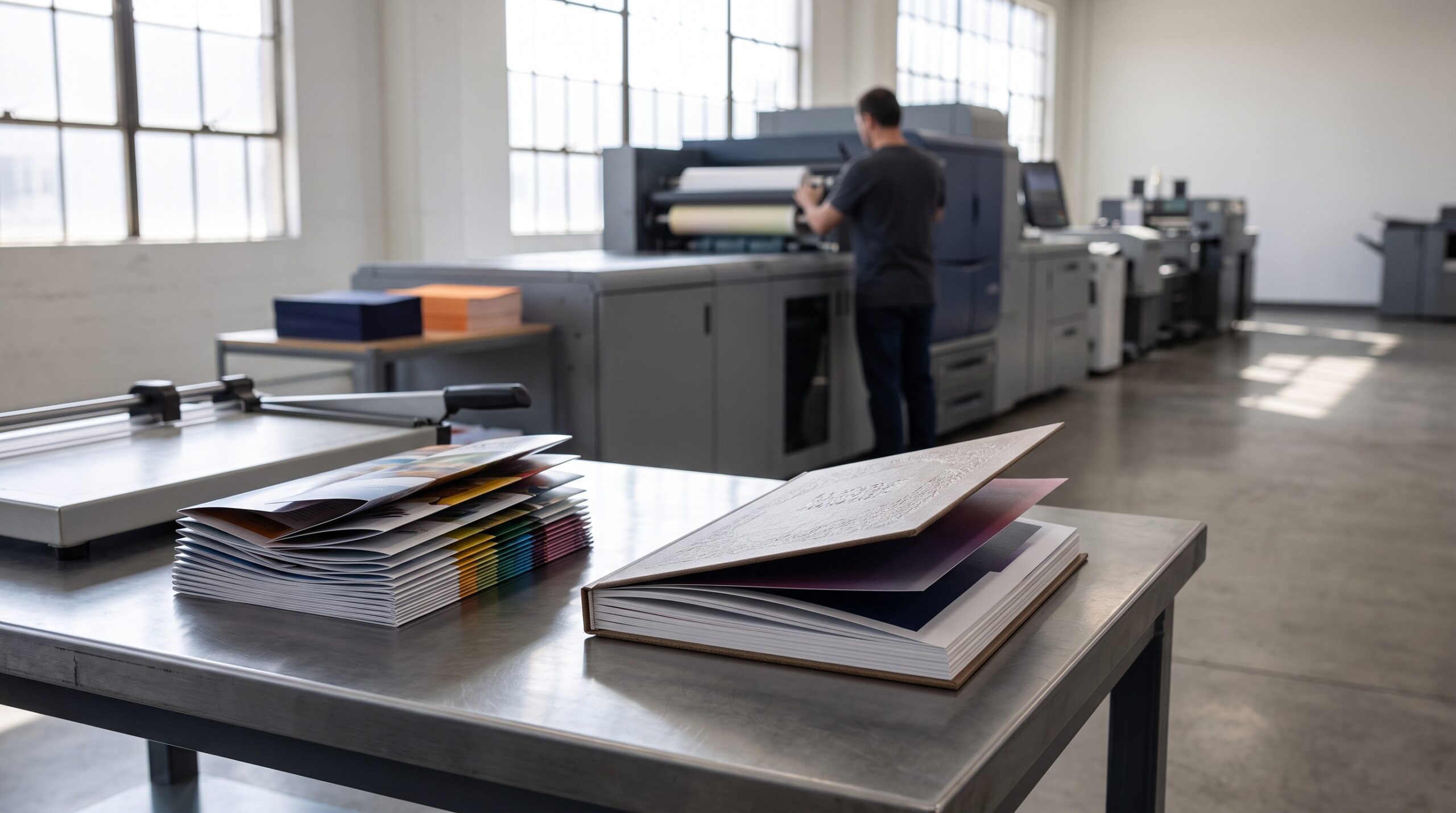
If you need printed marketing materials in California, the first decision isn’t color or paper stock—it’s format. Tri-fold brochures and booklets serve different purposes, budgets, and audiences. A tri-fold is typically a single sheet folded into six panels, ideal for direct mail or handout pieces. A booklet uses multiple pages bound together, suited for menus, catalogs, or detailed service guides. The right choice depends on how much information you need to share and how the piece will be distributed.
Understanding the Core Differences
Before you request a quote, understand what each format physically offers. The tri-fold is a standard letter-size sheet (8.5″ x 11″) folded twice. It gives you six panels for content—three on the front, three on the back. This format forces you to be concise. You have roughly 2,500 to 3,500 words of space if you use small type, but realistically, most effective tri-folds use half that and rely on strong visuals.
A booklet, on the other hand, starts at four pages and goes up from there. Saddle-stitched booklets (stapled along the spine) are common for 8 to 48 pages. Perfect-bound booklets (glued spine) are for thicker pieces, usually over 48 pages. With a booklet, you have room for long-form case studies, detailed specifications, or a full product catalog.
Physical Handling and Perceived Value
Consider how the piece feels in a customer’s hand. A tri-fold is lightweight, easy to slip into a pocket or a conference tote bag. It reads as a quick reference. A booklet has weight and substance. A 16-page booklet with a heavy cover stock signals that your company invested in this information. That perceived value matters when you’re bidding on high-ticket commercial projects or presenting to a board of directors.
When to Choose a Tri-Fold Brochure
Choose a tri-fold when your message fits on one sheet and you need volume at a low cost. This format is the workhorse of trade shows, real estate listings, and medical practice introductions.
- Direct mail campaigns: A tri-fold fits in a #10 envelope without extra postage costs. Booklets often require a larger envelope and higher postage rates.
- Trade show handouts: People collect dozens of pieces at a show. They are more likely to keep a single sheet than a bulky booklet.
- Quick overviews: If you just need to explain three core services or list five key benefits, a tri-fold is sufficient.
- Budget-conscious runs: For a run of 5,000 pieces, a tri-fold is significantly cheaper to print and mail than a booklet.
For California businesses, tri-folds are also easier to update. If your pricing changes or you add a new service, you reprint one sheet, not a 20-page document. Many print shops in California offer 24-hour turnaround on standard tri-folds because the process is simple: print, fold, and trim.
When to Choose a Booklet
Choose a booklet when your audience needs more than a summary. If you sell a complex product, like commercial HVAC systems or legal services, a tri-fold feels flimsy. A booklet gives you space to build a logical argument.
- Product catalogs: Show every model, specification, and option. A tri-fold cannot do this.
- Annual reports: Required financial disclosures and narrative sections need pages, not panels.
- Restaurant menus: A 12-page booklet with a durable cover withstands daily handling better than a folded sheet.
- Corporate capability statements: Government and enterprise RFPs often ask for detailed past performance data. A booklet organizes that information professionally.
Booklets also allow for better paper choices. You can use a 100# gloss cover with a matte text interior. This mix of textures is impossible with a single-sheet tri-fold. For a California winery or a boutique architecture firm, that tactile quality is part of the brand experience.
Cost Comparison and Print Runs
Pricing in California varies by shop, but the structural economics are consistent. A tri-fold is a one-sheet job. A booklet is a multiple-sheet job with binding labor. For short runs under 500 pieces, the price difference is small because setup costs dominate. For runs of 2,000 or more, booklets cost more per unit due to paper volume and binding time.
| Factor | Tri-Fold | Booklet (8–16 pages) |
|---|---|---|
| Base paper cost | 1 sheet per piece | 2–4 sheets per piece |
| Binding cost | None (fold only) | Stapling or gluing adds labor |
| Mailing cost | Standard letter rate | Higher weight, often non-machinable |
| Typical turnaround | 2–3 business days | 5–7 business days |
A common mistake is ordering a 4-page booklet when a tri-fold would work. A 4-page booklet (one sheet folded and stapled) costs more than a tri-fold but offers only one additional page of content. Unless you need a self-cover with a spine, stick with the tri-fold. A true booklet shines at 8 pages or more.
Design Considerations for Each Format
Designing a tri-fold requires strict attention to panel order. When folded, the outer front panel is the last panel on the right of the inside spread. Many first-time designers get this backward, resulting in a cover panel that appears upside down when unfolded. Always request a physical mock-up from your California printer before committing to a full run.
Booklet design is more forgiving but requires a different skill set. You must plan for page counts in multiples of four for saddle-stitching. A 12-page booklet is fine. A 14-page booklet is not—you will have blank pages. For perfect binding, page counts can be any number, but the spine width calculation requires a specific paper thickness.
Paper Stock and Finishing Choices
For tri-folds, use a 100# gloss text or a 14pt card if the piece is self-mailing. The heavier stock prevents the piece from bending in the mail. For booklets, choose a cover stock that is at least 10 points heavier than the interior pages. This creates a sturdy spine and prevents the cover from curling.
Finishing options also differ. Tri-folds can be folded with a crisp edge or a rounded corner. Booklets can be rounded, but the binding limits how much you can customize the spine edge. If you want a lay-flat booklet, ask for spiral binding, but note that this is a specialty item with longer production times.
Common Mistakes to Avoid
Most brochure problems are preventable. Here are the frequent errors we see from clients who come to us after a bad experience elsewhere.
- Overcrowding the tri-fold: Just because you have six panels doesn’t mean you should fill them all. White space is a design element.
- Using low-resolution images: A logo pulled from a website at 72 DPI will look pixelated when printed. Use 300 DPI files.
- Forgetting the bleed: California print shops require a 0.125″ bleed on all edges. Without it, your background color may show a white border after trimming.
- Choosing a booklet for a simple message: A 16-page booklet with only two pages of real content looks padded. Trim the content first, then decide the format.
Another mistake is ignoring the folding direction. A tri-fold can be a “C-fold” (both panels fold inward) or a “Z-fold” (one panel folds back). C-folds are standard for brochures. Z-folds work better for self-mailers where you want the address panel on the outside without opening the piece.
Local Printing Considerations in California
California has specific environmental regulations that affect print production. Many commercial printers in the state use soy-based inks and recycled paper stocks to comply with local air quality rules. If sustainability is part of your brand message, ask your printer about their certifications. You can also save on shipping by choosing a printer within driving distance of your office, which is worth considering for large runs.
Turnaround times vary by region. Printers in Los Angeles and the Bay Area often have same-day or next-day service for standard tri-folds because they have high-volume digital presses. Booklets usually require a bit more lead time, especially if you need perfect binding. Plan for at least one week for a booklet run of 1,000 pieces, including proofing and shipping.
How to Decide: A Practical Checklist
Use this quick decision framework before you contact a printer.
- Word count: Under 1,000 words? Tri-fold. Over 2,000 words? Booklet.
- Distribution method: Handout or mailer? Tri-fold. Reference document or leave-behind? Booklet.
- Update frequency: Changes quarterly? Tri-fold. Changes annually? Booklet.
- Audience expectation: Do they need specs and data? Booklet. Do they need a reminder of your existence? Tri-fold.
If you are still unsure, order a small proof run of both formats. A 100-piece run of each will cost less than a full production run of the wrong choice. Hold the physical pieces, hand them to a few colleagues, and see which one feels right for the message.
Frequently Asked Questions
Can I convert a tri-fold into a booklet later?
Yes, but it is not a simple file conversion. You will need to redesign the layout because the panel structure is different. A tri-fold’s content is organized in a grid across six panels. A booklet’s content flows across page spreads. Budget for a redesign if you think you might upgrade formats in the future.
What is the minimum page count for a saddle-stitched booklet?
Technically, 8 pages is the minimum for a saddle-stitched booklet to look like a booklet. A 4-page booklet is just a folded sheet, and it often costs more than a tri-fold without offering enough extra space. Start at 8 pages for a professional appearance.
Does paper weight affect postage for booklets?
Yes, significantly. A 16-page booklet on heavy 100# text stock can weigh over 3 ounces, which pushes it into a higher postage class. If you are mailing booklets, use a lighter interior paper and a heavier cover. This keeps the piece sturdy while minimizing weight.
For a detailed quote and to see samples of both formats, visit Commercial Printing California to discuss your project specs with a production specialist.