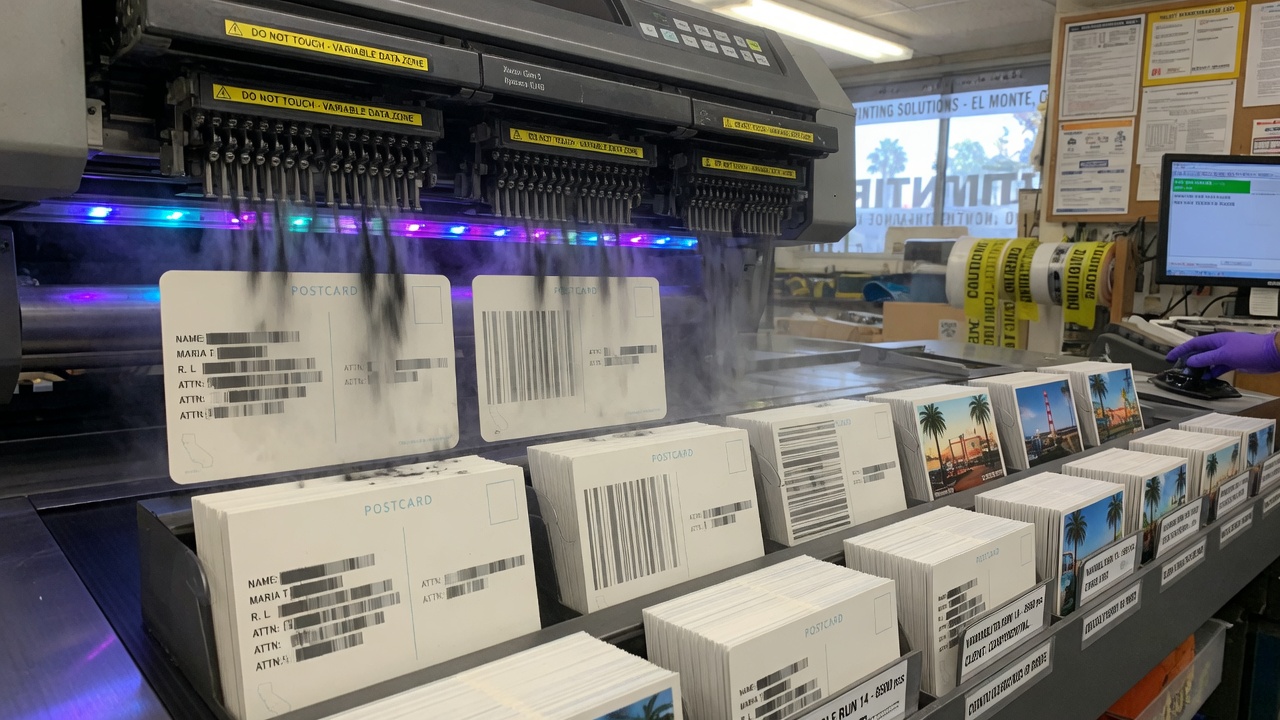
Variable data printing for California mail is one template plus a clean record file. Each piece can carry a different name, address, URL, offer code, or image. It is not a unique layout per row. Hygiene, PDF/VT versus merge, inkjet versus toner, and privacy decide whether the tray is a campaign or a reprint.
I estimate these jobs at Avanti Printing, 15321 Barranca Pkwy, Irvine, CA 92618. Mail we produce for this site originates here and travels Orange County and the rest of California. If you already have a file and a drop date, call (949) 387-0787. Quotes still confirm size, material, quantity, finish, and date. Postage is a separate USPS charge. Variable data sits on top of those five facts. It does not replace them.
People say “personalize it” and mean four different jobs. A first name in 12-point type. A unique landing URL. A store block that changes by ZIP. A one-to-one image swap. Those are not the same RIP, the same proof, or the same privacy conversation. This page is the estimator’s version of that split. It is not a ZIP-code catalog of postcard SKUs. It is not a saturation-route lecture. If you need Every Door Direct Mail, that is a different product with no names. Variable data starts when a record has a reason to differ, and when you can defend the file that feeds the press.
Who this is for in Irvine, Orange County, and statewide California
This guide is for the person who signs a print-and-mail estimate and also owns a spreadsheet: a marketing manager in Irvine Spectrum, a medical group mailing recalls from Tustin, a multi-location restaurant along the 405, a dealer in Anaheim, a broker with listings from Newport Beach to Santa Ana, a campus office near UCI, a B2B firm in the Irvine Business Complex, or a statewide brand that wants one origin on Barranca Parkway. You have a house file, a purchased file, or both. You want the piece to say something true about the recipient without inventing a unique design for every row.
It is not a walk-in name-badge job. It is not a lecture on folding panels. It is not a Laguna Woods or Laguna Hills ZIP product page. The plant is in Irvine, 92618. The mail is California mail that happens to start here. If the only instruction you have is “hit 92618 with names,” you do not have a variable-data spec. You have a geography and a wish.
You should read this if any of the following is true. An agency exported 18,000 InDesign pages and called the nine-gigabyte PDF “the VDP file.” A CRM dumped first names in all caps with a pipe character in the company field. Someone built unique URLs that embed the account number. You flooded UV on the address side and then asked for inkjet names. You last ran NCOA last spring and the drop is in August. You want Spanish and English versions from one list. You need offer codes that the call center can type without reading a 0 as an O. You plan to reprint 40 bad records without rerunning 40,000.
If the piece never takes a name — a counter stack, a rack, a booth handout — you are not in variable data. We still print that work. Versioned flyers for locations that never see a sorter are a cousin of VDP: a few static versions, not a record per sheet. If the story needs panels and the address lives on an envelope, we print brochures that can share a template across versions. If the mailer is a card, start from postcard printing and mail prep from Irvine and bring the field list with you. Do not force a brochure’s worth of copy onto a named card and then blame the RIP when the ZIP+4 collides with a map.
B2B readers in Spectrum towers should stay here too. A title, a suite, and a PURL on a letter-size card is variable data. Saturating the building with LOCAL POSTAL CUSTOMER is not. If your file has people, this page applies. If your file is a route table, you are in a different program.
Decide the variable fields before you pick a press
Start with the record, not the press tour. Every field you vary costs layout space, RIP time, proofing, and a privacy question. Every field you do not vary is a static plate — cheap, stable, easy to reprint. The amateur move is “variable everything.” The adult move is a short list of fields that change the response, plus the address block the Postal Service already requires.
Use this as the decision frame before anyone opens InDesign.
| Field | What it actually does | When it is worth varying | Typical fail | Privacy heat |
|---|---|---|---|---|
| Delivery address, ZIP+4, Intelligent Mail barcode | Gets the piece to a door at automation prices | Always, on named mail | Missing unit, fake barcode art, dark panel | Address is personal information. Still required to mail. |
| First name / salutation | Cheap proof that you know who they are | House files with real names; not a rented occupant file | Overflow, “Dear Occupant,” mixed case, encoding garbage | Low on its own. High if paired with a condition or balance. |
| Location / store / agent block | Puts a nearby phone, map, or hours on the piece | Multi-location retail, brokers, clinics, dealers | Wrong store for the ZIP, hours that wrap the barcode | Low. This is business data. |
| Offer code / version code | Lets you match response to a segment or a person | When the call center, POS, or landing page will actually capture it | Illegible font, 0/O confusion, codes that are account numbers | High if the code encodes an account, MRN, or student ID. |
| Unique URL or QR (PURL) | Routes a scan or a type-in to a tracked page | When the page exists, is mobile, and does not leak the record | Tiny QR on gloss, URL longer than the panel, 404 after the drop | High if the slug is firstname-lastname-ssn or a customer key. |
| Language version | English, Spanish, or both from one campaign | When the list has a language flag you trust | Marketing copy in Spanish with a broken English address line | Low. Do not infer language from a surname. |
| Hero image / map / product shot | True 1:1 creative | When the image changes the offer, not just the wallpaper | Missing image, RGB, 72 ppi, filename mismatch, RIP timeout | Medium if the image implies income, health, or kids. |
| Dollar, point, or balance | Transpromo on a marketing card | Almost never on a postcard. Envelope, or do not print it. | Cluster-box gossip. Informed Delivery thumbnail. | Stop. This is how incidents start. |
Two footnotes belong under that table. First, the address block is not optional “personalization.” On commercial First-Class and Marketing Mail it is how you buy automation prices. If your designer treats the IMb as clip art, you do not have variable data. You have a pretty reject. Second, a versioned job is not the same as a 1:1 job. Twelve store versions at 2,000 each is a versioned campaign. Twenty-four thousand unique PURLs is 1:1. Price, proof, and RIP them as different animals.
Typical industry pattern — and it is a pattern, not a promise — is that house files with a real name, a clean address, and one honest offer code outperform rented names with a fake-friendly headline. I will not invent a lift percentage for your category. I will insist you name the fields on the purchase order.
Names, URLs, and offer codes that survive the tray
Those three fields are the whole reason most California buyers ask for variable data printing. They are also the three fields that blow a layout, a call center, or a privacy review. Spec them as production objects, not as “we’ll drop in merge tags later.”
Names
A first name is the cheapest variable element and the fastest way to look sloppy. The file has to be a name, not a username, not an email local-part, not a nickname the sales rep typed in a hurry. Title-case it on purpose or leave it as stored; do not let a designer apply a random case function the night before RIP. All-caps CRM dumps look like a threat. Mixed “McDONALD” looks like a bug. Spanish and Vietnamese names in Orange County are not edge cases. They are the list. If your font cannot print á, ñ, or a compound last name, you picked the wrong font, not the wrong customers.
Measure the longest name, not the sample in row two. Build the salutation line to the 95th or 99th percentile character count you actually have, then decide what happens to the rest: shrink-to-fit down to a floor point size, wrap to a second line, or fall back to “Hello” / “Friend of the practice” / the company name. Shrink-to-fit with no floor is how a 4-point name appears next to a 12-point neighbor. A second line that collides with the IMb is worse. Put a dummy of the longest record on the proof. If it does not fit, the template is wrong. Do not hope the long names are rare. Rare names still mail, and they still photograph badly in a client screenshot.
Prefixes and suffixes eat width. “The Honorable” and “III, Esq.” are not theoretical. Occupant-style fallbacks belong in the data, not as a designer afterthought: if FirstName is blank, the line becomes “Neighbor” or you drop the salutation. Empty merge tags that print “Dear {{FirstName}}” are how you reprint. Empty tags that print “Dear ,” with a comma hanging in space are the same reprint with worse manners.
Do not put a clinical condition, a past-due amount, or a child’s name in the salutation line of a card. The cluster box is a hallway. The name on a dental recall can be “Maria,” not “Maria — perio maintenance, Unit 2B.” If the relationship needs privacy, the format is an envelope, not a tighter font.
URLs and QR codes
A unique URL is useful when a page will exist for the life of the campaign, the slug is typeable, and the tracking actually lands in a system someone reads. A PURL that is firstname.lastname.campaign.com looks clever in a deck and cruel in a cluster box: it announces who you think lives there and that they are in your file. A random token — go.example.com/7K2Q — is uglier and safer. Query strings that carry email, phone, or account are not tracking. They are a leak you printed at 2400 dpi.
Decide the action. Type-in URLs need short domains, no mixed I/l/1, and a fallback page for typos. QR codes need size, quiet space, contrast, and a surface a phone can see. A variable QR generated at RIP from the same token as the type-in is the clean pair. A designer-drawn QR that is identical on every card is not variable data. A unique QR that is 0.4 inch on a gloss sunset is not a QR. It is a gray smudge that fails in Irvine noon glare.
The landing page is part of the print spec even though we do not host it. If the page 404s the week after in-home, you spent print and postage to advertise a dead link. If the page is not mobile, you spent a QR. If the page asks for a password the recipient never set, you spent goodwill. Give us the live pattern, a test token, and the kill date. We will print codes that still resolve. We will not invent your web stack.
Informed Delivery can show a scan of the mailpiece. Design the address side knowing a JPEG of the unique URL may sit in an email. Do not put a surprise in the slug that you would not put on a website thumbnail.
Offer codes
An offer code is a key. It should be easy to read, hard to guess in bulk, and meaningless if a neighbor photographs it. Use a short alphanumeric. Avoid 0 and O, 1 and I, 5 and S in the same alphabet. Set it in a monospaced or clearly differentiated sans at a point size a call center can read from a phone snapshot. If the POS system only takes six characters, do not print eight. If the CRM already has a campaign code plus a person code, decide which one is on the card. Two codes is how the wrong one gets typed.
Version codes (SAVE-IRV, SAVE-TUS) are not unique IDs. They are cheaper, easier to proof, and enough when you only need to know which offer hit which city. Unique codes (one per record) are how you match a response to a person. They require a matchback file, a collision check, and a rule for reprints so you do not issue the same code twice. Do not use the medical record number, the student ID, the invoice number, or the last four of a card. Those shortcuts feel efficient in a spreadsheet and look like a breach in a tray.
Codes have to survive the same coating and inkjet rules as the address. A code knocked out of UV in a 6-point script font is decoration. Put codes on a pale panel, same as the IMb. If the recipient is supposed to write the code on a form, the form needs a writable surface. That is a stock conversation, not a VDP conversation, but it still kills the campaign when you ignore it.
PDF/VT versus merge versus a giant imposed PDF
This is the file-format argument that wastes the most calendar time. Agencies deliver what their desktop software can export. Plants RIP what a production DFE can cache. Those two files are not the same species. Variable data printing California jobs die here more often than they die on press.
Mail merge from a word processor is not VDP. It is a way to send 40,000 unique problems with one filename: RGB black, 72 ppi photos, letter-size pages with no bleed, Times New Roman substituting for the brand font, and an address that walked off the OCR band on page 2,441 because a long city name wrapped. We can sometimes rescue a short stack. We cannot honestly estimate a statewide drop from a merge to PDF that nobody preflighted as a mailpiece.
| What you deliver | What the RIP can reuse | Where it belongs | Typical fail |
|---|---|---|---|
| Word / Google Docs merge, exported PDF or DOCX | Nothing. Every page is a new drawing. | Letters at dozens of pieces, not campaigns | RGB, missing bleed, font sub, no IMb, legal-size accidents |
| InDesign Data Merge, one page per record | Poor. Images and static art often duplicate per page. | Hundreds to a couple thousand, if preflighted | Multi-gigabyte PDF, overset text, missing links, no DPart structure |
| Giant imposed PDF (printer spreads already run out) | Nothing useful. Record order is baked into sheets. | Only if we asked for it, for a specific device | Cannot pull one record. Cannot re-impose. Wrong sequence versus the list. |
| PDF/VT-1 (ISO 16612-2 on PDF/X-4) | Cached XObjects: static art once, variables per record | True VDP exchange with a shop that can consume VT | Labeled VT but flattened; missing fonts; no metadata; wrong output intent |
| PDF/VT-2 file set | Same idea, external references allowed | Very large image libraries, multi-file exchange | Broken relative paths, missing external pages |
| Template PDF + delimited data + image folder, composed at our RIP | Best case. We compose on the device that will print. | Most Irvine jobs we actually want | Column names that do not match, UTF-8 lies, image filenames with spaces |
PDF/VT stands for PDF for variable and transactional printing. ISO 16612-2 (2010) defined PDF/VT-1 and PDF/VT-2 on top of PDF/X-4 / PDF/X-5, themselves on PDF 1.6. The point of the standard is not a logo in the metadata. The point is that the RIP can cache the static picture of the restaurant and the logo once, then paint the name, the code, and the barcode per record without reinterpreting the whole page. A 24,000-record card job with a 15 MB hero image should not be a 24,000 × 15 MB file. If it is, you flattened it. You did not make VT.
PDF/VT-1 is a single-file exchange. That is what most commercial shops mean when they say they can take VT. PDF/VT-2 is a file set that may reference external page content and output intents. Do not send VT-2 because an export checkbox looked advanced. Send what we asked for. A later PDF/VT-3 family exists on newer PDF versions; I will not pretend every DFE on a California plant floor consumes it. If your agency’s VDP tool can write VT-1 with embedded fonts, PDF/X-4 output intent, and DPart (document part) metadata that identifies records, we can talk. If the tool writes “PDF/VT” into the document information dictionary and still flattens every page, that is a merge with a sticker on it.
PPML and other vendor-specific VDP languages still exist in some DFEs. I will not spec them from a blog post. I will spec a template, a data dictionary, and a proof path we have run. For most named mail out of this plant, the grown-up package is:
- A static print-ready PDF of the piece with 0.125 inch bleed, fonts embedded, CMYK, address panel empty but drawn at final size.
- A data dictionary: field names, max lengths, encodings, fallback rules, sample of longest and shortest records.
- A delimited file (CSV or TXT) UTF-8, quoted text, header row that matches the dictionary, no merged cells, no color coding that only lives in Excel.
- Variable images in a folder, named by a key that exists in the file, or no variable images.
- A record-level proof list: first, last, longest name, missing name, bilingual if any, a known bad ZIP we should have already dropped, and a handful of seeds.
That package lets us compose on the RIP that will actually print — toner digital, production inkjet, or an inkjet base after an offset shell. It also lets us reprint record 17,004 without rerunning the other 17,003. A giant imposed PDF does not. If your agency already lives in a VDP tool that writes honest PDF/VT-1, we will take that plus the same dictionary and a sample RIP on our device. Do not skip the sample RIP. VT that ran in their desktop preview is not VT that ran through our color management and our barcode engine.
If the static art is not PDF/X-clean — fonts embedded, images in a production colorspace, bleed present, no RGB black in the address — wrapping it in PDF/VT will not save you. Variable data does not launder a bad master. It multiplies it by the record count.
One more file we refuse with a smile: a ZIP of 20,000 single-page PDFs named by email address. That is not a campaign file. That is a denial-of-service attack on the prepress queue.
Inkjet, digital toner, and the offset shell
Once the fields and the file method are honest, pick a production path. Variable data printing California buyers mash three machines into the word “digital.” They are not interchangeable. The path has to match quantity, stock, how much of the page changes, and whether the address is a second pass.
| Path | What can vary | Where it shines | Stock and finish notes | Watch-outs |
|---|---|---|---|---|
| Production inkjet (web or cut-sheet), color in one pass | The whole page, including color versions | Long runs of letters, self-mailers, some cards; statements-adjacent volume | Inkjet-treated or proven sheets; primer on some coated; uncoated is friendlier | Heavy solids can band; not every 16 pt C2S is happy; roll-to-sheet waste on tiny cards |
| Toner or liquid-toner digital press | The whole page; better heavy coverage | Hundreds to low tens of thousands; cover stocks; matching other collaterals | 14 pt and 16 pt C2S, uncoated cover, some synthetics as tested | Click cost; sheet ceiling; coating after toner must not bury barcodes |
| Offset shell, then inkjet imprint | Name, address, IMb, code, small type; sometimes a second color | High volume with few static versions and a knock-out panel | Offset quality on the photo; knock-out must be inkjet-receptive | Knock-out too small; UV under the heads; version changes mean plates |
| Static digital or offset, then labels | Whatever you print on the label | Already-coated UV cards, late lists, salvage | Label is the writable, readable panel | Looks like a label; adhesive in OC heat; covers whatever you did not leave room for |
I am not going to pretend there is one correct machine for every named 6×9. I will pretend even less that “digital” on a quote request specified anything. Tell me the record count, how many unique color versions, the stock, the finish, and whether the list will still move after we go on press. Then the path is obvious more often than not.
When the whole page is variable
If every record gets a different hero, map, or colorway, you are on a digital toner press or a production inkjet. Offset cannot change the photograph per piece without becoming a very expensive joke. Digital toner (including liquid toner) is the usual conversation for cover-weight cards that need to sit next to a brochure printed to a similar look. Production inkjet is the usual conversation when the quantity is large, the piece is a letter or a text-weight self-mailer, and you can live with inkjet gamut and screening. Those two sentences are industry pattern, not a promise that your 14 pt food shot will look identical across devices. If the mailed card must match a leave-behind brochure, say so. We may print both on the same toner device instead of mailing inkjet and handing out offset.
Do not drag an offset-versus-digital catalog argument onto a named mailer. Catalogs are a different bindery and a different article. A named card or letter is a mailpiece. The question is whether the variable elements and the static art can live on one pass without killing the barcode or the budget.
When only the address and a code change
Then an offset shell plus inkjet is still how a lot of California volume should be built. Print the photography on offset. Knock out a pale panel large enough for name, address, IMb, and code, including quiet space and a registration pad. Inkjet the panel. You get offset color at shell quantity and variable text at inkjet speed. You do not get a unique photo per record. If you only needed the unique photo because a deck said “1:1,” drop it. A correct store block and a correct code outperform a unique sunset.
The knock-out is a production object. A window the size of three address lines with the barcode hanging onto varnish is how the first and last bars die. Coat the photo. Leave paper or a tested inkjet-receptive aqueous in the panel. Flood UV in the panel is a no. We have had this argument on coating jobs; it does not change because you added a first name.
Inkjet as a second pass versus inkjet as the press
Lettershop inkjet bases that spray black or MICR-style addresses onto already printed cards are not the same animal as a full-color production inkjet press. The base is an addressing device. It wants a receptive strip and a reliable record sequence. The press is a color printer that happens to be excellent at variable data. If you say “inkjet” on a quote without saying which one, I have to guess whether you mean $0.00 extra black names on a shell or a completely different manufacturing path. Guessing is how the finish gets specced for the wrong device.
Sequence matters on a second pass. The printed shells must match the data file order, or the inkjet must read a work-and-turn mark, or we reprint the mismatch. If you sort the Excel file after we print the shells, congratulations, you shuffled 20,000 names onto the wrong photographs. Lock the file. Version the filename. Stop “just cleaning a few rows” in email after approval.
Color inkjet on coated cover is a chemistry problem. Some sheets take it. Some need primer. Some never will. A dummy through the actual device is the estimate, not a mill swatch. Toner on C2S is an easier conversation for short and medium card runs, which is why a lot of named 6×9 work from this plant never sees a web inkjet. Quantity, not ideology, moves you to the web.
If the same campaign also needs a non-mailed stack — a version per store for the counter — say so. Handouts can flood UV both sides. Mailed cards cannot always. Mixing those specs on one ticket is how the UV stack goes through the inkjet by mistake. We will split the PO. You will not like the invoice for the un-split one.
Request a variable-data mail quote
Data hygiene before anyone RIPs a record
Variable data printing does not fix a dirty list. It prints the dirt in register. California named mail that wants commercial First-Class or Marketing Mail prices owes the Postal Service a Move Update process and a standardized address. That is not a plant upsell. That is how you keep automation prices and how you stop paying to kiss vacant units in Irvine apartments.
USPS: mailers who claim First-Class Mail presorted or automation prices, and mailers who claim USPS Marketing Mail prices, must demonstrate that they have updated the mailing list within 95 days before the mailing date, using an approved method. Alternative-address formats have their own rules. Read the current language on the Postal Service’s Move Update page. If a list vendor’s email disagrees with that page, the Postal Service wins.
Hygiene is a pipeline. Skip a step and the RIP will still run. The dock will not save you.
CASS, DPV, and the shape of the address
CASS is the USPS Coding Accuracy Support System. CASS-certified software standardizes the address, applies ZIP+4, and is the floor for automation work. Delivery Point Validation (DPV) asks whether that delivery point actually exists. They are related and they are not synonyms. A pretty ZIP+4 on a suite that never existed is a standardized fiction. Orange County business parks and Irvine Company villages are where fiction gets expensive. Secondary lines — Apt, Unit, Ste — are not optional decoration. “200 Spectrum Center Dr” without a suite is a receiving-room lottery. “Avenida” versus “Ave,” “Barranca Parkway” versus “Barranca Pkwy,” and a gate-code in the address line are how CASS either saves you or you override it and pay later.
Run CASS close enough to the drop that the ZIP+4 file is still in cycle, and always in the same breath as the rest of the job. A CASS certificate from last year is a souvenir. Details of the current cycle live on the Postal Service’s CASS certification pages. I do not need you to become a licensee. I need you to stop sending us a spreadsheet of user-typed addresses and calling it mail-ready.
LACSLink (converted rural-style addresses) and SuiteLink (business secondary) show up less in coastal Orange County than in other states, but suite data still matters here for a different reason: the buildings were born with suites. If the B2B file has firm name and no suite, hygiene will not invent the floor. Buy better data or visit the directory in the lobby before you print 8-point type.
NCOA, Move Update, and the 95-day clock
NCOALink is the licensed National Change of Address product. It matches your names and addresses to change-of-address orders. Move Update is the standard that says you used an approved method — NCOALink, ACS, certain ancillary endorsements, or another approved path — within 95 days before the mailing date for the prices you are claiming. NCOA is the common pre-mailing method. It is not the only method. “We NCOA’d” is not a sentence with a date. The date is the spec.
UCI-adjacent rentals, hospital staff housing, new villages, and apartment turns in Irvine, Tustin, and Costa Mesa go stale faster than a house file in a quiet ZIP. A list you mailed last fall is not legal for commercial discounts this summer just because the creative is the same. If the job slips six weeks, look at the clock again. We will. Do not be offended.
Move Update is about names and addresses that claim those commercial prices. Occupant / Current Resident and other alternative-address formats live under different rules. Simplified-address saturation is not this article. Named VDP is. If you mix a named house file and an occupant layer, hygiene them as two files. Do not NCOA an occupant file as if it had people, and do not skip NCOA on the named file because half the campaign is occupant.
NCOA also returns codes: moved, not moved, box closed, and the rest of the licensee’s report. Someone has to read that report. Dropping every moved or undeliverable record without a written rule is how you delete customers. Keeping every nixie because “maybe they’ll get it” is how you print waste. Set the rules in writing before we RIP. I will not invent your retention policy from a blog post. I will not RIP while you think about it.
Dedupe, seeds, and the matchback
Householding is a business rule, not a USPS rule. Two doctors at one Irvine address may both need the piece. Two spellings of the same restaurant owner probably do not. Dedupe on a normalized address plus last name is a common start. Dedupe on email only is how you mail the spouse you just suppressed. Tell us the key. Do not say “take out duplicates” as if that were a standard.
Suppression files are part of hygiene: your do-not-mail, your current customers if this is an acquisition drop, deceased if the vendor actually ran it, and any internal opt-out you already promised. DMA-style preference services apply to named lists, not to simplified-address saturation. If someone asked you to stop, honor it in the file. Do not hope the inkjet will feel the mood.
Seeds are records you insert so the client, the agency, and the plant can see a live piece. Put them at real California addresses that will actually receive mail, including at least one in the destination SCF if you care about in-home, and one at the plant. A seed that is a P.O. Box you never check is theater. Unique offer codes on seeds let you test the landing page and the call center before the trays leave. If the seed PURL 404s, you found the bug while we can still stop. That is the point.
The matchback file is the list as it actually printed: record key, name, address, IMb or sequence, offer code, PURL token, version, and mail date. Without it you cannot connect a response to a row, and you cannot reprint one row. Ask for it. We will not keep your PII as a free CRM. Agree on retention — often “long enough to finish returns and matchback, then destroy” — in the same email as the quote.
Encoding, columns, and the lie Excel tells
Send UTF-8. Orange County lists have ñ, accented vowels, and names that are not ASCII. If you save from Excel as a CSV and the ñ becomes a diamond, you did not send UTF-8. You sent a Windows code page and a future reprint. A TXT with a defined delimiter and a header row is friendlier than a color-coded workbook with three hidden sheets and a pivot table. We do not RIP from a pivot table.
Column names must match the dictionary: FirstName is not FName is not FIRST NAME is not “First name (use this one).” One header. No leading spaces. No two columns both named “ZIP.” Phone numbers as text so you do not drop leading zeros on ZIP+4 that Excel thought were integers. I still see ZIP 92618 become 92618.0. I still see leading zeros on Eastern ZIPs vanish on statewide files. If the campaign leaves California, that last bug is not theoretical.
Blank fields need rules. Missing FirstName, missing suite, missing offer code, missing language flag — each one either falls back or drops the record. Silent blanks become “Dear ,” or a QR to a generic page you did not intend. A preflight report that counts blanks is cheaper than a reprint. We will run it. You will answer it. That is the job.
Privacy, PII, and what a cluster box can read
Named mail is personal information: a person tied to a deliverable address, often with selects that imply income, move date, family, health, or school. Variable data printing California work does not get a free pass because paper feels old-fashioned. The cluster box in an Irvine Company village, the receiving room in a Spectrum tower, and the JPEG in Informed Delivery are all audiences you did not invite to the brand workshop.
I am not your counsel. I am the plant that will not print a file you cannot explain. California privacy law is mostly about how you collect, sell, share, and retain personal information, not a ban on letters. If we process your file to print and mail, treat us as a service provider under your contracts, not as a co-marketer who may reuse the names. We do not want your list for our list. We want a clean file, a defined retention, and a transfer that is not an open email to a personal Gmail.
- Transfer. SFTP, a portal, or another encrypted path. Not an unencrypted workbook of patients as an email attachment. Not a USB left in a rideshare. If the file is a medical, student, or financial list, say so before you upload it to a random link.
- Minimum fields. Send what the piece needs. Do not send Social Security numbers, full account numbers, diagnoses, or grades “in case we want them on version B.” Version B should not exist.
- Face of the card. If you would not pin it in the building hallway, do not print it on a postcard. Balances, claim statuses, prescription names, past-due language, and student standing belong under a flap or in an envelope, or they belong in a portal, not in a tray.
- Codes and URLs. Random tokens. Not MRN, not student ID, not email, not “lastname-92618.” A neighbor can read. A carrier can read. A phone can photograph.
- HIPAA, financial privacy, FERPA. These are not coating issues. A named appointment reminder with a clinical specialty on the face is a communications decision your privacy officer should already hate. We can print envelopes. We can print a generic “your appointment is coming” card with no specialty. We will not launder a bad decision through 8-point type.
- House lists versus purchased lists. You owe opt-outs you already stored. A compiler owes you a source story. If the vendor will not say how the names were gathered, we will not pretend the tray is clean. “We bought 20,000 Irvine names” is not a spec.
- Do-not-mail. Honor yours. Named lists can use preference services the saturation map cannot. Use them.
- Retention and destruction. When the matchback window closes, the file should go away on our side unless you have a written reason. Do not ask us to keep PII “for the next drop” without a contract that says so. Next drop gets a fresh hygiene pass anyway.
Occupant / Current Resident is the compromise retail should use more than it does when the name is stale but the street is right. You keep a deliverable address. You skip the wrong first name. You still do not get saturation postage just because line one says Occupant. Occupant mail is still addressed mail. It still needs a list and a barcode plan. It is a VDP field with a boring value, not a different product.
B2B is not a privacy-free zone. Titles are people. A home address scraped onto a “business” file is a home address. Office parks around Spectrum, University Research Park, and South Coast Metro need suites. A named piece without a suite is not targeted. It is lost.
If the campaign is sensitive enough that this section made you uncomfortable, good. Change the format. We print envelopes and letterhead for a reason. A named letter in an envelope is still variable data. It is just data that does not perform for the hallway.
Files, fonts, proofs, and the dummy we will not skip
Send a print-ready static PDF: fonts outlined or embedded, 0.125 inch bleed, live matter off trim, CMYK, address panel drawn at final size on a light field. Mark variable frames. If a unique QR or code lives there, show a dummy token at final size and final point size. A pretty front with “VDP TBD” in the middle of a photo is not a mail file.
Fonts used in variable lines must be licensed for the RIP, embedded, and capable of the character set in the file. A display script that looks expensive on “Ann” will collapse on “Nguyen-Vasquez.” A font that does not contain ñ will substitute a box. Outline the static logo type if you want. Do not outline the variable name and then ask us to merge. Outlines are not data. If the name shrinks-to-fit, the font still has to be a live font on our side.
Color: the delivery address and IMb want a solid black or the device’s inkjet black, on a pale field. Do not build the name in RGB gray. Do not put a 5 percent yellow wash in the panel for brand warmth. That wash is how contrast dies. Variable color in a hero image is a different conversation: those images must be CMYK or a space we agreed to convert, at production resolution, named by a key. RGB phone photos named IMG_3489.jpg are not variable images. They are a folder of regrets.
Bleed and trim still matter when the art is 1:1. A 6.00-inch-high letter that “gains” 0.20 inch of safety becomes a flat. A QR that sits 1/16 inch from trim gets cut. Variable elements have to obey the same OCR band as static addresses: roughly a shallow strip above the bottom edge on letters and cards, with quiet space for the IMb. I will not rerun the entire postage-size lecture here. I will reject a variable name that lives in the barcode clear zone because the photo needed to breathe.
Proofs for VDP are a set, not a JPEG:
- Contract-quality proof of the static art on the intended stock, or as close as the proofing system gets, with the address panel shown empty and occupied.
- Data proof: a paginated PDF or printed stack of selected records — first, last, longest, shortest, blank-name fallback, bilingual, a store version if you have stores, and every seed.
- A barcode / address-block inspection at print size, not on a monitor at 400 percent.
- A physical dummy of the finished piece: stock, coating, fold or tab if any, through the actual inkjet or toner path when the quantity justifies it.
- A landing-page check of several live tokens, from a phone, outdoors, because that is how recipients scan.
You will not visually inspect 40,000 unique pieces. Neither will I. Inspection is statistical plus the selected records plus a press-side check that the first and last boxes of a tray match the sequence we think we have. If you need every record printed as a PDF proof, say so and budget time. Most buyers need the selected set and a sign-off that the rules (fallback, shrink, drop) are correct. Sign the rules. Do not sign a vibe.
Reprints of a subset are why we did not want your imposed 9 GB PDF. Give us keys. We will RIP the bad records, not the campaign. If the error was in the static art, that is a campaign reprint and you should sit down. If the error was 200 bad suites, that is a data reprint. Catch it at CASS, not at in-home.
If you also need named postcard mailers with a knock-out for inkjet, say which path — toner, inkjet press, or offset shell — you think you are buying. If you need versioned brochures that mail in envelopes, the VDP may live on the letter and the brochure may be static. That split is allowed. It is often the grown-up split. If you need store-version flyers that never get an IMb, do not build them from the mail template with a barcode on the rack copy. We will strip it if we catch it. Catch it yourself.
Orange County conditions that change VDP, not slogans
Mail we produce for this site originates at Avanti Printing, 15321 Barranca Pkwy, Irvine, CA 92618. Phone (949) 387-0787. That origination is useful when the in-home window is built around Orange County carrier routes and still valid when the same job continues to Los Angeles, San Diego, the Inland Empire, or statewide. It does not create a magic ZIP. It does not excuse a stale NCOA date.
- Suites and apartments. Irvine Company communities, Spectrum high-rises, UCI-adjacent housing, mixed-use in Santa Ana. Secondary lines are the job. A beautiful unique URL on a missing Unit 2B is a beautiful return.
- Turnover. Students, hospital staff, new villages. House files rot. Move Update is a mail spec, not a nicety. First-Class can still be the right class when the record is valuable and forwarding matters.
- Business parks. Spectrum, the Irvine business complex, University Research Park, South Coast Metro, Anaheim Canyon. B2B VDP needs titles and suites. A first-name card to “Current Occupant” at a tower is a receiving-room liner.
- Cluster boxes and Informed Delivery. Design the face and the slug for an audience in the hall and on a phone. HOA rules do not veto USPS delivery the way they veto a yard sign. Do not confuse those projects.
- Bilingual creative. Useful on a lot of California files. Keep one standardized delivery address the equipment can parse. Do not interleave Spanish marketing lines between the name and the ZIP. Language flags belong in the data, not in a guess from the last name.
- Heat. Summer trays cook. Inkjet on a closed UV face fails harder in an Anaheim yard than in a climate-controlled studio. The root cause is still varnish under the heads. Heat is the amplifier. Design the coating stack for Orange County logistics.
- Convention and resort inventory. Anaheim Convention Center hotels and resort deliveries are not households for a roofing offer or a pediatric recall. If those records are in the purchased file, suppress them on purpose.
- Multi-city in-home. A “California drop” on a slide is a ZIP histogram, an entry plan, and a 95-day hygiene clock. VDP does not shorten USPS processing. It can lengthen plant time if the RIP is heavy. Build dummy and data-proof time into the calendar.
Entry discounts, SCF versus local entry, and permit paperwork are real and they depend on the current price list and how the mailing is prepared. I will not invent a per-piece postage here. Bring the ZIP histogram, the class, and the record count. Printing 50,000 unique codes without a density report is how you leave money on the dock and still miss the in-home window.
The Irvine plant will print and, when you ask, prep the mail. We cannot pretend Barranca Parkway is every delivering office in the state. If you want us to handle entry, say so on the quote. If you want print-only VDP, you still need a legal address block and a file we can reprint from. “We’ll take them to our lettershop” is fine. “The lettershop will invent IMbs from a flattened merge” is how Friday dies.
Mistakes that reprint a variable job
These are repeats. They come from good agencies as often as from a file built in a word processor.
- Exporting one PDF page per record, flattened, 8 to 12 GB, and calling it PDF/VT because the job ticket said variable.
- Mail-merging from a word processor with RGB black, no bleed, and the address in the middle of a photograph.
- Sending the list as an Excel file with ZIP codes stored as numbers, hidden sheets, and a pivot table as the “real” tab.
- Saving CSV in a Windows code page so every ñ becomes garbage, then blaming the RIP.
- No fallback for blank first names. “Dear ,” mails. Then a photo of it lands in a group chat.
- Shrink-to-fit with no minimum point size. The long names become microtype. The barcode does not care. The brand does, later.
- Unique URLs that embed email, account, or last name plus city.
- Offer codes that are the medical record number with a dash.
- QR codes too small, on gloss, with no quiet zone, generated as 72 ppi PNGs named by row number that do not match the file.
- Flood UV on the address panel, then a PO note that says “inkjet the names.”
- A coating knock-out that does not include the IMb quiet space.
- Sorting the data after the shells are on press.
- NCOA dated outside the 95-day window, or “we cleaned it last year.”
- Skipping secondary designators in Irvine and Spectrum suites.
- Mixing a house-file offer that cites a balance with a purchased-file acquisition card in one template.
- Imposing before composition, so one bad record is a bindery problem instead of a RIP problem.
- Approving a static JPEG and never looking at the longest-name data proof.
- Locking an in-home date before the data dictionary exists. RIP time is not zero. Hygiene time is not zero. Dummy time is not zero.
- A landing page that expires, 404s, or requires a login the recipient does not have.
- Asking us to keep the PII forever so “next month is easier,” with no contract and no re-hygiene plan.
Reprints are worse than a path change on the first pass. Once inkjet hits flood UV, that sheet is scrap. Once 15,000 names are on the wrong store map, you do not have a campaign. You have a customer-service event. Send the dictionary. Send the dummy. Send the dated CASS/NCOA story. That is slower than clicking approve on a PDF. It is faster than reprinting.
What to send for a quote
Write one email or use the form with the facts a plant estimates from. “Personalized” is not a spec. Adjectives do not change RIP time or caliper.
- Finished size and format: card, letter, self-mailer, or enclosed in an envelope. Height and length labeled.
- Quantity, unique record count, and unique color versions. Those three numbers are not always the same.
- Stock and finish per side, including any knock-out for inkjet.
- Production path if you care: toner digital, production inkjet, offset shell plus inkjet, or “recommend.”
- Field list: name, address, IMb, code, URL/QR, store block, language, images. Max lengths. Fallback rules.
- File method you can actually deliver: template plus CSV, honest PDF/VT-1, or something we will have to rebuild.
- List status: record count, last CASS and Move Update / NCOA date, house versus purchased, suppressions.
- Privacy notes: PHI, student, financial, or “none of that, we swear, and here is why.” Transfer method.
- Landing page pattern and kill date if URLs or QRs are variable.
- Mail class, in-home or drop date (wish versus contract), who enters the mail.
- Files: static PDF, data dictionary, 20–50 sample rows including the longest name, or a note that design is still open.
We confirm size, material, quantity, finish, and date on every quote. If postage is included, it is shown as postage, not hidden in a blended “per piece” that pretends USPS does not change prices. If postage is yours, the address block still has to be legal for the class you claim. Avanti Printing, 15321 Barranca Pkwy, Irvine, CA 92618. (949) 387-0787. The quote link on this page is the same form we use for commercial printing work across California.
FAQ: variable data printing for California mail
Is variable data printing just putting first names on postcards?
No. A first name is the smallest example. Real VDP is a template plus records that can change address, IMb, store block, language, offer code, URL, QR, or image. If the only thing you needed was “Dear Maria” on an otherwise identical card, say so. That is a cheap field. It is still a data-hygiene job. It is not a reason to flatten 20,000 PDFs.
Can I send a merged PDF instead of PDF/VT?
For a few hundred preflighted pages, sometimes. For a campaign, send a template and a file, or send honest PDF/VT-1 with reusable content, embedded fonts, and a data dictionary. A giant flattened PDF makes reprinting one record painful, explodes RIP time, and usually arrives with RGB and overset type. Originating the job in Irvine does not make a 9 GB merge smaller.
Should an 8,000-piece named card run inkjet or digital toner?
Often toner or liquid-toner digital if it is cover stock that must look like your other collaterals. Production inkjet starts to win when quantity climbs, the sheet is inkjet-friendly, and you are changing a lot of the page. Offset shell plus black inkjet wins when the photo is static, the volume is high, and you left a real knock-out. I will not pick from a blog post without stock, finish, and a dummy. I will not call all three “digital” on the estimate.
How fresh does NCOA or Move Update need to be?
For commercial First-Class presort or automation prices, and for USPS Marketing Mail prices, USPS wants an approved Move Update method within 95 days before the mailing date. NCOALink is the common pre-mailing method. Put the process date on the job ticket. A cleaning from last year is not a process date. Confirm the live rule on the Postal Service Move Update page when you lock the drop, because the standard is theirs.
Is a personalized URL with the person’s name a good idea?
Usually no. It is typeable and it is a privacy billboard. Use a random token. Keep the name on the salutation line if you must personalize. If the PURL 404s, or if it reveals that Maria in Unit 2B is on a clinical list, you spent postage to advertise both problems. The landing page still has to exist, on mobile, for the life of the in-home window plus stragglers.
Can one file drive English and Spanish pieces?
Yes, if the file has a language field you trust and each layout has room for the longer copy. Do not infer language from a surname. Do not let Spanish marketing lines break the standardized English (or fully standardized) delivery address. Two templates plus a flag is cleaner than one template that shrinks until the barcode weeps. Proof both, including the longest Spanish name and the longest English name.
How do you proof 40,000 unique pieces?
You do not, not by eye. You proof the static art, a designed sample of records (longest, shortest, fallbacks, seeds, each version), the address block at size, a dummy on the real stock with the real coating, and a live check of tokens. Then you inspect by sequence and by sampling on press. If you need a PDF of every record, budget it. Most California drops need signed rules plus the sample set, not a 40,000-page flipbook.
How do I get a VDP mail quote from Avanti?
Send size, stock, quantity, unique records, finish, field list, file method, CASS/NCOA dates, mail class, and drop date. Use the quote form or call (949) 387-0787. We will confirm size, material, quantity, finish, and date in writing. A 400-piece named toner card and a 40,000-piece offset shell with inkjet codes are not the same estimate. Postage is quoted from current USPS prices for the class you choose, or omitted if you are using your own permit.
Print the record that is legal and readable
Variable data printing for California mail is a records problem that happens to land on a press. Names, URLs, and offer codes earn their keep when the file is clean, the layout can hold the longest row, and the code does not leak an account number in a cluster box. PDF/VT and a template-plus-CSV beat a flattened merge. Inkjet, toner, and an offset shell are three paths, not a synonym. Hygiene is a 95-day clock, not a feeling. Privacy is the face of the card, the slug in the URL, and the way you send the workbook.
Khalid, Avanti Printing, Irvine. Bring the data dictionary if you have one. Bring a dummy if you have that. Bring a Move Update date, not a story about last year. We will tell you whether the job is a few versions, true 1:1, or a merge you should not mail. Then we will print the version that actually leaves the dock.