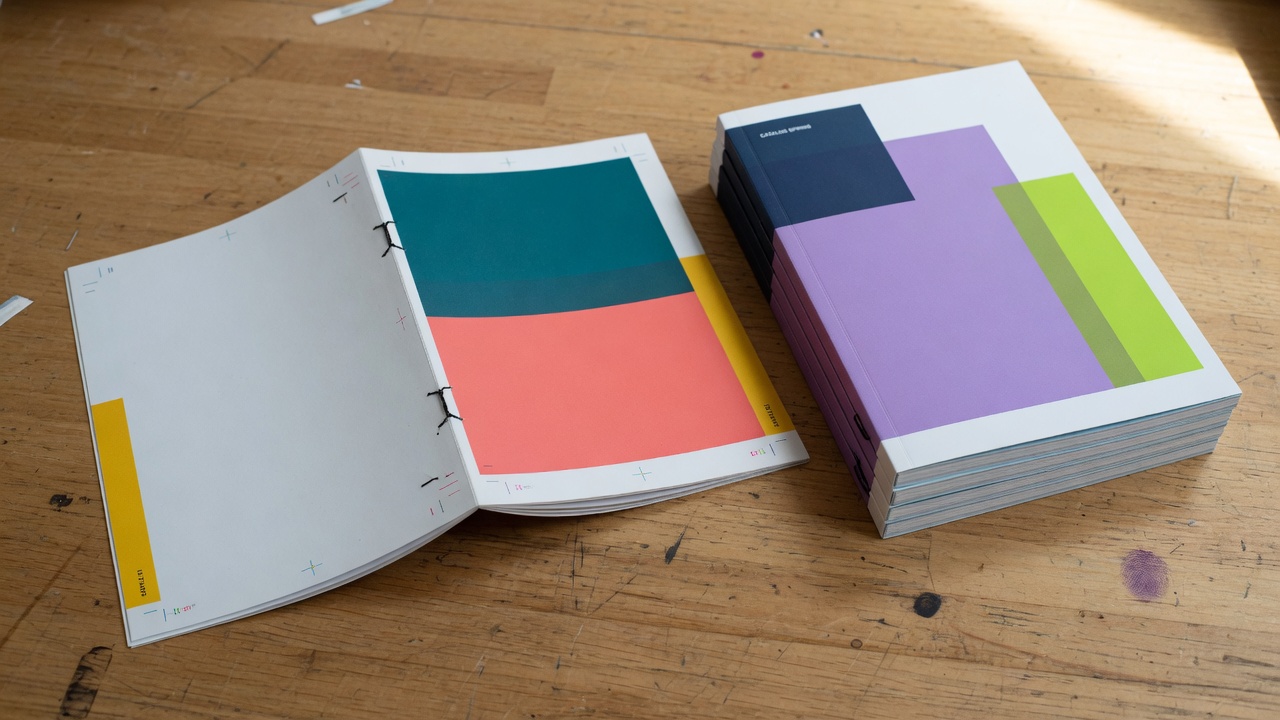
Saddle stitch vs perfect bind is a page-count and bulk decision. Nested sheets get stapled through the fold when the book is thin, the spread must open, and you do not need a printable spine. Perfect bind when bulk will make a square spine, a catalog feel, and a glue line that survives handling. Creep, gutter, and heat are how each bind fails.
That is the spec. Binding is not a personality for the brand. It is how leaves become a book, and how that book opens, sits, and dies. I estimate these jobs at Avanti Printing, 15321 Barranca Pkwy, Irvine, CA 92618. We bind catalogs and booklets that leave this plant and live in Spectrum lobbies, Anaheim booth bags, dealer counters, and trunks from Newport to the Inland Empire. Call (949) 387-0787 if you already have a page count and a dummy. Quotes still confirm size, material, quantity, finish, and date. A pretty cover on the wrong bind is a reprint with extra holes or a handful of loose leaves.
If you came here from a dropdown that says “booklet” or “catalog,” ignore the product name until you count pages and measure bulk. An 8-page saddle-stitched piece is a booklet that happens to have wire. A 96-page glued book is a catalog that happens to have a spine you can print. Calling a 16-page stitch a catalog does not give you a square back. Calling a 32-page perfect bind a “premium booklet” does not make the glue line thick enough. Write page count, stock, and how the piece must open on the purchase order. Then pick a bind.
Who this is for in Irvine, Orange County, and statewide California
This page is for the person who signs a catalog or booklet estimate: a product manager in the Irvine Business Complex, a medical-device team that needs a SKU book for hospital in-services, a dealer group along the 405, a commercial broker with a property book, a campus-adjacent vendor near UCI, a restaurant group that wants a seasonal menu book, or a statewide brand that wants one origin on Barranca Parkway. It is not a fold-style lecture. A tri-fold is a different ticket. It is not a bulk-flyer event spec. A rack sheet that dies after Saturday does not need a spine. It is not a press comparison. Offset versus digital is a quantity and version conversation. This article is the bind.
You should read this if any of the following is true. You ordered a 72-page saddle stitch because “staples are cheaper,” then the book would not close and the inner photos lost their captions at trim. You perfect-bound a 24-page piece so it would “feel like a catalog,” then the spine was a mean 1/16 inch and the cover hinge cracked on the first open. You designed a poster across the center of a perfect-bound book and watched the gutter eat the product. You skipped creep compensation on a 48-page stitch. You put last year’s price grid on the cover of a glued book that will sit in a trunk through September. You asked for a printable spine on a stitch. You asked a glued book to lay as flat as a magazine.
If the story is a few panels and no bind, you do not need this page. We print sales brochures that should stay a fold, not a fake catalog. If the leave-behind is a single un-folded sheet, we print one-sheet flyers when the leave-behind should stay a single panel. If the story needs pages, a bind, and a decision between wire and glue, we print bound catalogs with a specified stitch or glue spine. Name the product. Count the pages. The bind follows the bulk, not the filename.
The plant is in Irvine. The books we bind for are California books: Orange County first, then Los Angeles, the Inland Empire, San Diego, and the rest of the state when one origin is the point. Heat, car trunks, office-park storage, and trade-show freight are part of the glue spec, not color commentary. A hot-melt spine that never leaves a climate-controlled closet is not the same object as a hot-melt spine that rides in a Highlander on the 5 in September.
Saddle stitch vs perfect bind at a glance
These are typical industry behaviors, not a promise that every mill’s 80 lb text and every binder’s glue pot break at the same integer. We still dummy the bulk. Use the table to stop arguing from product names.
| Question | Saddle stitch | Perfect bind |
|---|---|---|
| How it is built | Sheets nested, folded, wire through the spine fold, face trimmed | Leaves gathered, spine milled or notched, adhesive, cover wrapped and hinged |
| Page-count rule | Must be a multiple of 4. Each nested sheet is four pages. | Even counts are normal. Signature work still likes 4s, 8s, and 16s. Thin books are the problem, not odd math. |
| Typical page band (80 lb text, plus cover) | 8 to 64 pages is the honest working range. 72 to 80 is possible on thinner text and starts to fight the close. | About 48 pages and up looks like a book on common text. 32 to 40 is skinny. 24 is usually a mistake. |
| Spine | A fold. No printable spine panel. Loop wire is a different ticket. | A square back you can print. Width is caliper times leaves, plus a little adhesive film. |
| Creep (push-out) | Real, and worse as pages and caliper climb. Inner pages lose face trim unless we shingle the file. | Not the saddle problem. Gutter loss is the cousin: type walks into the glue. |
| Lay-flat | Opens well. Center spread is one sheet. Maps and grids like this. | Fights you. Cheap hot melt fights harder. True lay-flat is a named construction, not a hope. |
| Feel | Booklet, program, magazine, thin catalog. Hands know it is wire. | Catalog, annual, price book. Hands know it is a spine. |
| Where it fails first | Too thick to close, wires tear, creep chops face art, odd page counts | Too thin to mill, glue starves, heat softens EVA, hinges crack, gutter eats spreads |
Read the typical page band twice. People treat those integers as laws. They are patterns on common coated text with a cover. 100 lb cover interiors shrink the saddle maximum fast. Bulky uncoated text can make a 40-page perfect bind look more like a book than a 48-page 70 lb coated stitch looks like a magazine. Measure the dummy. Do not quote a blog breakpoint as if it were a micrometer.
Binding follows bulk and use, not the word in the file name. If the spread must open and the book is thin, stitch it. If you need a square spine and the stack is thick enough to mill, glue it. Everything else is how those two objects fail in a trunk.
Page count is a physical object, not a design mood
Start every bind conversation with two numbers: how many printed pages, and how thick that stack is on the real stock. Designers count “slides.” Bindery counts leaves. A leaf is one sheet of paper in the finished book. In a saddle stitch, one press sheet folded in half becomes four pages. In a perfect-bound book after milling, each leaf is two pages. If you cannot say whether “32 pages” includes the cover, you do not have a spec.
Saddle stitch: multiples of four, or you are inventing a blank
A saddle-stitched book is a nest. Sheet A wraps sheet B wraps sheet C. Two wires (sometimes three on a taller book) punch through the fold. The face opposite the fold is trimmed so the edges line up. Because every sheet is four pages, the finished page count must be 8, 12, 16, 20, 24, 28, 32, 36, 40, 44, 48, 52, 56, 60, 64, and so on. A 30-page PDF is not a 30-page stitch. It is a 32-page stitch with two blank pages, or a 28-page stitch with two pages cut. Pick which blank you can live with before prepress invents it at 6 p.m.
Self-cover versus plus cover is the second counting fight:
- Self-cover: the same stock throughout. Page 1 is the outside front. An 8-page self-cover is two nested sheets. Common for programs, cheap catalogs, and pieces that should not pretend to have a hardcover.
- Plus cover: a separate cover stock wrapped around text. Industry language “32 pp + cover” usually means 32 text pages plus a 4-page cover, 36 printed pages total. The cover is still a 4-page unit. The text still needs to be a multiple of 4. Say “32 plus cover” or “36 self-cover,” not “about 32.”
Typical saddle working range, as a pattern, not a warranty:
- 8 to 16 pages: booklet territory. Often the right object. Often cheaper and more honest than a skinny glue job. If this is really a folded sales piece with no nested interior, you may still want a brochure, not a stitch.
- 20 to 32 pages: the default saddle catalog or booklet on 70 lb to 80 lb text with a 80 lb to 100 lb cover. Creep exists. It is manageable if live matter stays off the face.
- 36 to 48 pages: still a stitch on text-weight interiors. Creep is now a production object, not a footnote. The book starts to mushroom. Two wires may want a third on a tall 8.5×11.
- 52 to 64 pages: the high end on 80 lb text. On 100 lb text or cover-weight interiors, you are already past “opens and closes like a magazine.” Dummy it. If it will not stay closed, it is not a stitch.
- 68 to 96 pages: possible on 60 lb or 70 lb text in a magazine plant. On a commercial catalog with photo coverage and a 10 pt cover, I will push you to perfect bind. The wires will hold. The book will look stuffed. Inner face trim will be ugly if the file was designed as if every page were the same width.
Cover-weight interiors are how a “modest” page count becomes a brick. Eight leaves of 100 lb cover are not eight leaves of 80 lb text. If someone wants a 32-page “luxury” stitch on 100 lb cover throughout, the bulk can match a 48-page text book. The wires then have to punch a lot of board. They will, until they tear the fold on the first hard open. Text for pages, cover for covers is the boring, correct pair for most Orange County catalogs.
Perfect bind: even pages are easy; skinny spines are not
A perfect-bound book is a block. Leaves are gathered, the spine edge is milled or notched so adhesive can wet fiber, glue is applied, and a cover wraps the block with hinge scores at the joints. You can bind an even page count that is not a multiple of 4 if the job is sheeted as single leaves. Signature work still prefers 16s and 8s because that is how presses and folders like to run. I will not make this a press lecture. I will make this a bulk lecture. The mill needs something to chew. A 16-page block on 80 lb text is a pamphlet with glue envy.
Spine width is not a design token. It is (number of leaves in the book block) times the caliper of the text sheet, plus a film of adhesive. Cover board wraps that number; it does not replace it. Example pattern — mill-dependent, coating-dependent, not your quote:
- 80 pages of text at a nominal 0.004 inch caliper is 40 leaves times 0.004 inch = 0.160 inch of book block before glue film. That is a spine you can print a title on.
- 48 pages of the same sheet is 24 leaves times 0.004 inch = 0.096 inch. That is near the 1/8-inch band people treat as the “now it looks like a book” line. Some mills caliper less. Then you are under 1/8 inch and the square starts to look like a pinched fold.
- 32 pages of 80 lb text can land around 1/16 inch. Glue area is small. The mill can eat the book. The cover hinge has nothing to stand on. It can be done. It often looks like a brochure that went to the wrong department.
A common industry rule of thumb — and it is a thumb, not a law — is that you want something like 1/8 inch of spine before the square is honest on 70 lb to 80 lb text, which often lands near 48 pages. Bulky uncoated text gets you there earlier. Hard coated 100 lb text gets you there later, and then the book is heavy. If you need a printed spine for a shelf in a Spectrum suite, count caliper, do not count pride.
Maximum page count on perfect bind is a different problem: weight, clamp opening, and whether a rep will carry it. A 200-page price book is a real catalog. A 200-page leave-behind for a one-call visit is a doorstop. I will bind it. I will also ask who is supposed to walk it into an Irvine Company building.
The decision band: 32 to 64 pages
Most fights I see sit in this band. Below 32 on common text, stitch unless you have a bulky sheet and a reason. Above 64 on common text, glue unless you have a magazine stock and a dummy that still closes. Between those integers, ask four questions:
- Does anyone need to read a spread as one image — a map, a floor plan, a product family, a timeline?
- Does the book need a printable spine for a shelf, a booth riser, or a numbered series?
- What is the real caliper of the dummy, not the basis-weight nickname?
- Where will this book live in July: a drawer, a bag, or a closed car on Barranca Parkway?
If the spread is the point and the dummy still closes, stitch. If the spine is the point and the dummy has a square you can print, glue. If you want both a poster spread and a square spine, you want two products, or a lay-flat construction you should name and pay for. You do not get both for free by picking the bind you saw in a sample drawer.
Creep: the inner pages that shrink toward the face
Creep — also called push-out or shingling — is the saddle-stitch problem designers discover at trim. Nested sheets are not the same width after the face is cut. The inner-most sheet sticks out the farthest before trim. After the knife, that inner sheet is the narrowest. Art that was a comfortable 3/8 inch from the face on page 1 can lose its caption on the center spread. Art that was centered on every page will appear to walk toward the gutter as you move inward. It did not walk. The paper got narrower.
How much creep you get is bulk math. A typical way to think about total push-out is (number of nested sheets minus one) times the caliper of the sheet. A 64-page self-cover is 16 nested sheets. Fifteen steps of caliper add up. On 80 lb coated text at a nominal 0.004 inch, that is a pattern on the order of 0.060 inch of total creep — about 1/16 inch — which does not sound like much until your page number and your bleed photo both live in that band. On 100 lb text, it is worse. On cover-weight interiors, it is a trim disaster if nobody compensated.
Those numbers are order-of-magnitude, mill-dependent, and not a substitute for imposition. We calculate shingling from the actual stock. What belongs on your side of the file:
- Keep live matter at least 3/8 inch from face trim on a thin stitch, and closer to 1/2 inch on a 40-page-plus stitch. Folios, URLs, and captions are the usual victims.
- Do not run a full-bleed color bar that must match from page 2 to the center. After creep, the bar widths will not match, and the center will look cropped.
- Do not put a logo on the face edge of inner pages “for a thumb index.” The knife does not care about your index.
- Assume we will shingle in imposition. That moves inner pages’ content slightly toward the face so that after trim, the margins look even. If your file already tried to fake this, tell us. Two compensations is how type falls off the other side.
- Center spreads are the worst case and the best feature. The center is one physical sheet. It can hold a poster. It also takes the most trim. Design the poster with a quiet face margin, not with a face-trimmed headline.
Creep is not a perfect-bind problem in the same way. Perfect-bound leaves are trimmed as a block. They are the same width. What you lose on a glued book is the inner margin, into the spine, which is a different paragraph. Mixing the two words on a ticket is how a designer “fixes creep” on a perfect bind by spreading type into the glue.
Self-cover stitches creep on the cover too. The outside cover is the outermost sheet, so it keeps more of its face width. The inside cover, being the other side of that sheet, still follows the nest. Plus-cover stitches put the thick cover on the outside of the nest, which adds a step of caliper to every inner sheet’s push-out. A 10 pt cover around 48 pages of text is not “just a wrap.” It is more creep. Mention the cover caliper when we talk shingling. Do not send a 14 pt cover as a surprise on a file we shingled for 80 lb self-cover.
If the job is a 12-page program on 80 lb text, creep is a courtesy check. If the job is a 56-page product book on 100 lb silk, creep is the difference between a catalog and a pile of cropped SKUs. I would rather pad a few pages of honest blank or drop to 70 lb text than stitch a brick and then argue that the knife was “aggressive.” The knife was square. The nest was thick.
Spines you can print, spines you cannot
A saddle-stitched spine is a fold with wire in it. You can foil a tiny mark if you enjoy pain. You cannot put a readable title, a year, and a volume number on that fold and expect a shelf to make sense of it. If the book must sit in a row in a sales library, in a booth riser, or in a numbered series of SKU books, you need a square back. That is perfect bind, or a different mechanical bind that is not this article.
Two or three wires are the usual saddle pattern on an 8.5×11. Two is default. Three shows up on taller books or on bulky nests where the center wants to gap. Loop stitch — wires that stick out as loops so the booklet can clip into a ring binder — is a real option and a different die and a different packing conversation. It is still a saddle. It still creeps. It still has no printable spine. It is how some dealer catalogs live in a binder in a parts counter. Say loop if you need loop. Do not assume “stitched” included the loops.
Wire is metal. It can rust in a coastal Newport closet if the book is stored damp. It can snag a silk bag. It can pull through a thin self-cover if you specified 60 lb text and a 64-page nest. It can sit slightly off the fold if the nest was not jogged, which looks like a drunk staple and reads as a bindery error even when the file was the problem because the bulk was never dummy-checked. None of that is a reason to hate wire. It is a reason to use wire on the page counts it was invented for.
A perfect-bound spine is a printable rectangle. Type reads along the height. Color can flood. A series can be numbered. That is the catalog argument in one object. Getting that rectangle square is the bindery argument:
- Too little bulk and the spine rounds or pinches. Type that was “centered on 0.125 inch” is now half on the front hinge.
- Wrong spine width in the cover file and the hinges land on the wrong panel. Front cover type wraps onto the spine, or the spine color spills onto the front.
- No hinge scores, or scores in the wrong place, and the cover cracks at the joint instead of folding where we told it to fold.
- Grain running against the spine and a dark flood on 10 pt or 12 pt C1S: white hairline at the hinge. People photograph that hairline and call it a press problem. It is a grain and score problem.
Cover wrap math is a production object. The cover file is not “front and back.” It is back panel plus spine plus front panel, plus bleed, plus the hinge scores marked. A typical hinge sits about 1/4 inch out from each side of the spine, so the cover can flex without breaking the ink film right on the mill. That 1/4 inch is a pattern, not a religion. Thick covers and thick books want a conversation. Thin books have no room for a generous hinge. That is another reason skinny perfect binds look tired: the hinge has nowhere to live, so the cover fights the block on every open.
Do not put a price, a date, or a rep name on the spine if those things move. The spine is the slowest panel on a glued book. It is the one a shelf sees. Put the series title and the year only if the year is the point. Put the SKU table inside, on a sheet you can reprint, or accept that you will rebind when legal changes a sentence. Rebinding 2,000 covers because a disclaimer grew is how catalogs earn their bad reputation in accounting.
Lay-flat, gutter, and whether the spread actually works
Lay-flat is a mechanical claim. Saddle stitch, on a reasonable page count, actually does it. You open the book, the wires act as a hinge, and the spread sits there. The center spread is one sheet of paper. A map of Orange County industrial parks, a product family shot, a before-and-after pair, a wide table: those are saddle jobs if the page count allows. Designers love this and then specify 80 pages. The open is still better than glue. The close is no longer a magazine. Pick which failure you want.
Perfect bind, in its ordinary hot-melt form, does not lay flat. You open it, the book fights, and the gutter becomes a valley. Type that sat 3/8 inch from the spine in InDesign is now in shadow or in glue. Photos that crossed the spread lose a quarter inch into the mill. If you force the book flat, you break the spine. That crack is permanent. It is also how leaves start to let go, because you just flexed the glue film past its job.
What “gutter loss” means on a glued catalog, in practice:
- Keep live matter at least 1/2 inch from the spine on text pages, more on inner spreads you care about. 3/8 inch is a magazine instinct from saddle work. It is not enough on glue.
- Do not run a face across the gutter unless you have designed the loss. Noses disappear. Product seams disappear. A car split down the windshield looks like a wreck, not a spread.
- Tables that span a glued spread need a dead zone in the middle, or they need to stop being spreads. I would rather you stack two pages than hide column 4 in the mill.
- Inside covers are not page 1 and page last of the text. They sit on cover board and they still disappear into the hinge. Keep inside-cover type off the joint.
True lay-flat perfect bind exists. Names you will hear: Otabind-style constructions, sewn-and-glued, scored flexible spines, some PUR builds with a deliberate gap so the cover is not tight-backed. Those are specified products with dummy time and a price. “Please make it lay flat” on an ordinary EVA ticket is a note, not a construction. If the catalog is a parts book that must stay open on a counter in Santa Ana, say so. We will talk stitch, lay-flat glue, or a mechanical bind. We will not pretend a tight-backed 10 pt cover on EVA will behave like a saddle-stitched 16-pager.
PUR versus EVA belongs here because it changes how hard the book fights and how it dies in heat, not because it is a brand slogan. EVA (ethylene-vinyl acetate) hot melt is the common, fast, cheaper glue. It sets in the binder. It also re-softens when it gets hot. Orange County trunks in summer are a heat test. PUR (polyurethane reactive) is a different chemistry. It wets coated fiber better, page-pull is typically stronger, and it handles heat and cold better than a garden EVA. It also needs cure time — hours, not the length of a bindery anecdote — and not every line is set up for it. I spec PUR when the stock is hard coated, the book will live in cars, or the page-pull has to survive a parts counter. I spec EVA when the book is uncoated or friendly coated text, the quantity and calendar want speed, and storage is an office, not a Highlander. I will not invent Newton values for your PO. If you want a named test method, the page-pull conversation in this industry points at ISO 19594, the binding-strength page-pull test for perfect-bound products. We dummy a pull. A clean leaf in your hand is a no, even if the spine looked square on Friday.
Sewn bind, side stitch, and spiral or wire-o are other tickets. They solve lay-flat in other ways. They are not saddle stitch versus perfect bind. If your “catalog” is actually a training manual that must open 180 degrees on a table at UCI, say that. Do not force this comparison to carry a third bind in silence.
Booklet feel versus catalog feel
Hands know the difference before marketing does. A saddle-stitched piece flexes, shows a fold, and reads as a program, a magazine, a lookbook, a menu, a capabilities booklet, a thin product line. It says “open me on a table and I will cooperate.” A perfect-bound piece has a brick edge, a title you can find on a shelf, and a little resistance. It says “I am a book. I have a lot of SKUs. Put me down.” Neither is more premium. Premium is stock, file, and whether the bind matches the bulk. A 16-page perfect bind in 100 lb cover is not premium. It is confused. A 96-page saddle stitch on 100 lb text is not a magazine. It is a stuffed nest.
Use booklet feel on purpose when:
- The piece is an event program, a campus day at UCI, a dealer open house, a seasonal menu, a 16-page line card.
- You want a center spread that works as one sheet.
- The quantity is modest and the version will change next quarter. Stitching a short book is a shorter bindery path than milling and wrapping.
- The handoff is a bag or a folder pocket. A thin stitch fits a 9×12 pocket. A glued catalog often does not, unless the folder has a gusset.
Use catalog feel on purpose when:
- The piece is a SKU book, a price book with a long life, an annual, a capabilities book with a spine for a library, a dealer catalog that sits on a counter.
- You need the spine for identification. Five lookbooks in a row without titles are a guessing game.
- Page count and bulk are honestly in the glue band.
- You are willing to design gutters for a valley, and you will not force a poster spread.
Mixing the feels is how Orange County sales teams hand out the wrong object. A 48-page stitch can be a serious catalog if the stock is text, the creep was compensated, and nobody needed a spine title. A 48-page perfect bind can be a serious catalog if the spine is square and the glue matches the climate. A 48-page stitch with a fake drawn spine on the cover is a tell. A 48-page glue job with magazine inner margins is a gutter full of missing type. Pick the feel, then pick the bind that produces it. Do not decorate the other bind to imitate it.
Weight in the hand is part of feel. Text-weight interiors keep a stitch friendly. Cover-weight interiors make a stitch feel like a board sample book — which is sometimes the point for a finish book, and is usually a mistake for a mail catalog. Perfect-bound 80 lb text with a 10 pt C1S cover is the ordinary catalog sandwich. 12 pt C1S is stiffer and cracks more at the hinge if grain and score are wrong. Uncoated text in a glued book takes glue more honestly than a closed film coating. Photos dry back on uncoated. Design for that if the brand voice is stationery rather than retail insert.
A thin stitch in a presentation folder is a kit, not a catalog program. If the bound piece is the kit, skip the folder. If the folder is the kit, keep the insert thin enough for the pocket. We already lose jobs when a 64-page glued book is asked to live in a standard 4-inch pocket. That is a capacity problem on another ticket. Here, the sentence is simpler: booklet feel fits pockets; catalog feel often wants to be the thing you hand, not the thing you stuff.
When saddle stitch fails
Saddle stitch fails in predictable ways. Most of them are bulk, count, or file. The wire is rarely the villain.
- Page count not a multiple of 4. Prepress inserts blanks. The blanks land on the inside cover or the back, which is how a call to action sits opposite a white page. Count in fours. If you have 34 pages of content, cut two or add two on purpose.
- Too many pages, or too much caliper, for the nest to close. The book mushrooms. It will not stack. It will not sit in a pocket. The face trim looks stepped even after the knife. Dummy the bulk. If you have to sit on it to close it, it is not a stitch.
- Creep not compensated, live matter on the face. Inner folios vanish. A bleed photo of a device loses the part number. A full-bleed color that was supposed to match across pages does not match.
- Center-spread poster designed to the trim. The center takes the most face cut. Headlines on the face die. Put a margin on the poster or accept a cropped poster.
- Cover-weight interiors on a long page count. Wires punch board, then tear the fold on open. Text interiors exist for a reason.
- Thin self-cover on a long nest. Wires pull through. A 60 lb self-cover on 64 pages is a perforation, not a bind.
- Dark flood across the fold with grain running the wrong way. The fold cracks white. Score helps. Grain parallel to the spine helps more. Moving the flood off the fold helps most.
- Asking for a printable spine. There is no spine panel. A drawn “spine” on the cover is a stripe on a booklet. It will not file on a shelf.
- Wires too close to the head or foot, or only one wire on a tall 8.5×11. The book pivots and the fold splits. Two wires, placed as bindery intends, are not a style choice.
- Loop stitch specified after the file was built as a flush stitch, or the other way around. Loops change trim, packing, and whether the piece fits a binder. Say it on the PO.
- Mailing a mushroomed stitch as if it were a uniform flat. Thickness that varies from spine to face is a machinability problem. Bound Printed Matter and flats want a book that is actually a book, not a wedge.
- UV flood on a tight fold. Same crack as any other cover-weight fold, plus a hard film. Aqueous on a stitch cover is the adult default if the cover must fold through ink.
The repair is almost always “fewer pages, lighter interiors, or switch to glue,” not “use nicer staples.” There are no nicer staples. There is a correct nest.
When perfect bind fails
Perfect bind fails in predictable ways too. Most of them are skinny spines, heat, grain, and gutters.
- Not enough bulk to mill. The binder chews the book. The spine is round or wrinkled. Type that needed 1/8 inch is sitting on a 1/16-inch pinch. Stitch it, or add pages, or pick a bulkier sheet — on purpose, with a dummy.
- EVA hot melt in an Orange County trunk. The glue re-softens. Leaves shift. A hard open in a hot car starts the peel. PUR or a different bind if the book lives in cars. An office drawer is a different climate.
- Coated, closed film on the spine edge with a glue that wanted fiber. Milling is supposed to open fiber. If the mill is light and the coating is a skating rink, page-pull fails. Dummy the pull on the real stock.
- Grain against the spine on the cover. Hinge cracks. Dark floods advertise the crack. Grain parallel to the spine. Score the hinges. Knock a hard coating off the score if the film is brittle.
- No hinge scores, or scores that ignore the real spine width. The cover breaks at a random stress line. Measure the block. Draw the wrap. Score where the wrap actually bends.
- Wrong spine width in the cover file. Front panel type wraps onto the spine. Spine color spills onto the front. Recalc from caliper times leaves, then add the adhesive film we tell you, then dummy.
- Live matter in the gutter. Spreads that were pretty in a PDF become two pages with a missing middle. Inner margins are a bind spec, not a typography preference.
- Forcing the book flat. You hear the spine. That sound is the glue film failing. If the use is “open on a counter all afternoon,” this is the wrong ordinary perfect bind.
- Price, phone, or legal copy on the cover wrap, including the spine, when those lines change. You rebound the slow piece because the fast piece was printed on it.
- Cover too thick for the book too thin. 14 pt wrap on a 32-page 70 lb block is a box around a pamphlet. The hinges have no geometry. 10 pt C1S on a book that has bulk is the ordinary pair.
- Insufficient cure on PUR, or shipping PUR like EVA. PUR is not instant. A carton sent the same afternoon can arrive with a spine that is still becoming a spine. Calendar the chemistry.
- Blocking in heat if the covers are UV-on-UV in a strapped carton. The books stick, then pick when they separate. Aqueous, slip sheets, and not leaving a pallet in a trailer in August are the mitigations. Glue strength does not save a blocked cover.
The repair is almost always “enough bulk, honest gutters, grain and score, and glue that matches climate and coating.” A foil logo will not save a skinny mill. A thicker cover will not save a valley you designed into the spread.
Request a catalog binding quote
Cover, text, grain, glue, and the dummy
Name the sandwich before you name the bind. An 8.5×11 48-page stitch on 80 lb silk text with a 100 lb silk cover is not the same ticket as an 8.5×11 48-page perfect bind on 100 lb gloss text with a 12 pt UV wrap. Process — digital or offset — is a quantity and version footnote. I will run either when the sheet and the count want it. I will not let that footnote pick your bind.
Typical catalog sandwiches in this plant
Ranges, not promises:
- Saddle, 8 to 32 pages: 80 lb coated text self-cover, or 80 lb text plus 80 lb to 100 lb cover, aqueous. The workhorse booklet.
- Saddle, 32 to 48 pages: 70 lb or 80 lb text plus cover. Drop to 70 lb if creep and close are already nervous. 100 lb text is a dummy conversation, not a default.
- Saddle, photo-heavy lookbook, short count: 100 lb text plus cover can be the feel. Keep the page count honest. This is a 16 or 24, not a 64.
- Perfect bind, 48 to 96 pages: 80 lb coated text, 10 pt C1S cover, aqueous, EVA or PUR depending on climate and coating. Ordinary catalog.
- Perfect bind, 96 pages and up: 70 lb or 80 lb text so the book can be carried. 10 pt or 12 pt C1S. PUR if it will be handled hard or stored hot.
- Uncoated text, either bind: writes, dry-back on photos, friendlier to glue on a milled spine, scuffs in a bag. Professional-services books and some medical leave-behinds like it. Retail product shots like it less.
C1S cover (coated one side) exists so the outside can take ink and the inside, against the book block, can take glue. C2S covers are printable inside and can be more of a glue conversation at the spine turn. I like C1S for ordinary catalogs. I like C2S when the inside covers are part of the story and we have planned the glue. Soft-touch and film wraps are tactile and a hinge-crack conversation. Flood UV on a cover that must hinge is the same crack conversation you already know from folders. Spot UV on a front panel that does not sit on a score can be the pop. I will quote the film when the empty cover is the hero. I will push back when that film has to hinge 2,000 times in a field bag.
Grain and score
Grain should run parallel to the spine on both stitch and glue. On a saddle, that is the fold. On a perfect bind, that is the hinges and the leaves flexing. Against-grain folds on coated cover hairline. Digital sheets and offset sheets do not always give you the same grain at the same trim. That can force a sheet rotation that changes how a signature fits. Bring it up early. Do not discover it on 800 cracked covers.
Score the saddle cover if it is cover-weight. Score the perfect-bind hinges from the measured spine, not from a template you downloaded that assumed 0.25 inch. A template that is wrong by 1/16 inch is how spine color shows on the front of every copy. We would rather delay a day to measure a folded dummy than print 1,500 wraps to a guess.
The dummy is the job
A PDF does not tell you whether a 56-page stitch will close, whether a 40-page glue job has a spine you can print, or whether a spread is readable. A dummy on the real stock, with the real score, the real wire or the real glue, opened and closed, left overnight, and — if the book will live in cars — left in a warm car for an afternoon, does. That last step is not ASTM. It is Orange County. Paper still takes up and gives up moisture; laboratories condition sheets before they trust a test, which is the idea behind practices such as ASTM D685. You are not running a lab. You are still holding hygroscopic leaves that will curl, crack, and let go of glue when the climate is a closed vehicle in September.
For a glued book I want a page-pull on the dummy, not only a pretty square spine. For a stitch I want the book to close without a rubber band. If the first 30 from a run mushroom, crack, or shed leaves, stop. That is not “character.” That is a lift that will look worse after the rest of the cartons hit trunks.
Files: pagination, bleed, spine width, creep compensation
Send a print-ready PDF, fonts outlined or embedded, images at production resolution, 0.125 inch bleed. Live matter off trim, off the face, and — on glue — off the spine. Color: CMYK. If the catalog must match an existing sell sheet, send a sample, not a hex from a website.
Saddle files
Paginate as reader spreads or as single pages in reader order, and say which. Do not send printer spreads unless you and prepress already live in that language. We impose. You number. Page 1 is the cover on a self-cover. On plus cover, send the cover as a separate 4-page file or as a wrap, and send text as page 1 through page N. Name the files so a human can see cover versus text versus version.
Bleed on all four sides of every page, including the spine fold. People knock bleed off the fold because “it is the middle.” The fold still needs ink if the photo goes there, and the face still needs 0.125 inch because the knife is real. Keep live matter 3/8 to 1/2 inch off the face, more on thick nests. Folios belong in a band that survives shingling. If you want us to apply creep compensation, say so and do not also apply your own. If you already shingled, send a note in 14-point type, not a buried layer name.
Center spread: treat it as one poster with a fold, plus the extra face trim. If a product has to sit across that fold, put the fold on a quiet seam, not on a logo or a face.
Perfect-bind files
Text: single pages in reader order, even count, inner margin larger than a magazine instinct. 0.125 inch bleed. Do not put critical type in the last 1/2 inch toward the spine.
Cover: one wrap file, from left to right as back + spine + front (or the opposite if you like to live dangerously — say which). Include bleed around the whole wrap. Mark spine width as a guide, and mark hinge scores. Spine width comes from us after we have stock caliper, page count, and glue film. A designer-guessed 0.25 inch spine on a 48-page 80 lb book is how the hinges miss. If design must proceed before paper is chosen, design the front and back as separate panels with a spine to be rebuilt, not as a locked wrap you will refuse to reopen.
Inside covers: either in the wrap file (inside front and inside back) or as the first and last text pages only if the cover is self-cover, which a perfect bind usually is not. Do not put page 1 of the SKU table on the inside front unless you have allowed for the hinge and you understand that inside front is cover stock, not text stock.
Versioning: one PDF per version. Language, price table, partner cover. If the interior is shared and only the wrap changes, say that. If page 17 differs by a disclaimer, that is not a shared interior. A flattened “final_catalog_all.pdf” with hidden layers is how the wrong price grid binds into 400 books on a Thursday.
Variable names, QR codes that die, and campaign UTMs do not belong on a glued wrap if they will unpublish. Put a stable URL on the cover. Put the campaign tracking on a short-run sheet, a belly band, or a sticker. The wrap should still work when marketing kills a bit.ly. That is the same advice as on a folder, because it is the same mistake.
If the catalog also needs a one-sheet that people can take without stealing the book, that sheet is a flyer, not a ripped-out leaf. We print those as leave-behind flyers that match a bound catalog without destroying the book. If a short story should also live as a fold for a pocket, that is a brochure line, not a 8-page stitch pretending it is still the 80-page catalog.
Local conditions that change the bind, not the slogan
Mail and signage have their own Orange County rules. Bound books have climate, pockets, and freight. The plant address is 15321 Barranca Pkwy, Irvine, CA 92618. Phone (949) 387-0787. From here, cartons go to suites, freight forwarders, and sometimes a show dock. The following are true often enough to belong on the ticket.
- Heat. EVA in a closed car on Barranca Parkway in September is a different glue than EVA in a 72-degree viewing room. PUR or stitch for books that live in trunks. Empty cartons survive heat better than a dashboard library.
- Coastal versus inland humidity. Newport and Laguna offices do not store like a Tustin industrial park. Scores and glue both notice. Rotate stock. Do not be surprised when one office’s stack looks tired first.
- Office parks. Spectrum, the Irvine Business Complex, University Research Park, South Coast Metro: receptionists take one book, not a carton. A thin stitch is a leave-behind. A 200-page glued catalog is a scheduled meeting object. Plan which you are sending to a lobby.
- Anaheim Convention Center and resort-area shows. Freight deadlines freeze files early. Weight is freight. A glued catalog stuffed with every SKU is money in the crate. A show stitch plus a QR to the rest of the line is sometimes the adult kit. Freeze the version before you freeze the freight.
- UCI, campus, and student-adjacent events. Programs are stitches. Dated covers should be the fast piece. Do not perfect-bind a one-day program so it “feels official.”
- Medical and regulated calls. Irvine’s device and health corridor lives on claims. Put the claim on a version you can kill. A glued catalog with last year’s indication is a problem you can photograph. Short stitch runs or a stable glue book plus a dated flyer insert beat a warehouse of last year’s IFU-adjacent language.
- Bilingual Orange County. Spanish sections are often a real share of handoffs. A bilingual stitch is one version. Two catalogs are two quantities. Do not hide a language in the gutter of a glued spread.
- Statewide teams. One pallet in Irvine and a starved office in San Jose is not a California program. Split shipments on the PO. We can carton by office. We cannot invent a San Jose closet.
If the book mails, class follows content, weight, and shape, not the word “catalog” on your PO. Bound Printed Matter is a USPS product for eligible bound books and catalogs that meet the Postal Service’s content and weight rules; the current commercial overview lives in USPS DMM 263, Bound Printed Matter. Flats and parcels are different physical standards. A mushroomed stitch, a book with a sample glued to the cover, or a square that is too rigid can leave the automation you thought you bought. Dummy the packed piece. Postage is a separate USPS charge when we mail. The quote still has to confirm size, material, quantity, finish, and date.
The same plant handles commercial printing work across California that never sees a sales bag. Tell us which pile is which. A board-level capabilities book and a field SKU stitch can share a visual system and still have two binds, two stocks, and two freeze dates.
Mistakes that reprint, shed leaves, or ship a wedge
These are the repeats. They come from good agencies and from files built in a slide deck.
- A 72-page saddle on 100 lb text because staples felt cheaper than glue. The book would not close. Inner captions died at the face. Glue would have been cheaper than the reprint.
- A 24-page perfect bind so the piece would “feel like a catalog.” The spine was a pinched line. The cover cracked. A stitch would have felt like a booklet, which is what 24 pages is.
- No creep compensation on a 48-page stitch. Page numbers walked off the inner sheets. The center photo lost the product.
- A poster spread across a glued gutter. The subject’s face sat in the mill. Everyone blamed the printer. The bind was correct. The layout was a saddle layout.
- Spine width guessed in the wrap file, then paper changed from 70 lb to 100 lb. Every hinge was wrong. 1,200 covers became waste.
- EVA books stored in trunks through a heat wave. Leaves let go. The file was fine. The climate was the spec nobody wrote.
- Grain against the spine, dark flood, 12 pt C1S, no real score. White hairline on every hinge. Photographed as “cheap print.”
- Page count of 30, sent as “close enough.” Two blanks landed on the inside back, opposite the order form.
- Price grid on the glued wrap. Legal changed a number. The slow piece became the reprint.
- Loop stitch needed for a dealer binder, flush stitch produced. The book did not clip in. The counter built a pile.
- UV wrap, tight hinges, OC heat, strapped carton. Covers blocked. First open picked ink.
- Asking the center of a stitch to carry a 1/8-inch face margin like the cover. The knife disagreed.
- Filling Anaheim bags with the 96-page glued book. The table ran out at 2 p.m. The leftover freight came home as a weight charge and a crush mark.
- Self-cover 60 lb on a 64-page nest. Wires pulled through the fold on the first hard open.
- Designer-applied shingling plus plant-applied shingling. Type fell off the face the other way. One compensation. Named.
Reprints are worse than a dummy on the first pass. Once 800 glued wraps have last quarter’s offer on the spine, you do not have inventory. You have a shredding appointment. Send the page count. Send the stock. Send the dummy bulk. That is slower than clicking a bind in a portal. It is faster than stitching the wrong object twice.
What to send for a quote
Write one email or use the form with the facts a plant estimates from. The word “catalog” does not choose a wire or a glue pot.
- Finished size (8.5×11, 8.5×11 landscape, 6×9, 5.5×8.5, or a measured custom) and page count, with cover included or plus cover stated.
- Bind you think you want, or “recommend from bulk and use.” If you need a printable spine, say so. If you need a spread that stays open, say so.
- Stock and finish: text basis weight, cover caliper, C1S or C2S, aqueous, UV which panels, uncoated write-on, or “recommend for bag and trunk use.”
- Quantity per version, not a blended total.
- Whether names, prices, or partner logos sit on the wrap or on an interior sheet you can kill.
- Ship split: one Irvine dock, cartons by office, show freight deadline if Anaheim or similar is in play.
- In-hands date, and whether that date is a wish or a contract. File freeze date if it is different from bindery date. PUR cure if PUR is in play.
- Files: reader-order PDF, cover wrap or a note that spine width is still open, or a note that design is still open. A dummy if you have one.
- Whether this is print-only or you also need a matching flyer or brochure as a separate line. Whether anything mails, and whether postage is ours or yours.
We confirm size, material, quantity, finish, and date on every quote. Bindery is part of finish. Postage, if any, is postage. Avanti Printing is at 15321 Barranca Pkwy, Irvine, CA 92618. (949) 387-0787. The quote link on this page is the same form we use for commercial work that starts on Barranca Parkway and ships the state.
FAQ: saddle stitch vs perfect bind catalogs
How many pages can I saddle stitch?
On common 70 lb to 80 lb text with a cover, 8 to 64 pages is the honest working range, always in multiples of 4. 72 to 80 can work on thinner text if the dummy still closes. Cover-weight interiors drop that maximum. A 32-page stitch on 100 lb cover throughout can already feel like a board book. Dummy the bulk. If it will not close, glue it or cut pages. Originating the job in Irvine does not change how nested sheets behave.
What is the minimum page count for perfect bind?
You need enough bulk to mill a square spine. A typical industry pattern on 70 lb to 80 lb text is that you start to see an honest ~1/8-inch spine around the high 40s in page count. 32 to 40 pages is skinny. 24 pages is usually a stitch pretending to be a book. Bulky uncoated text gets you a square earlier. Hard coated 100 lb text gets you there later. Measure caliper times leaves. Do not order glue because the word catalog felt serious.
Do I have to worry about creep on a perfect-bound catalog?
Not in the saddle-stitch sense. Perfect-bound leaves trim as a block, so they stay the same width. You do have to worry about gutter loss: type and faces walking into the glue. Keep live matter about 1/2 inch off the spine on a glued book, and do not treat a glued spread like a saddle center. Creep compensation applied to a perfect-bind file is how you invent a new margin error.
Will a perfect-bound catalog lay flat on a table?
Ordinary EVA tight-back books will not, and forcing them cracks the spine. Saddle stitch lays flatter by nature, which is why maps and grids like it. True lay-flat glue is a named construction (Otabind-style, some PUR builds, sewn-and-glued). Put that name on the ticket if the book must stay open on a counter. “Please lay flat” on a standard perfect-bind PO is a wish.
EVA or PUR glue for Orange County?
EVA is fast and common. It can re-soften in a hot car. PUR typically page-pulls better, especially on coated stock, and handles heat better. PUR needs cure time. If the catalog lives in trunks, on a parts counter, or on a hard film wrap, ask for PUR or ask for a stitch. If it lives in a climate-controlled Spectrum suite and the sheet is glue-friendly, EVA is often enough. We dummy a pull. A leaf in your hand is a failed bind, even if the spine looked square at delivery.
Can I put a title on the spine of a saddle-stitched booklet?
Not a readable one. The stitch spine is a fold with wire in it. If the book must sit in a row and be identified from the shelf, you want a perfect-bound square, or a mechanical bind with a printable spine piece. A drawn stripe on a stitch cover is decoration. Loop stitch lets the booklet clip into a binder; it still does not give you a printed square.
Is an 8-page stitch a catalog or a brochure?
It is a booklet. Hands will treat it like a brochure that happens to have wire. If the piece is really a fold with no nested interior, print a brochure. If you need eight pages as nested sheets, stitch it and do not pretend it has a catalog spine. We will still print it on the catalog path when you want the same stock family as a larger book. The bind does not become glue at 8 pages because someone wrote “catalog” in the subject line.
How do I get a binding quote from Avanti?
Send size, page count with cover called out, stock, finish, quantity per version, whether you need a printable spine or a lay-flat spread, ship split, and date. Use the quote form or call (949) 387-0787. We will confirm size, material, quantity, finish, and date in writing. A 16-page stitch on 80 lb text and a 96-page PUR catalog on 10 pt C1S are not the same estimate. Walk-in booklets and statewide SKU programs are not the same estimate either.
Bind the bulk you actually have
Saddle stitch vs perfect bind is a bulk and use problem. Multiples of four, creep, and a fold that opens: that is wire. Enough caliper for a square, gutters that allow a valley, glue that matches heat and coating: that is a spine. Booklet feel is a nest. Catalog feel is a mill. Each bind fails when you ask it to imitate the other. A dummy on the real stock is cheaper than a carton of wedges or a handful of loose leaves.
Khalid, Avanti Printing, Irvine. Bring a page count and a dummy if you have one. Bring leftover books if this is a match. We will tell you whether the job is a stitch that will still close, or a glued spine you can still file next quarter. Then we will bind the version a rep can open without apologizing.