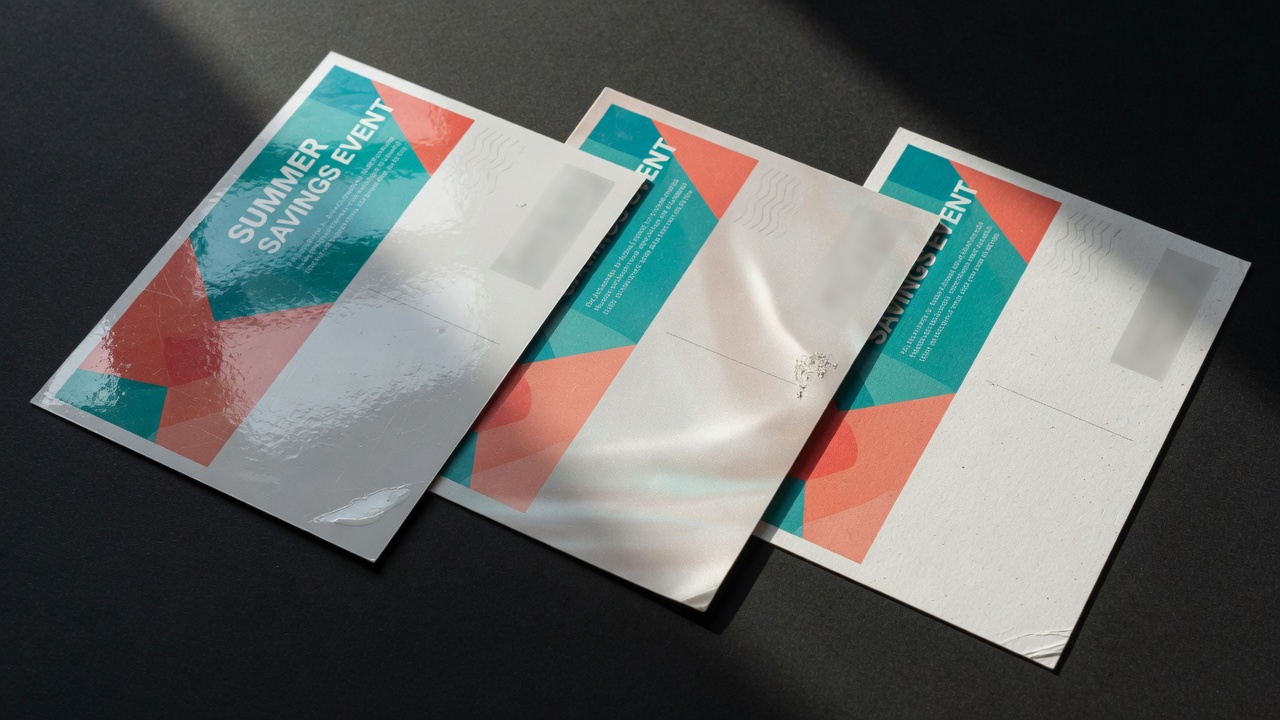
Gloss vs silk vs uncoated mailers comes down to three jobs the sheet still has to do after it leaves press: take an inkjet address, survive trays without scuffing, and stay readable in glare. Gloss protects photos. Silk lowers sheen. Uncoated writes and addresses. Flood UV on the address side is how campaigns stall.
That is the spec. Sheen is not a brand personality. It is a film, or the absence of one, sitting on the face a lettershop has to print and a carrier has to read. I estimate these jobs at Avanti Printing, 15321 Barranca Pkwy, Irvine, CA 92618. We print postcards and self-mailers that originate here and travel Orange County and the rest of California. Call (949) 387-0787 if you already have a dummy. Quotes still confirm size, material, quantity, finish, and date. Postage is a separate USPS charge.
If you came here from a catalog of “premium coatings,” ignore the adjectives. The address side either accepts water-based inkjet or it does not. The image side either shrugs off tray edges or it rubs. The recipient either sees the photo or sees a mirror. Write those three tests on the purchase order. Then pick gloss, silk, or uncoated — and decide whether aqueous or UV flood is even allowed on that side.
Who this is for in Irvine, Orange County, and statewide California
This page is for the person who signs a print-and-mail estimate: a marketing manager in Irvine Spectrum, a medical group mailing recalls from Tustin, a broker dropping listings from Newport Beach to Santa Ana, a restaurant group along the 405, a dealer in Anaheim, a campus office near UCI, or a statewide brand that wants one origin on Barranca Parkway. It is not a business-card coating lecture. Wallet cards and letter trays are different abuse tests. It is not a rack-flyer spec either. A flyer that never sees a sorter can flood UV on both sides and look expensive. A mailer cannot always.
You should read this if any of the following is true. You flooded UV both sides because the proof looked like a magazine. You asked for inkjet addresses on a skating-rink gloss. You wanted recipients to jot a date on the back and then coated that back. You picked silk because someone said it was “more premium than gloss,” then the lettershop said the heads would not wet the sheet. You are mailing a folded piece and the glue flap is sitting on varnish. You are comparing a 14 pt C2S gloss card to a C1S sheet and you do not know why the estimator keeps talking about the uncoated side.
If the piece is a leave-behind at a booth, coating is a tactile choice and USPS almost does not care. If the same art goes into trays, every film on the address panel starts to cost money or reprints. The buyer who specs the address side first controls the budget. The buyer who only picks a pretty sheen finds out at the inkjet base — or in a hot gaylord in an Orange County yard in August.
Format still matters, but this article is not a size chart. Size, caliper, and postage class live on a different spec. Here the question is the surface. We print postcard mailers with mail-safe coatings from Irvine every week. We also print brochures that mail in envelopes or as folded pieces. Envelope-enclosed work has more coating freedom because the address lives on the envelope. Self-mailers and postcards do not get that luxury. If you only need a handout, we print flyers that can take a full gloss or UV flood on both sides because nobody is spraying an Intelligent Mail barcode on the back of a counter stack.
Spec the address side first, then pick sheen
Start every mailer coating conversation with the addressing method, not the hero photo. The photo can live under gloss, silk, dull aqueous, or even UV if that side never sees a print head. The delivery address, the ZIP+4, and the Intelligent Mail barcode have to print, dry, and stay high-contrast through induction. That is a materials problem. Treat it like one.
Choose the addressing path before you choose the mill sheet:
- Inkjet at the lettershop or in our mail prep: the address panel must be absorbent or genuinely inkjet-receptive. Uncoated paper is the honest answer. A tested inkjet-receptive aqueous can work. Standard gloss aqueous is a maybe that we proof on the real stock. Flood UV, film laminate, and soft-touch films are a no unless you switch to labels.
- Imaged with the job (variable data on the same pass as the rest of the color): you can coat after the addresses only if the coating does not bury barcode contrast and does not fill the bars. Most UV floods after inkjet are a bad idea. A light aqueous over toner or pigment is a lab test, not a slogan.
- Laser or toner addressing: some coated covers fuse, some shed toner in the tray. We test. Do not assume office-laser paper behavior on 14 pt C2S gloss.
- Paper labels: ugly on a full-bleed photo, reliable on a two-sided UV card. A white label on a dark UV face is honest. A smeared inkjet on UV is not a style.
Once the address path is locked, pick sheen on the image side. Gloss if the job is photography and the piece will be handled in stacks. Silk if the offer has a lot of type, a map, or will be read outdoors. Uncoated if someone has to write, stamp a form, or if you want the piece to feel like stationery instead of a retail insert. You can split the two sides. A gloss or silk face with an uncoated back is not a compromise. It is how a lot of California mail should have been specced in the first place.
USPS does not publish a coating brand list. It publishes machinability, thickness, and the requirement that the face can be read at speed. Physical standards for commercial letters and cards are in USPS Quick Service Guide 201. Design and automation layout, including the face the camera actually sees, are summarized in USPS Quick Service Guide 201a on designing letters and cards for automated processing. If a coating makes the barcode unreadable or the piece too slick, rigid, or thick, the guide wins and your finish book loses.
Coat the picture. Leave a working paper surface for the address, the barcode, and any write-back. If those two jobs fight, the address wins. A beautiful card that the sorter cannot read is scrap with good photography.
Gloss vs silk vs uncoated at a glance
These are typical industry behaviors, not a promise that every mill’s “silk” is the same film. We still run a dummy. Use the table to stop arguing from adjectives.
| Surface | What it actually is | Inkjet address | Ballpoint / write-back | Tray scuff | Glare | Photo saturation | Watch-outs |
|---|---|---|---|---|---|---|---|
| Gloss aqueous (AQ) | Water-based flood, high sheen, thin film | Sometimes; test the real sheet | Poor; ink sits and smears | Good for a mailer film | High, especially on dark photos | High | Not automatically inkjet-safe; fingerprints show less than silk |
| Silk / satin / dull AQ | Same family as gloss AQ, lower sheen | Sometimes; often worse than gloss AQ | Poor | Medium to good | Low to moderate | Medium-high; slightly softer than gloss | People call it uncoated. It is not. Still a film. |
| Uncoated cover or C1S back | No film; fibers take liquid | Excellent if the sheet is sized for inkjet | Excellent | Ink can rub; stock can scuff and pick | None to speak of | Lower; ink sinks, colors dry back | Lint in inkjet, duller photos, more show-through on thin sheets |
| Gloss UV flood | UV-cured hard film, high build | Fails. Droplets bead. | Fails | Excellent until sheets block in heat | Harsh | Highest “magazine” look | Adds caliper; glue and tabs often fail; OC heat blocking |
| Matte / satin UV flood | Same UV chemistry, low sheen | Fails | Fails | Excellent | Low | Medium | Still a hard film. “Matte” does not mean writable. |
| Press varnish | Oil or AQ varnish from a print unit | Unreliable | Poor | Fair | Depends on gloss level | Slight pop | Slow dry on oil; can yellow; not a UV substitute |
| Film laminate (gloss, matte, soft-touch) | Plastic film glued to the sheet | Fails without labels | Fails | Best scuff if it does not peel | Gloss laminate glares; soft-touch fingerprints | High | Caliper, rigidity, glue, recyclability, mail heat |
| C1S gloss or silk + uncoated back | Mill-coated face, raw back | Excellent on the back | Excellent on the back | Face protected; back behaves uncoated | Face can still glare | High on the face | Back-side color looks flatter; plan the layout around that |
Read the silk row twice. Silk is the coating that causes the most expensive vocabulary fights. Designers say silk when they mean uncoated. Mills say silk when they mean a low-sheen aqueous. Lettershops say silk when they mean “this still rejected the inkjet.” If the quote does not say aqueous silk flood, mill-run silk cover, or uncoated, you do not have a spec. You have a mood.
Aqueous, UV flood, varnish, and film: what coating actually is
Gloss and silk describe sheen. Aqueous, UV, varnish, and laminate describe the chemistry that makes that sheen. You need both words on the ticket. “Gloss mailer” can mean a gloss mill sheet with no extra flood, a gloss aqueous, or a gloss UV. Those three pieces do not behave the same in a tray or under a print head.
Aqueous coating (AQ)
Aqueous is a water-based flood, usually applied in-line with a blanket coater after the inks. Typical industry solids sit in a rough 35 to 45 percent range depending on the product; the rest is water that has to leave the sheet. Heat and air do that work. AQ dries faster than oil varnish, smells less, and is the default protective flood on a lot of commercial cover work in this plant.
Gloss AQ raises sheen and helps rub. Silk, satin, and dull AQ use matting agents to cut that sheen. The film is still there. It still closes pores. It still can hold out a water-based inkjet droplet so the droplet sits on top, looks wet, and then smears in the transport belts. Some AQ formulas are sold as inkjet-receptive. Those are specific products. “We aqueous coated it” is not a synonym for “the lettershop can spray addresses.” If the job needs inkjet on an AQ side, we test that mill’s coating on that caliper with that inkjet. A pass on 80 lb text last year does not certify 14 pt cover this year.
AQ adds very little caliper compared with UV. That matters if you are hugging a 0.016 inch card-price ceiling. It also matters less than people think: a 16 pt sheet can still walk over the limit with two-sided UV, not with a normal AQ flood. For most 4×6 and 6×9 mailers that must stay in a card-price thickness window, AQ is the adult protective coat. UV is the upgrade you buy only on the image side, and only after you have a plan for the address.
AQ is not armor. Aggressive tray edges, rubber bands, and a night in a hot truck will still mark a dark gloss AQ panel. It just marks less than raw ink on uncoated cover. If the art is a full-bleed black photo on both sides, even AQ will show rub. Design a quiet area. Or accept that mail is a physical process.
UV flood and spot UV
UV coating is a 100 percent solids film cured by lamps. It does not dry by evaporation. It hardens. Gloss UV is the high-build, high-glare, magazine-cover look people mock up in a PDF and then want on 25,000 postcards. Matte UV exists. It cuts glare. It is still a hard, closed film. Recipients cannot write on it. Inkjet will not drink it. Glue flakes off it. Calling matte UV “like uncoated” is how you reprint.
Flood UV means the whole side. Spot UV means selected areas — a logo, a photo well, a headline — with the rest of the sheet left AQ or raw. For mail, spot UV on the image side is often the grown-up version of the magazine mockup. You get the pop where the camera is supposed to look. You leave paper where the heads, the tabs, or the glue need to work.
UV adds caliper. A nominal 16 pt sheet that already sits near 0.016 inch can read 0.017 or more after two-sided UV. Card-price postage dies at 0.016 inch on the finished piece, not on the mill’s nickname for the stock. Measure a coated dummy. Do not argue from the swatch book. UV also adds stiffness. “Too rigid” is a nonmachinable trait on letter-size mail. A board-like 18 pt plus two-sided UV 6×11 can process worse than a flexible 14 pt AQ card. We would rather tell you that on the estimate than after a 20,000-piece run.
Orange County heat is unkind to UV-on-UV stacks. Sheets block — they stick face to face — in a hot gaylord, a closed trailer, or a warehouse without the air conditioning a studio has. Aqueous on the address side and UV on the image side is a common split for that reason, not because estimators enjoy extra steps. If you insist on UV both sides, plan slip-sheeting, smaller lifts, climate, and labels for the addresses. Budget that. Do not surprise the mail dock on a Friday before a Monday drop.
Press varnish
Varnish from a print unit is older chemistry. Oil varnish dries slowly and can yellow. Aqueous varnish sits closer to a light AQ. Neither is a substitute for UV scuff resistance. Both can still ruin inkjet if you flood the address panel. I spec varnish when we need a slight rub-up on a side that will not be addressed and UV would be overkill or a caliper problem. I do not spec varnish because a file is named “varnish_overlay.pdf” and nobody wants to delete a layer.
Film laminate and soft-touch
Laminate is plastic film, not a coating flood. Gloss, matte, and soft-touch (velvet) films all kill inkjet and ballpoint. Soft-touch also fingerprints and scuffs in a way that looks like a dirty suede in trays. It can be the right finish for a leave-behind folder. It is usually the wrong finish for a self-mailer. If the campaign needs that tactile, put it on the piece that does not get sprayed, tabbed, or glued, and keep the mailer on a saner film.
Laminate adds caliper and can push rigidity. It can also peel at corners in high-speed equipment if the bond is cheap. I will quote it when the job is a non-mailed handout or when addresses will be labels. I will push back when the same laminate is supposed to take a 600 dpi inkjet address in a pale knock-out that does not exist.
Inkjet addressing: droplets, holdout, and barcodes
Most California jobs in the quantities this page cares about are inkjet addressed after press. The heads throw water-based dye or pigment. The sheet has to take that liquid, let it set, and hold a barcode the camera can score. Coatings are designed to do the opposite of that: hold ink out so process color sits on top and looks glossy. Those two laboratory goals are not friends.
On uncoated cover, droplets wick into fibers. Bars look slightly fuzzy at a loupe and still read, because they are dark on a light, matte field. On a closed gloss or UV, droplets stand up, merge, and then skate when a belt kisses the surface. Heat slows drying. Southern California summer trays are a drying-time problem sitting on top of a holdout problem. Heat is not the root cause. The root cause is varnish under the heads. Heat just makes a marginal spec fail in Anaheim instead of in the lettershop.
Barcode readability is a contrast problem as much as a wetting problem. USPS automation wants a light background and dark bars with enough reflectance that the camera is not guessing. A navy full-bleed address side with black inkjet looks premium in InDesign and looks like mud to an optical reader. Gloss on that navy adds specular bounce that can make the camera’s life worse, not better. Keep the address panel pale — uncoated stock color, a light AQ tint, or a knock-out to paper white. Put the brand flood on the front. If the brand is dark on both sides, you are designing a reject.
Quiet space around the Intelligent Mail barcode is part of the coating window, not a typography nicety. If you knock out a coating hole the size of the address lines and leave the barcode bars printing half on UV, those bars fail. The window has to include the quiet zone, a margin for registration error, and a little extra because coaters are not die-cutters. I would rather see a larger pale panel than a clever, tight halo around the type.
Inkjet-receptive AQ is real chemistry. Some products take the droplet, lock it, and still give you a sheen. They are not all gloss levels, they are not compatible with every plant’s inkjet, and they are not free. If you want that path, say so on the quote and we will name the coating, not a generic “gloss.” Then we still print a few hundred test cards through the actual inkjet before you own 40,000 sheets.
Do not “fix” a bad coating with a heavier inkjet throw. More water on a closed film makes a bigger smear. Do not fix it with a darker flood behind the address. Do not fix it by rotating the card so the heads print with the grain of the scuff. Fix it by changing the surface or changing the addressing method.
Knock-outs, C1S sheets, and labels
There are three honest ways to give inkjet a place to live on a coated mailer. Pick one on purpose.
Mill C1S — coated one side
C1S is a mill sheet with a coated face and an uncoated back. It is the least dramatic solution and the one I recommend most for photo-front postcards that will be inkjet addressed. The face can be gloss or silk mill coating, plus an extra AQ or even spot UV if we stay off the edges that scuff into the back of the next card. The back is paper. Inkjet drinks it. Ballpoint writes. A doctor’s office can check a box. A homeowner can circle a date.
The cost is visual. Process color on the uncoated back dries back — it looks flatter and slightly dirtier than the same file on C2S. Design for that. Use stronger type, fewer subtle greys, and a layout that does not depend on a photographic wash on the address side. A pale panel with black type is the point of the back, not a second hero image. If both sides must be photographic, C1S is the wrong sheet and you need a knock-out on C2S, or you need to image addresses before a compatible coat, or you need labels.
Coating knock-outs on C2S
C2S is coated two sides at the mill. You can still flood AQ or UV on press and hold a window out of that flood with a coating plate. That window should be bigger than you think. Include the OCR read band, the IMb, quiet space, and a registration pad of at least 1/8 inch, preferably more on a flood UV. A 2-inch postage-stamp hole is not a window. The heads will print on varnish at the edges, and the first and last bars die.
Knock-outs have to land on a light field. Knocking out UV over a 80 percent navy still leaves a dark, possibly sealed mill coating. The mill coating on C2S is already a film. Some C2S mill coatings take inkjet; many take it poorly. If the knock-out reveals gloss C2S instead of uncoated fiber, you have only solved the UV problem. You may still have an inkjet problem. That is why a dummy through the real heads matters more than a PDF with a white rectangle labeled “address.”
Tell the designer the window is a production object, not negative space to fill with a texture. No 5 percent yellow wash “for warmth.” No faint logo behind the ZIP. No security pattern. Those tricks drop contrast. They also make a failed barcode harder to diagnose because everyone will blame the inkjet when the real culprit is a beige tint.
Labels
A white label is a portable uncoated panel. Use it when the creative already committed to two-sided UV, laminate, or a dark full-bleed and the drop date will not survive a redesign. Expect it to look like a label. Do not ask us to match a gloss UV with a dull label and then complain that you can see the edge. You can see the edge because the piece is honest about its materials.
Label stock has to stay on in heat and belt friction. Cheap office labels curl. Mail labels are a different adhesive. If the job is 6×9 cards with UV both sides into August, I would rather you budget mail-grade labels than a heroic inkjet test that fails on card 400.
Scuff, blocking, and Orange County heat
Mail is not a coffee-table book. Cards ride in trays, then in sacks or tubs, then in a vehicle that may sit in a Santa Ana parking lot. Edges rub. Ink on an uncoated sheet can burnish. Gloss AQ usually wins that fight. Uncoated loses it on dark solids. UV wins scuff and then loses in a different way: blocking, where the film on one card grabs the film on the next.
Blocking loves three things: UV flood against UV flood, pressure from a tall lift or a strapped tray, and heat. Orange County gives you the heat for free from late spring through fall. Inland yards are worse than a climate-controlled plant. If your mail sits overnight in a closed trailer after induction, that is part of the coating spec. I cannot control USPS equipment. I can stop you from stacking two wet-looking UV faces against each other with no slip sheets and no AQ on one side.
A practical split that survives this climate:
- Image side: gloss AQ, silk AQ, or spot UV on a silk or gloss AQ field.
- Address side: uncoated (C1S) or a tested inkjet-receptive AQ, knock-out large enough for the block.
- Avoid: UV both sides plus inkjet; soft-touch both sides; film laminate plus tabs; dark full-bleed uncoated solids that will scuff into a black smear on the next card.
Scuff is also a bindery problem. Guillotine clamps mark silk and soft-touch more visibly than gloss. Trimmer dust sticks to AQ if the coat is under-cured. If you see clamp marks in the first 200 cards, stop. That is not “character.” That is a lift that will look worse after 15,000 more cuts. We adjust clamp, wait for cure, or change the coating. We do not ship a marked run and hope the trays hide it.
Uncoated scuff looks different: fibers polish, ink rubs, and a dark panel becomes mottled. If you need an uncoated back for write-back, keep large dark floods off that back. Type, rules, and a light tint survive handling. A full-bleed charcoal photograph on uncoated cover will look handled before it leaves Irvine.
Rubber bands, too-tight trays, and dragging a handful of cards across a concrete floor will defeat every coating. I still spec the coating for the handling we can predict: bindery, inkjet belts, tray sides, summer heat. If your field team is going to toss bundles onto a truck tailgate, say so. We might move you from uncoated to AQ on the face even if the mockup was “natural paper.”
Glare, photography, and codes on the face
Gloss is a lighting problem as much as a printing problem. A gloss photo under a press-viewing booth looks rich. That same card in a metal mailbox, on a Spectrum windshield, or in a carrier’s hand at noon on Barranca Parkway becomes a mirror. Recipients photograph offers. They scan QR codes. They read a phone number while standing outside. Silk exists for those people, not for designers who are tired of gloss.
Use gloss when the piece is mostly image, will be seen indoors, and you want maximum saturation: restaurant food photography, a listing photo that has to compete on the kitchen counter, a product shot. Use silk when the piece is mostly type, a map of Irvine Company villages, a schedule, a bilingual block, or a QR that must scan in sun. Use uncoated when glare would be an insult — a form, a clinical notice, a piece that should not look like advertising even when it is.
QR codes fail on gloss for two reasons. Specular reflection blinds a phone camera. Low contrast (grey code on a photo) fails even on silk. Give the code a quiet, light, matte nest. That nest can be uncoated paper, dull AQ, or a knock-out. Do not put a QR on a full-bleed gloss sunset and then tell the brand the printer “made the code too small.” Size matters. Surface matters more than people budget for.
Carriers read the address, not your headline. If the address side is gloss over a busy photo, you have built glare into the one panel the Postal Service has to see. That is backwards. Even when inkjet will physically mark that gloss, the camera and the human both prefer a dull, light field. Sheen belongs on the marketing face.
Indoor glare is real too. A 6×11 letter-card on a receptionist desk under LEDs can be unreadable at a shallow angle if the flood is gloss UV. Silk AQ or a dull mill coating keeps the offer visible without forcing someone to tilt the card like a windshield. If the mailer is meant to live on a counter for a week — dental recall, service reminder, school date — I would rather lose a little photo pop than lose the date in a hotspot.
Uncoated write-back and reply panels
Write-back is the uncoated job nobody remembers until the client tries to pen a date on UV. Typical uses: RSVP, a circled appointment, a survey checkbox, a technician’s note, a real-estate open-house time written in by an agent, a parent initialing a school flyer that was also mailed, a medical form that should not require a Sharpie. If any human is supposed to mark the piece after it arrives, that panel must be uncoated or a true writable stock. Silk is not writable. Matte UV is not writable. Soft-touch is not writable. Aqueous dull is not writable. I will keep saying that until the mockup stops showing a lined form on a coated back.
Ballpoint needs fiber. It needs tooth. Coating fills tooth. Recipients will press harder, skip, and then smear the still-wet ink with a thumb. If you print “write your email here” on gloss AQ, you printed a decoration. Move the form to an uncoated back, a C1S sheet, or a separate reply card that is actually paper.
Reply cards that mail back have two surfaces to worry about. The side the recipient writes on must take pen. The side that carries the return address and barcode must still meet automation contrast. You can do both on uncoated. You can do a C1S reply card with the writable side uncoated and the return-address side mill-coated only if that coated side still takes the return inkjet or is preprinted. Do not UV the return face of a reply card. You will get pretty cards that cannot come home.
Pencil, stamp-pad, and some hospital markers behave differently than ballpoint, but they all fail on UV. If a clinic wants to rubber-stamp a received date, that is an uncoated spec. If a field tech needs to sign a carbonless pack, that is a different product than a coated mailer. Do not invent a hybrid on press because the campaign calendar is tight. Tight calendars are how writable panels disappear from the coating plate.
Uncoated also changes color management. Expect dry-back. Reds go brick. Dark blues go dusty. Photographs look like they were printed on stationery, because they were. That can be the right voice for a letter from a school, a civic notice, or a law office. It is the wrong voice if you sold the client a liquid, high-chroma food shot on both sides. Split the job: coated face, uncoated write-back. That split is a layout decision in week one, not a coating checkbox in week four.
Self-mailers: glue, tabs, and fold cracking
A self-mailer is a folded piece that carries its own address. It is not an envelope job. Coatings that make a postcard look finished can make a self-mailer fail in three mechanical ways: glue does not stick, tabs do not stick, and the fold cracks through ink and film.
UV flood on a glue flap is a classic fail. Most wafer seals and many glue lines want paper fiber or a compatible AQ, not a cured UV skin. If the interior panel that receives glue is UV, the flap lifts in trays and the piece becomes a nonmachinable bird. Keep glue zones uncoated or AQ as the adhesive manufacturer specifies, and keep those zones off the coating plate. The same is true of tab positions on the top and leading edge. USPS tab rules care about location and number. Chemistry cares about whether the tab adhesive grabbed anything. Both have to be true.
Fold cracking shows up on heavy cover with heavy ink and a hard coating. The sheet is asked to fold after the film has already locked. Gloss UV on a 14 pt or 16 pt fold line will hairline, then show a white crack through a dark panel. Silk AQ cracks less than UV and more than a raw sheet. Workarounds we actually use: score before fold, grain parallel to the fold, stay off ultra-heavy cover if the piece must fold tightly, knock coating off the score, or move the dark flood away from the break. A dummy that is scored, folded, and rubbed is worth more than a debate about which silk is “flexible.”
I am not going to walk you through panel counts or bindery styles here. That is a different job. What belongs on this page is simpler. If the mailer folds, the coating diagram must show glue, tabs, scores, and the address panel as four objects, not as one “overall gloss.” If those objects collide, the fold and the address win. The photo can live on the panels that do not have to stick or get sprayed.
Pieces that mail inside envelopes have more freedom. The envelope takes the inkjet. The brochure inside can be gloss, silk, or even UV if it still folds without cracking and if it will not block in the envelope in heat. That is why enclosed California brochure printing and a self-mailer built from similar art are not the same coating ticket. Copying the brochure finish onto the self-mailer is how the glue flap shines and then lets go.
Handout flyers from our Irvine plant can take the aggressive finish the mailer cannot: two-sided gloss UV, heavier build, no knock-out. If the same PDF is supposed to be a rack flyer and a mailed letter-size piece, you have two products. Say so. We will coat them differently and you will not put the UV stack through the inkjet by mistake.
Stock, caliper, and which side is which
Finish sits on a stock. Naming the coating without naming the sheet is how 80 lb uncoated text gets asked to behave like 14 pt C2S. Typical mailer conversations in this plant:
- 14 pt C2S with gloss or silk AQ, knock-out or C1S alternative, for 4×6 and 6×9 cards that must stay under 0.016 inch finished.
- 16 pt C2S with AQ only, or UV on the image side only, when you want a stiffer card and you have measured the dummy against the card-price ceiling.
- 100 lb or 80 lb uncoated cover when write-back and inkjet both matter and photos can live with dry-back. Watch the 0.009 inch minimum on jumbo sizes; some uncoated covers are bulky, some are not. Micrometer, not the basis-weight name.
- C1S 10 pt to 14 pt for photo-front, write-back-back mailers. Confirm the uncoated side is truly uncoated, not a light mill seal that still rejects pen.
- Text-weight self-mailers (70 lb to 100 lb coated text) with AQ, grain and score specified, UV reserved for spots that are not on folds or glue.
Those calipers are nominal. Coatings, humidity, and mill lots move the number. Card prices care about the finished inch reading. Letter-size pieces that are more than 4-1/4 inches high or more than 6 inches long need at least 0.009 inch. UV can help you on the low side and hurt you on the high side. AQ rarely saves a too-thin sheet. Uncoated bulk can save a too-thin jumbo if the mill is a bulky sheet — or it can push a thick cover into a rigidity conversation. This is why the quote lists stock and finish as two lines, not one “gloss postcard” bundle.
Curl is a coating problem. Heavy AQ or UV on one side of a C1S sheet will pull. Inkjet then misregister or the tray jams. We balance coats, or we pick a more stable sheet, or we let the uncoated side stay uncoated and accept the curl we measured on the dummy. A PDF cannot show curl. The dummy can.
If you already know trim and only need production on cards, start from our Irvine postcard printing and mail prep and bring the coating split with you: face finish, back finish, addressing method. Do not write “gloss” in the subject line and assume that specified anything.
Files, coating plates, and the dummy we run
Send a print-ready PDF with fonts outlined or embedded, images at production resolution, 0.125 inch bleed, and live matter pulled back from trim. For a coated mailer, also send a coating diagram. That is a separate page or a spot-color layer that shows floods, knock-outs, glue flaps, tab zones, and the address panel at final size. A pretty front with “address TBD” in the middle of a photo is not a mail file. A single PDF where gloss, UV, and paper white are all the same CMYK yellow is not a coating file.
Build knock-outs as a true spot, not as a white CMYK box that might overprint. Name the spot something a pressroom will not guess at: COAT_KNOCKOUT, not “Layer 18.” If UV is spot, not flood, show the UV as its own spot. If the address will be inkjet later, put a dummy address in position, in black, on a pale field, with the barcode area indicated. We will not typeset your variable data from a screenshot in a Slack channel.
Color on uncoated backs should be tagged as uncoated in the conversation even if the file is one CMYK PDF. We proof that side knowing it will dry back. Do not approve a coated proof and then ask why the uncoated back looks tired. That tired look is physics. If it is unacceptable, change the stock, not the invoice.
The dummy is the job. A contract-quality proof of the static art plus a data proof of first and last records plus a physical dummy on the actual stock with the actual coating, run through the actual inkjet if we have it, or at least marked with a compatible water-based pen as a crude first fail. The dummy answers caliper, curl, scuff, glue, tab, glare, and write-back in one object. For a California drop with a hard in-home window, dummy time is part of the schedule. Do not squeeze it the afternoon before trays are due.
If the campaign also needs a non-mailed leave-behind, split the purchase order. Handouts can flood UV both sides. Mailed cards cannot always. Mixing those specs on one job ticket is how the wrong lift gets addressed.
Request a mailer coating quote
Mistakes that reprint a coated mailer
These are the repeats. They come from good agencies as often as from files built in a word processor.
- Flood UV both sides, then a purchase order note that says “inkjet addresses.” The UV wins. The addresses smear. The drop date dies.
- Calling silk “uncoated” on the ticket. The lettershop treats it as paper. It is a film. The heads disagree with the ticket.
- A coating knock-out the size of the address lines with no quiet zone. Bars print on varnish. Automation prices leave the building.
- Dark full-bleed on the address side, even uncoated. Contrast dies, glare dies, scuff shows.
- Write-in lines on silk AQ. Recipients cannot write. The form was decoration.
- Glue flap on UV. Self-mailer opens in the tray.
- Tabs on laminate or UV. Tabs decorate instead of seal.
- 16 pt plus two-sided UV on a job that must stay under 0.016 inch. You bought letter postage with a coating upgrade.
- Soft-touch on a mailer that will be handled in stacks. Fingerprints and rub become the finish.
- QR code on a gloss sunset. Phones see a highlight, not a module.
- Approving a coated proof for an uncoated back. Color shock at delivery is not a press error.
- One PDF for a rack flyer and a mailed card, one coating for both. The flyer looks right. The card cannot be addressed.
- Asking us to “just use labels if inkjet fails” after the run is already UV both sides, without label real estate in the layout. Then the label covers the phone number.
- Locking an in-home date before anyone coated a dummy. AQ, UV, and inkjet each take calendar time. Cure time is not a rumor.
Reprints are worse than a stock change on the first pass. Once inkjet hits flood UV, that sheet is scrap. Once 15,000 self-mailers are glued to varnish, you do not have a mailing, you have a bindery rescue. Send the dummy. Send the addressing method. Send the coating diagram. That is slower than clicking approve on a PDF. It is faster than reprinting.
What to send for a quote
Write one email or use the form with the facts a plant estimates from. Sheen adjectives do not change holdout.
- Finished size and whether the piece is a card, a folded self-mailer, or enclosed in an envelope.
- Quantity, and whether this is a test or the full drop.
- Stock: 14 pt C2S, 16 pt, C1S, 100 lb uncoated cover, or “recommend for inkjet and card-rate caliper.”
- Finish per side: gloss AQ, silk AQ, UV flood, spot UV, uncoated, laminate. Say which sides. Say knock-outs.
- Addressing method: inkjet, labels, imaged with the job, or print only.
- Write-back: yes or no, and where on the piece.
- If it folds: glue, tabs, score, and which panels may not take UV.
- Mail class you want to buy, list count, and in-home or drop date — wish versus contract.
- Files: both sides, coating diagram, or a note that design is still open.
We confirm size, material, quantity, finish, and date on every quote. If postage is included, it is shown as postage. If postage is yours, the finish still has to leave a readable, legal piece. Avanti Printing is at 15321 Barranca Pkwy, Irvine, CA 92618. (949) 387-0787. The quote link on this page is the same form we use for commercial printing work across California.
FAQ: gloss vs silk vs uncoated mailers
Can I inkjet addresses on a gloss mailer?
Only if that gloss is a tested, inkjet-receptive aqueous or a mill coating we have run, or if you knock out a large uncoated or receptive panel. Standard gloss UV is a no. Many gloss AQ floods are a no until they pass a live inkjet test. C1S with the gloss on the face and paper on the back is the clean answer. Labels are the honest answer when the face and back are already sealed.
Is silk the same as uncoated?
No. Silk, satin, and dull are low-sheen coatings. They still lay down a film. They still reject a lot of inkjet and almost all ballpoint. Uncoated is fiber with no film. If someone writes “silk/uncoated” on a spec, I will split it into two lines and make them pick. Originating the job in Irvine does not change the chemistry.
Will flood UV survive Orange County heat in trays?
UV survives scuff. It does not always survive UV-on-UV pressure in heat. Blocking is the failure: cards stick, then pick when they separate. Aqueous on one side, smaller lifts, and not leaving strapped UV stacks in a hot trailer are the mitigations. Heat also keeps inkjet wet on a closed UV face, which is a second reason not to spray addresses on flood UV in summer.
Do I need uncoated if nobody writes on the card?
Not for writing. You may still need an uncoated or receptive panel for inkjet and barcode contrast. If addresses are imaged on press and the coating will not bury the bars, a coated-only card can mail. If a lettershop will inkjet after UV, you need paper or a label even if no recipient ever holds a pen.
Should a photo postcard be gloss AQ or UV?
Gloss AQ is the default mail-safe pop. UV on the image side only is the upgrade when you want a harder scuff layer and you have measured caliper. UV on both sides is for handouts, or for mailers that will be labeled, not inkjetted. Silk AQ is the better photo-and-type compromise when the card will be read outdoors or under harsh indoor light. I will not put UV on the address side to make a proof look wetter.
Can I coat a self-mailer and still glue or tab it?
Yes, if glue and tab zones are left uncoated or on a compatible AQ, and if those zones match USPS tab locations. UV in the glue zone is how flaps open. Laminate in the tab zone is how tabs decorate. Put the aggressive finish on the panels that do not have to stick. Score and grain still matter so the fold does not crack the coat.
Does coating change postage?
Coating does not have a postage line of its own. Thickness, rigidity, and readability do. Two-sided UV on 16 pt can push you over 0.016 inch and out of card prices. A too-stiff laminated letter can pick up a nonmachinable problem. An unreadable barcode can lose automation prices. Measure the finished dummy and keep the address readable. Do not treat “UV upgrade” as free relative to postage.
How do I get a coating spec quoted at Avanti?
Send finished size, stock, quantity, finish per side, addressing method, write-back needs, fold/glue/tab notes, mail class, list count, and date. Use the quote form or call (949) 387-0787. We will confirm size, material, quantity, finish, and date in writing. Walk-in gloss postcards for a front desk and 25,000 inkjet-addressed 6×9 cards are not the same estimate.
Coat the side that can still be mailed
Gloss vs silk vs uncoated mailers is a split-surface problem. Gloss and UV earn their keep on the photograph. Silk earns its keep where glare would hide type or a code. Uncoated earns its keep under inkjet heads, pens, glue, and tabs. Aqueous is the usual protective flood that still leaves you a chance at addressing. UV flood is a hard film you apply on purpose, on one side, after the address plan exists. Mix those up and you reprint, or you pay someone to apply 20,000 labels on a card that was supposed to look like a magazine.
Khalid, Avanti Printing, Irvine. Bring a dummy if you have one. Bring a coating diagram if you have that. We will tell you which side can take the film and which side still has to be paper. Then we will print the version that leaves the dock.