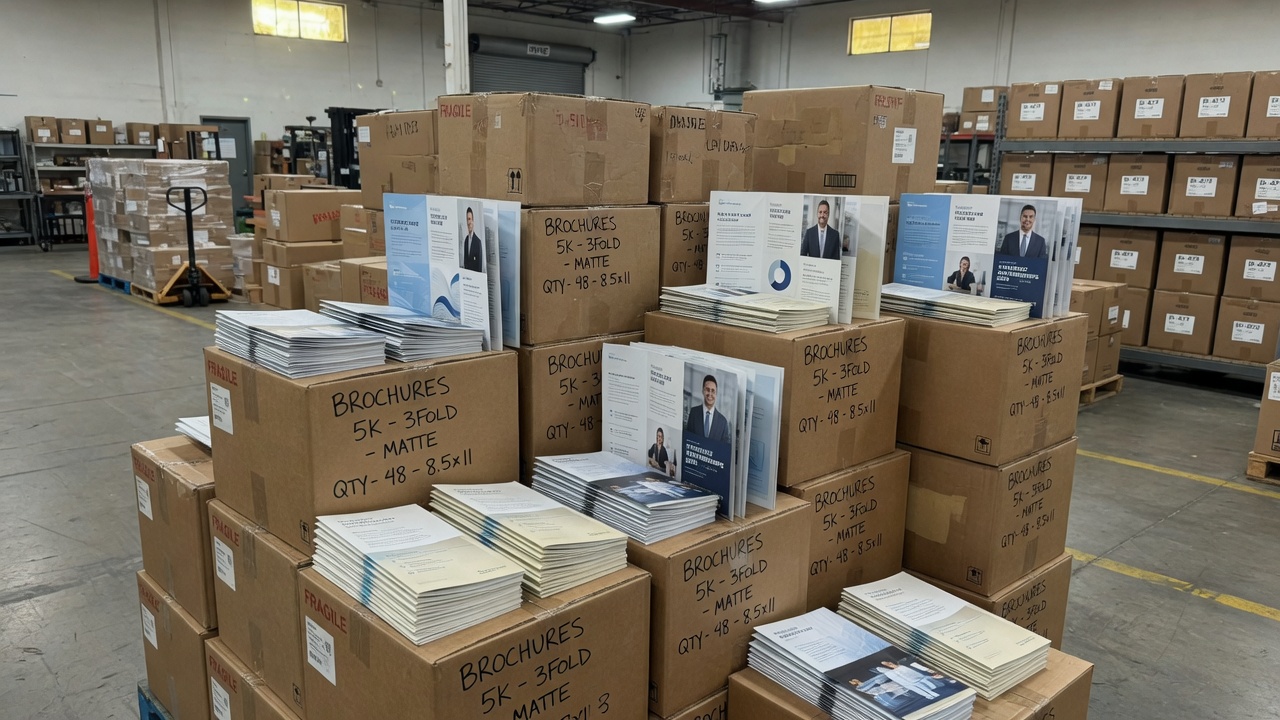
How many brochures to print for a California sales team is not a round number. Count heads, months of use, versions, and events, then add a short buffer. Under 500 copies, digital usually wins. Around 1,000 to 2,500, offset starts to compete on unit cost. Overprint is waste when prices, SKUs, or reps change.
That is the spec. Quantity is a planning problem, not a pressroom superstition. I estimate these jobs at Avanti Printing, 15321 Barranca Pkwy, Irvine, CA 92618. We print sales collateral that leaves this plant and lives in trunks, Spectrum reception desks, Anaheim show aisles, and offices from San Diego to Sacramento. Call (949) 387-0787 if you already have a dummy and a headcount. Quotes still confirm size, material, quantity, finish, and date. A pretty unit price on 10,000 copies is not a plan if 6,000 of them will be wrong in ninety days.
If you came here from a “standard quantities” dropdown, ignore the dropdown. 250, 500, 1,000, and 2,500 are manufacturing buckets. They are not demand. Demand is how many pieces a named person will actually hand out before the file is stale. Write that number on the purchase order. Then pick digital or offset — and decide whether you are buying one version or eight.
Who this is for in Irvine, Orange County, and statewide California
This page is for the person who signs a collateral estimate: a sales VP in the Irvine Business Complex, a regional manager with reps in Tustin and San Diego, a medical-device team that works hospitals and IDNs, a commercial broker covering Newport to Santa Ana, a dealer group along the 405, a campus-adjacent vendor near UCI, or a statewide brand that wants one origin on Barranca Parkway. It is not a fold-style lecture. Panel count is a different ticket. It is not a bulk-flyer event spec. A rack flyer that dies after Saturday is a different waste problem than a priced sales story that has to survive a quarter. It is not a catalog press comparison. If the piece needs a spine and a page count, that is another product.
You should read this if any of the following is true. You ordered 5,000 because the unit cost looked serious. You printed each rep’s cell phone on the back and then two people left. You have English and Spanish files and treated them as one quantity. You stored last year’s price list in a garage in August. You are walking Anaheim Convention Center with a carton that is already the old SKU. You reprint 250 at a time and never add up the year. You were told “offset starts at a thousand” as if that sentence were a law. You need the same story in a leave-behind, a mailed envelope, and a booth kit, and you have not split those piles.
If the piece is a single un-folded sheet for a counter or a bag, quantity still matters, but the product is a flyer. We print one-sheet flyers when the leave-behind should stay a single panel. If the story needs many pages and a bind, you have left brochure math. We print bound catalogs when the story needs pages, not a brochure quantity. Those jobs have their own sheetwork and schedule. Do not force a catalog’s worth of SKUs onto an 8.5 by 11 folded piece and then blame the quantity when nobody can find the model number. For the actual folded or short-stitched sales piece, start with sales brochures printed for California field teams and bring versions and a use window, not a lucky integer.
The plant is in Irvine. The teams we print for are California teams: Orange County first, then Los Angeles, the Inland Empire, San Diego, and the rest of the state when one origin is the point. Heat, car trunks, office-park storage closets, and trade-show freight are part of the quantity, not color commentary. A carton that never leaves a climate-controlled warehouse is not the same object as a carton that rides in a Highlander on the 5 in July.
Count people, months, versions, and events — then pick a bucket
Start every brochure quantity conversation with four numbers, not with a press. People. Months the file will still be true. How many distinct PDFs you actually have. Events that are not the weekly call pattern. Add those. Then add a short buffer. Then look at digital versus offset. Doing it in reverse — picking 5,000 because a chart said unit cost drops — is how you buy landfill with a nice aqueous coat.
Use this as the planning surface before anyone opens a quantity dropdown.
| Planning number | How to count it | Typical California sales pattern | What inflates it | What should shrink it |
|---|---|---|---|---|
| Field supply | Reps × pieces per week × weeks the version stays accurate | A small OC team might move 8 to 20 pieces per rep per week if they are in rooms. Inside sales moves fewer physical pieces. | New hire ramps, ride-alongs, leaving extras “just in case” on every desk | QR-to-PDF as the deep spec; one piece per meeting, not a stack on the table |
| Event / show supply | Shows × expected conversations × 1.0 to 1.2, plus a small aisle-loss pad | Anaheim, local chambers, campus fairs, dealer open houses. One serious show can exceed a month of field use. | Filling bags for everyone who walks past; freighting a full carton “so we don’t run out” | A show-only one-pager plus a brochure for qualified stops only |
| Office / lobby / kit | Front-desk take rate × months, plus assembled kits you actually ship | Spectrum and IBC lobbies leak slowly. Kits for new reps and partner offices are lumpy. | A bowl of brochures by the candy; kits built for people who already have last year’s stack | A counted drawer, not an open bowl; kits issued against a roster |
| Mail enclosed (if any) | List count plus a small spoilage over (often around 1 to 3 percent, job-dependent) | A letter with a brochure inside is a mail quantity plus a field quantity. They are not the same carton. | Printing the mail drop and the field supply as one unsplit pile | Split the PO: mail lift and field lift, even if the PDF is identical |
| Versions | Count PDFs, not “the brochure.” Language, product line, region, partner co-brand, price table. | English/Spanish is common. So is a product-line split. So is a partner cover. | Treating eight 250s as one 2,000 | A shared interior with a short-run cover or a sticker panel for the part that changes |
| Buffer | A small pad on the largest real use case, not 40 percent on the whole year | 5 to 15 percent is a typical industry pad for spoilage, new hires, and a missed box. It is a range, not a promise. | Rounding up to the next “nice” thousand | A 2-week reprint path from Irvine instead of a closet full of maybe |
Two footnotes belong under that table. First, “typical” is a pattern I see, not a forecast for your category. A surgical-device rep does not move pieces like a restaurant group. I will not invent a response rate or a close rate. I will insist you count physical handoffs. Second, the buffer is not a second product. If you do not know whether the price list survives the quarter, the buffer should be small and the reprint path should be short. Digital exists for that. Offset exists for the run that will actually leave the building as identical copies.
Quantity is the number of accurate pieces you can place in a real hand before the file changes. Everything else is inventory. Inventory in a California sales org is not an asset if the SKU, the phone number, or the offer is already wrong.
Do the arithmetic on one page. Example pattern — and it is a pattern, not your quote: six field reps, call it 12 pieces a week each, a version life of 16 weeks, plus one Anaheim show budgeted at 800 qualified handouts, plus 200 for two lobbies, plus 50 for new-hire kits. That is 6 × 12 × 16 = 1,152 field, plus 800, plus 200, plus 50. Subtotal 2,202. Add a 10 percent pad and you are in the low 2,400s. That is a real estimate input. “Let’s do 5,000 so we get the break” is how 2,600 of them wait in a closet until legal sends a new disclaimer.
If the same team has three product-line covers, you do not automatically triple the 2,400. You split demand. Maybe the hero line is 60 percent of handoffs, the second line 30 percent, the third 10 percent. Then you are looking at three quantities, not one heroic carton. That split is why digital still wins a lot of California sales work even when the total of all versions looks like an offset number.
How California sales teams actually consume brochures
A brochure leaves this plant and then has a job. The job is almost never “exist in a carton.” Map the jobs or you will over-buy the quiet ones and starve the loud ones.
The weekly field pattern
Outside reps in Orange County and the rest of California still put paper on a table. The piece has to survive a bag, a car, and a handshake. Consumption is lumpy. A week of hospital in-services is not a week of Zoom. Count from a real month, not from a pep talk. If last quarter’s expense reports and show recaps show 40 pieces a month per person, do not budget 200 because someone said “be visible.” Visibility is a retractable and a follow-up PDF. The brochure is for the meeting that earned it.
Inside sales and SDR teams barely touch cartons. If half your “sales team” never leaves a seat, do not multiply headcount by a field rate. Count the people who physically hand the piece. I will print for the people who exist. I will not print for an org chart.
Partner and channel copies are a second field. Dealers, referring offices, and property managers in Irvine Company buildings will take a short stack and then stop. Issue 25, not 250, and tell them how to reorder. Uncounted channel dumps are how you find a yellowed pile behind a receptionist six months later — with the old logo.
Shows, open houses, and campus days
Anaheim Convention Center, local association days, UCI-adjacent fairs, dealer launches, Spectrum pop-ups: these are quantity spikes. They are also where waste is most visible, because the leftover carton comes home and nobody wants to count it. Budget the show as its own line. A qualified-stop rule (brochure for the conversation, flyer for the bag) keeps the expensive piece from becoming aisle litter. If you must fill a bag, fill it with the cheaper sheet and keep the brochure behind the table.
Freight and union labor at a serious show make “bring extra” expensive in a different way. An extra carton is weight. An extra carton of the wrong version is weight plus embarrassment. Freeze the file before you freeze the freight. If legal is still in redlines the week of ship, you do not have a show quantity. You have a date problem.
Lobbies, kits, and the drawer nobody owns
Front desks in Irvine office parks will empty a bowl or they will not touch it. Neither behavior is a forecast. Put a counted stack in a drawer with a reorder point — 25 left, send a note — and stop using the candy bowl as inventory control. New-hire kits should match the roster. Building 40 kits for 12 seats is how versions diverge: the kits sit, the field reprints, and the new person starts with last spring’s offer.
If you assemble a folder with a brochure and a sell sheet, quantity the components together. A folder without a brochure is a prop. A brochure without the current sell sheet is a conversation you will regret. We print those as a set when you say so. We will not guess the kit from a brochure-only PO.
Digital vs offset quantity breakpoints for brochures (not a catalog lecture)
Digital versus offset is a breakpoint conversation about identical copies, plates, and how soon the file will change. It is not a personality. It is not a quality slogan. And it is not a catalog thesis. On a brochure, I care about how many of the same PDF you will still want in ninety days, whether the stock and coating want a plate, and whether you have six versions hiding inside one “2,000” request.
Typical industry behavior — ranges, not a promise that every sheet and every coating breaks at the same integer:
| Quantity of one identical version | Usual process in this plant | Why | Watch-outs |
|---|---|---|---|
| 25 to 250 | Digital | No plates. Fast reprints. Versions are cheap to keep honest. | Do not expect offset-like unit cost. Do not gang eight tiny versions and call it a 2,000 offset job unless the interiors truly match. |
| 500 | Usually digital; quote both if the sheet and coating are offset-native | Still a short run. Digital wins when the next change is near. | Heavy cover, special coatings, or a tight color match to an existing offset family can pull you toward a small offset form. Ask. Do not assume. |
| 1,000 | Quote both. This is the conversation, not the answer. | Plate cost starts to amortize on a simple four-color brochure. Digital still wins if you might reprint at 300 next month instead of sitting on 700. | If you have four versions of 250, you do not have a 1,000-offset job. You have four digital jobs, or an offset interior with digital covers. |
| 2,500 | Offset often wins on unit cost for one version on a standard sheet | Makeready is paid. The copies are identical. Aqueous in-line is ordinary. | Only true if the file is frozen. A 2,500 of a price table that legal will touch in six weeks is an expensive freeze. |
| 5,000 and up | Offset for one frozen version, unless the job is wildly versioned or on a sheet digital handles better | Unit cost and color consistency across a long identical run. | Storage, version life, and distribution now dominate. The press is the easy part. |
Read the 1,000 row twice. That integer is where sales managers get mystical. Sometimes offset is cheaper at 1,000 on an 8.5 by 11 four-color, two-sided, aqueous, standard text-weight brochure. Sometimes digital is cheaper because the coating, the odd size, or the calendar wants a reprint, not a pallet. I run both numbers when the quantity sits in that band. I do not recite a blog breakpoint as a quote. The quote still has to confirm size, material, quantity, finish, and date.
What actually moves the breakpoint on a brochure:
- Sheet size and how the piece gangs. A small folded piece that fits a smart offset form can break earlier. An awkward size that wastes the sheet can keep digital in the game longer.
- Ink and coating. A simple four-color aqueous job is the clean comparison. Heavy coverage, a fifth color, a difficult silk, or a coating that wants an offset coater will move the math.
- Bindery. Score, fold, stitch, drill, and kit assembly are not free on either process. They can dwarf the click-versus-plate argument on a short run.
- Color match to a family. If the brochure has to sit next to an existing offset sell sheet, we may lean offset earlier. If it has to match a digital letter, we may lean digital. Say what it sits next to.
- Reprint cadence. A team that will order 400 now and 400 in six weeks is not a 800-offset candidate if the file might change. Two digital orders can be cheaper than one obsolete carton.
Hybrid production is a real option and it is not a slogan. Offset the common interior. Digital the cover, the language wrap, or the partner panel. Print a short-run belly band or a label for the phone number. Those tricks exist because versioning is the California sales problem, not because estimators enjoy extra tickets. If the interior is 1,800 of the same four pages and the cover is six partner logos at 300 each, say that. Do not send one flattened PDF named final_FINAL_all.pdf and expect the breakpoint to find you.
Variable data is a digital conversation. Names, territories, QR codes that point at a rep’s calendar, a plant map that changes by region: those are not offset extras you sprinkle on. If only the back panel changes, we can talk about a common face and a versioned back. If every page changes, you have many short jobs. Either is fine. Pretending they are one offset form is how the first 400 are right and the rest are a mail-merge accident.
I will not pretend digital is always “good enough” or offset is always “real printing.” Both are real. Digital is the default when quantity is low, versions are high, or the file is still twitching. Offset is the default when one frozen PDF will actually consume thousands of identical copies. The California sales team that reprints from Irvine every six weeks is not a failure. That team is using the plant as inventory instead of a closet. That is often the cheaper system once you count obsolescence.
Versioning: languages, SKUs, prices, and the sales-team fork
Most waste I see on brochure programs is not a press error. It is a version error that got printed at scale. Count PDFs. If you cannot name the versions on one line, you are not ready for a quantity.
Common forks on California sales collateral:
- Language. English and Spanish are the usual pair. Vietnamese, Chinese, and Korean show up in specific Orange County and LA trades. A bilingual panel is one version. Two separate brochures are two quantities. Do not print 2,000 bilingual pieces if 80 percent of handoffs are English and the Spanish stack will sit. Do not print zero Spanish if your actual rooms need it. Ask the reps what they handed out last month, not what the brand deck wishes.
- Product line. Three lines in one brochure is a catalog instinct. It makes a thick piece that nobody opens to page four. Three thin brochures with honest quantities often outperform one stuffed piece. That is a content choice with a quantity consequence. It is not a fold lecture.
- Price and offer. If a number that can change sits on the cover, the whole carton is dated. Move prices to a one-page insert, a QR, or a short-run sell sheet. Keep the brochure as the story that survives the quarter. We print those inserts. We would rather reprint 500 sheets than 5,000 covers.
- Region and compliance. A statewide piece with a Los Angeles County disclosure, a medical IFU-adjacent line, or a contractor license block that is not true in every territory is how you pulp. Split the back panel. Do not hide a territorial lie in 8-point type and then print 10,000.
- Partner co-brand. Channel covers are real. They are also how a 3,000 becomes twelve 250s. Plan cover swaps. Do not lock a partner logo into an offset form if that partner can churn.
- Rep identity. Names, direct dials, headshots, and email addresses on a brochure are a gift to the future reprint. Put the person on a card, a sticker, a QR, or a card slit in a folder. The brochure should outlive the territory map. I will print personalization when you insist. I will also tell you what it costs when two people leave in the same quarter.
A practical version map looks like a table, not a mood:
- List every PDF that is actually different. If two files differ by a logo, they are two versions.
- Assign a use share. Percent of handoffs, not percent of pride.
- Assign a freeze date. Prices freeze. Legal freezes. Product freezes. If any one of those is mushy, that version stays digital and short.
- Assign a storage owner. A version with no owner becomes the pile in the hallway.
- Kill the old PDF in the same email that releases the new one. Field kits do not self-update.
Shared interiors with versioned covers are how you get offset economics without lying about demand. The interior has to be truly shared. A “shared” interior with a different caption on page two is not shared. It is two jobs. Prepress will find that. You would rather find it in the file name.
Seasonal California versions deserve their own honesty. HVAC before heat, tax before April, enrollment windows, harvest, back-to-school around UCI: those are dated on purpose. Print to the window. Do not “add a thousand for later.” Later is another season with another file. Dated show pieces for Anaheim or a campus day should say the event or they should be generic enough to reuse. A headline with last year’s date is not a souvenir. It is scrap.
If marketing wants a hero brochure and sales wants a blunt price piece, that is two products. Give sales the short-run sheet they will actually use. Keep the hero piece at a quantity they will not hide in the trunk because it feels too fancy to mark up. A brochure that cannot take a pen note in a meeting is a different finish conversation. Quantity still follows use. A piece nobody wants to carry will not consume 2,500 copies no matter what the unit cost was.
Waste: the carton that never should have been a carton
Waste on brochures is usually obsolescence, not trim. Trim waste is a manufacturing line. Obsolescence is a planning line. California sales teams generate both. Only one of them is interesting on this page.
Obsolescence looks like this. The logo moved 12 percent to the left. The CEO changed. The 800 number died. The SKU dropped. The disclaimer grew a paragraph. A competitor made a claim you now have to answer. A price went up. A price went down. Two reps left and their names are still on the back. The show date passed. The QR still points at a campaign UTM that marketing unpublished. Every one of those is a reason a remaining carton is no longer a brochure. It is paper you have to store, shred, or accidentally hand out.
I will not moralize about recycling. Recycle the dead carton. Do not mail it to a prospect. California businesses already have waste rules and goals; CalRecycle’s overview for reducing business waste is a sane starting point if you need a policy language, not a print spec: CalRecycle, waste reduction for businesses. The print spec is simpler. Do not manufacture a dead carton on purpose because a price break looked good in a cell.
Underprint is the opposite waste: a show without enough pieces, a new hire with a photocopy, a rep who stopped carrying the piece because last time they ran out. Underprint is real. It is also how people justify 5,000 when 1,200 would have done with a reprint in the calendar. The cure for underprint is a reorder point and a plant that can turn a digital reprint, not a pallet “so we never think about it.” If your file is frozen and your use is high, a larger offset run can be honest. If your file is not frozen, a larger run is a wish.
Spoilage inside manufacturing is a different, smaller number. Bindery, coating, and make-ready consume sheets. We plan overs on the ticket. Typical industry overs on a commercial brochure are a small percentage, not a second thousand. Do not confuse plant overs with your marketing buffer. If you need 2,000 deliverable, say 2,000 deliverable. We will print what it takes to ship 2,000 good. If you say “2,000 plus whatever,” you will get a conversation about storage you did not want.
Mixing versions in the field is a third waste. A trunk with two covers that differ by a disclaimer is a compliance incident waiting for a quiet moment. When a new version ships, the old one needs a kill date and a physical pull. That is operations, not ink. I can print a small version slug on the back foot — a code, a month, a letter. I cannot crawl every Highlander in Orange County. Assign the pull. Count what came back. Do not assume.
Handing a thick, expensive brochure to every badge at a show is waste you can photograph. Qualify. The flyer is the cheap “you found us” sheet. The brochure is the “we had a conversation” sheet. If those two PDFs are the same file, you do not have a quantity problem. You have a content problem. Split them. Quantity both. You will print fewer of the expensive one and you will not miss it.
Request a brochure quantity quote
Storage, climate, and the Irvine carton after it leaves press
Paper is not furniture. It takes up moisture and it gives up moisture. It curls, scuffs, blocks, and yellows when you store it like bottled water in a garage. Quantity planning that ignores storage is how a correct press run becomes an incorrect field piece two months later.
ASTM D685 is the standard practice laboratories use when they condition paper for testing — temperature and relative humidity in a controlled band so results mean something. You are not running a lab. You are still holding hygroscopic sheets. Read the idea, even if you never buy the standard: ASTM D685, conditioning paper and paper products. A typical industry pressroom conversation sits around roughly 70°F and 50 percent relative humidity, plus or minus a band. That is a pattern, not a warranty. What matters in the field is the opposite climate: a closed car in July, a sun-facing window in a Spectrum suite, a damp coastal closet in Newport, an inland garage in Tustin, a warehouse without the air a studio has.
Practical storage rules I want on the operations side of a California brochure program:
- Keep cartons sealed until you need a pack. Open cartons pick up dust, scuff on the face sheet, and collect whatever the break room is frying.
- Store flat, off concrete, away from exterior glass that cooks in afternoon sun. A windowsill in Irvine is an oven with a view.
- Do not stage a season’s supply in a car trunk. Orange County heat will curl, block UV-on-UV, and make aqueous stacks look handled before the first call. Take a week’s worth. Replenish from an office.
- FIFO the versions. New carton in the back. Old carton in the hand. A version slug on the back foot makes this possible. Unmarked cartons will be opened at random because they are all brown.
- Do not mix leftover show freight with office stock without a count. Show pieces get crushed, band-marked, and sometimes rain-kissed on a dock. Those are not lobby copies.
- If the finish is flood UV or a film, respect heat and pressure. Tall stacks in a hot room block. Aqueous is more forgiving. Neither wants a summer trailer as a warehouse.
- Humidity swings curl covers and make folds look tired. If pieces will sit for months, a modest carton in a climate closer to the office, not the garage, is part of the quantity. A 5,000 that has to live in a garage is a reason to print 1,500 now and 1,500 later.
How much space is a quantity constraint. A 9 by 12 carton of heavy cover is not a ream of copy paper. Ten thousand 100 lb text brochures are a pallet conversation. Five hundred are a shelf. If your Irvine suite has a coat closet, do not buy a pallet because the unit cost was persuasive. We can hold short-term at the plant by arrangement. We are not a free warehouse for a year of maybe. Say on the quote if you need staged releases: 1,000 now, 1,000 in sixty days, same file. That is a storage decision that also happens to be a process decision. If the file might change at day 45, do not prepay the second release as if paper were a bond.
Office-park rules are not theoretical. Some Irvine Company and similar buildings care about what sits in hallways and what a tenant stores in a suite. Pallets in a corridor are not a collateral strategy. Plan the shelf. Plan the kit cart. Plan who has the key. A brochure program with no physical home will leak into trunks, and trunks are where versions go to get confused.
Count remaining stock before you reprint. Not a glance. A number. Subtract it from demand. I still see teams order 2,000 because “we’re out” when 600 sit in a second office in San Diego and 200 sit in a rep’s guest room. Statewide teams need a one-line inventory, even a spreadsheet. The plant cannot see your closets. We will print what you order. We will also ask, on a reorder, whether the file changed and whether you counted.
Materials, process, and files that change the quantity math
Quantity sits on a physical piece. A 70 lb uncoated text fold is not the same object as a 100 lb coated cover with a hard score, and it does not store, scuff, or cost the same at 2,000. Name the piece before you name the integer.
Stock and finish
Typical brochure conversations in this plant, as ranges:
- 80 lb or 100 lb coated text, four-color, aqueous, scored and folded: the workhorse sales brochure. Stores reasonably. Scores cleanly when grain is right. Quantity math is the cleanest digital-versus-offset comparison.
- 80 lb uncoated text: writes, feels like stationery, scuffs, and shows dry-back on photos. Teams that mark up a piece in the meeting like it. Trunks and show bags like it less. If the job is a write-on working document, uncoated is a spec, not a vibe.
- Cover-weight folds (80 lb to 100 lb cover, or 10 pt to 14 pt): stiffer leave-behind, more curl and crack risk at the fold, more storage bulk. Offset and digital both run them; bindery and grain matter more than the click-versus-plate speech.
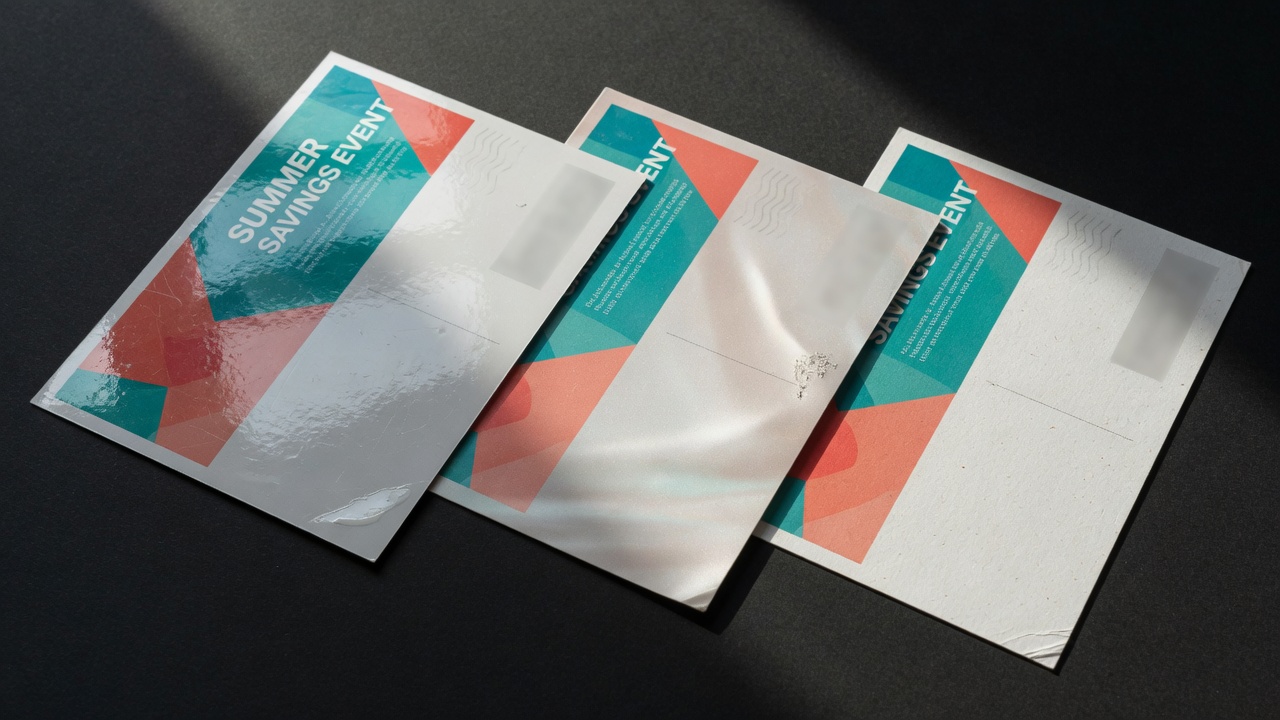
- Aqueous both sides: default protection for a piece that will live in a bag. UV on a brochure that must fold is a crack and glue conversation. Spot UV on a panel that does not fold can be the grown-up pop. Flood UV on a tight fold is how you photograph a white crack through a dark panel.
- Silk versus gloss: glare in a parking-lot handoff versus photo pop on a table. Silk fingerprints differently. Neither changes the quantity formula except through scuff returns. If the team will handle the piece hard, budget a protective coat and a slightly higher spoilage in the field, not a second thousand “for wear.”
I am not going to walk panel styles as if that were the article. Fold the dummy. If it cracks, we change grain, score, stock, or coating. That change can move you between digital and offset. It does not change how many people you can honestly supply. Do not pick a board-stiff cover because it felt premium in a sample book and then order 5,000 that will not survive the fold in a dry inland office.
The dummy, the grain, and the first carton
A PDF does not tell you whether 2,500 copies will sit flat in a carton or mushroom at the fold. A dummy on the real stock, with the real score, in the real climate, does. For a California sales program that will live in cars, I want a dummy that has been in a bag, not only on a conference table. If the first 200 from a run scuff or crack, stop. That is not “character.” That is a lift that will look worse after the rest of the cartons hit trunks.
Grain should run parallel to the fold on a text-weight brochure unless there is a documented reason not to. Against-grain folds on cover-weight crack. Digital sheets and offset sheets do not always give you the same grain option at the same trim. That is a production constraint. It can force a sheet change that changes unit cost at your quantity. Bring it up early. Do not discover it on 4,000 folded pieces.
Files: one PDF per version, or you do not have a quantity
Send a print-ready PDF per version, fonts outlined or embedded, images at production resolution, 0.125 inch bleed, live matter off trim and off the fold. Name the files so a human can see the version: product, language, date, not “newbrochure3.” If covers swap, send covers as separate pages or separate files and say which interior they share. A single InDesign package with hidden layers is not a version map. Someone will flatten the wrong layer at 6 p.m.
If prices, names, or QRs are still in flux, they are not in the brochure file. They are on an insert, a sticker, or a later digital hit. Locking a 2,500 offset form while the URL is a bit.ly someone might reuse is how you reprint. Put a stable URL in the print. Put the campaign tracking in a short-run overlay if you must measure this week’s UTM.
Color: CMYK. If the brochure must match a digital letterhead or a previous offset run, say so and send a sample, not a hex code from a website. Website color is not press color. A family match can be the reason we choose a process at a given quantity. Silence on that point is how the new 500 looks like a cousin of the old 2,000, not a sibling.
If the same campaign also needs a rack flyer and a mailed letter, split the PO. Handouts, envelopes, and field brochures scuff differently and die on different calendars. Mixing those specs on one ticket is how the wrong lift gets folded. We print Irvine brochure printing and reprints as their own line so the quantity stays attached to the use.
Local conditions that change quantity, not the slogan
Mail and signage have their own Orange County rules. Brochures have logistics. The plant address is 15321 Barranca Pkwy, Irvine, CA 92618. Phone (949) 387-0787. From here, cartons go to suites, freight forwarders, and sometimes a show dock. The following are true often enough to belong on the ticket.
- Heat. A week in a car on Barranca Parkway in September will age a piece faster than a month on a shelf. Smaller, more frequent draws beat a heroic trunk stash.
- Coastal versus inland humidity. Newport and Laguna offices do not store like a Tustin industrial park. If you split stock between those, do not be surprised when one office’s stack looks tired first. Rotate.
- Office parks and HOA-adjacent sales. Spectrum, the Irvine Business Complex, University Research Park, South Coast Metro: receptionists control bowls. Property and HOA sales still use leave-behinds; the brochure is not a yard sign and does not need an HOA variance. Do not print 8,000 because a door-hanger program was forbidden. Those are different products with different counts.
- Anaheim Convention Center and resort-area shows. Freight deadlines freeze files early. Quantity has to be right at ship, not “we’ll print more and drive it up on Tuesday” unless you have actually planned a Tuesday drive from Irvine. Sometimes that is the right digital reprint. Budget the van, not a wish.
- UCI, campus, and student-adjacent events. Dated pieces and bilingual pieces show up here. Count the day, not the year.
- Statewide teams. One pallet in Irvine and a starved office in San Jose is not a California program. Split shipments on the PO. We can carton by office. We cannot invent a San Jose closet.
- Medical and regulated calls. If a piece has a claim, an NPI-adjacent line, or a fair-balance paragraph, version control is a compliance quantity. Short digital runs with a kill date beat a warehouse of last year’s indication.
- Bilingual Orange County. Spanish is not a novelty version. It is often a real share of handoffs in service, health, home, and retail-adjacent B2B. Count it. Do not print it as a token 100 if the rooms need 400, and do not print it 1-for-1 with English if they do not.
If the brochure mails inside an envelope, that lift is a mail quantity with its own overs and its own in-home date. Keep it off the field carton. Originating mail from Irvine is useful for Orange County in-home windows; it does not change how many pieces a rep should carry on a Tuesday. Postage is a separate USPS charge when we mail. The brochure still has to be the right version when it lands.
The same plant handles commercial printing work across California that never sees a sales bag. Tell us which pile is which. A corporate capabilities piece for a board packet and a field brochure for a hospital in-service can share a visual system and still have two quantities, two stocks, and two freeze dates.
Mistakes that reprint, landfill, or starve a team
These are the repeats. They come from good agencies and from files built in a slide deck.
- Picking 5,000 because the unit cost fell, while the price list has a 90-day life. You bought a discount on scrap.
- Treating four versions of 400 as one 1,600 offset job. The interiors were not the same. The covers were not the same. The cartons were confused on day one.
- Printing each rep’s name and cell on 1,000 pieces. Two departures later you have 1,400 pieces you will not hand out and a rush digital job for the new people.
- No version slug, no kill date, two covers in the same trunk. The old disclaimer goes to the new logo meeting.
- Ordering “we’re out” without counting San Diego, the garage, and the leftover show freight.
- Filling Anaheim bags with the expensive brochure. The qualified-stop piece becomes aisle litter. The table runs out at 2 p.m.
- Locking an offset form while legal still has redlines. The press date is not a negotiation with counsel.
- A board-stiff cover that cracks on the fold after a weekend in dry air, then 4,000 more get folded anyway.
- Flood UV on a tight fold, photographed as a white hairline, then argued as “the paper.” It was the film on the score.
- One PDF for a rack flyer and a sales brochure, one quantity, one finish. The flyer should have been cheaper and more plentiful. The brochure should have been scarcer and better.
- Putting a campaign UTM that marketing will unpublish into 2,500 covers. The QR dies. The carton does not.
- Storing the annual supply in a car and a sun-facing window. Then asking why the stack looks handled before the first serious call.
- Building 50 kits for 12 reps and leaving them in a hallway until they are the old version.
- Refusing a 400-piece digital reprint because “we already printed this year,” then photocopying the last 20 on an office device for a hospital visit. That photocopy is now your brand.
- Asking us to “just print extra, offset overs are cheap” without a shelf, an owner, or a freeze date. Cheap overs are not cheap storage.
Reprints are worse than a smaller first pass. Once 5,000 covers have last quarter’s SKU, you do not have inventory. You have a shredding appointment. Send the version map. Send the use window. Send the dummy. That is slower than clicking a quantity in a portal. It is faster than reprinting.
What to send for a quote
Write one email or use the form with the facts a plant estimates from. Adjectives do not change plate cost or closet space.
- Finished size and that it is a brochure (folded or short-stitched), not a flyer and not a catalog. Panel count only as a size fact, not as a style debate.
- Quantity per version, not a blended total. If you want us to recommend a split, send headcount, months of file life, shows, and leftover inventory.
- Stock and finish: 100 lb coated text, 80 lb uncoated, cover weight, aqueous, UV which panels, uncoated write-on, or “recommend for bag and trunk use.”
- How many distinct PDFs, and which interiors are truly shared.
- Whether names, prices, or partner logos sit on the piece or on an insert.
- Ship split: one Irvine dock, or cartons by office. Show freight deadline if Anaheim or similar is in play.
- In-hands date, and whether that date is a wish or a contract. File freeze date if it is different from press date.
- Files: one PDF per version, or a note that design is still open. A dummy if you have one.
- Whether this is print-only or you also need kits, sell sheets, or a mailed enclosed lift as a separate line.
We confirm size, material, quantity, finish, and date on every quote. If you ask for digital and offset at 1,000, we will show both when the sheet makes that comparison honest. If postage is involved, it is shown as postage. Avanti Printing is at 15321 Barranca Pkwy, Irvine, CA 92618. (949) 387-0787. The quote link on this page is the same form we use for commercial work that starts on Barranca Parkway and ships the state.
FAQ: how many brochures to print in California
How many brochures should a five-person California sales team print?
Count handoffs, not seats. Five field reps who each move about 10 to 15 pieces a week for a 16-week version life are in a roughly 800 to 1,200 field band before shows, lobbies, and a pad. Five people who mostly sell on screens may need 200 plus a show spike. I will not pick 1,000 because it sounds professional. Send a month of real use and the date the file goes stale. Then we put a number on the ticket.
When does offset beat digital on brochure quantity?
Often somewhere in the 1,000 to 2,500 band for one identical version on a standard coated-text brochure, and more clearly at 5,000 if the file is frozen. That is a typical industry pattern, not a law. Odd sizes, heavy cover, versioned covers, and a file that will change in six weeks all keep digital in the game. At 250, stop asking. Digital. At 1,000, ask for both numbers on the same size, stock, and finish.
Should I print one version or split languages and product lines?
Split when the handoff is actually split. A token 100 Spanish next to 2,400 English is a gesture if your rooms need more Spanish. A 50/50 split is a waste if they do not. Product lines that change on different calendars should not share a carton. Shared interiors with versioned covers are the grown-up middle. Count PDFs, assign use share, freeze dates separately.
Can I put each rep’s name and phone on the brochure?
You can. You will reprint when people leave, and they leave. Put identity on a card, a sticker, a QR, or a card slit in a folder. If you still want a named panel, print that panel digital and short, and keep the rest of the piece un-named. A 5,000 offset run of headshots is a yearbook, not a sales program.
How long will a carton last in an Irvine office or a car?
On a shelf, in a sealed carton, away from sun and swings in humidity, a well-coated brochure can sit for many months and still look like itself. In a trunk in July, it can look handled in a week. UV-on-UV in heat can block. Uncoated in a bag will scuff. Quantity should assume the worse storage you actually have, not the climate-controlled photo of the plant. Draw weekly from an office. Do not warehouse the year in the car.
What if prices or SKUs will change in 90 days?
Do not put those numbers on a long offset run. Move them to a short-run insert, a sell sheet, or a QR that you control. Print the brochure at a quantity you will consume before the change, usually digital. If the story is stable and only the grid changes, we will quote a stable brochure plus a cheap grid. That pair almost always beats 5,000 covers you will shred in May.
Should I print extra for Anaheim Convention Center or a campus fair?
Budget the show as its own line, with a qualified-stop rule for the brochure and a cheaper sheet for the bag if you must fill bags. Extra should be a small pad, not a second carton “in case.” Freight freezes the file. If you run out, a digital reprint driven from Irvine on a planned second trip is sometimes cheaper than the leftover carton you will not want to count on Thursday night. Plan the second trip or plan to be out of the fancy piece and still have flyers.
How do I get a quantity quote from Avanti?
Send size, stock, finish, quantity per version, ship split, and date. Use the quote form or call (949) 387-0787. We will confirm size, material, quantity, finish, and date in writing. A 250-piece digital version set and a 5,000-piece single-PDF offset run are not the same estimate. Walk-in guesses and statewide programs are not the same estimate either.
Print the number you can still stand behind
How many brochures to print in California is a use-window problem. Count the hands, the months, the PDFs, and the shows. Digital covers the short, the versioned, and the nervous file. Offset covers the frozen, identical run that will actually leave the shelf. Storage, heat, and a name on the back are how a correct press count becomes waste. A 2-week reprint from Irvine is often cheaper than a closet of last quarter.
Khalid, Avanti Printing, Irvine. Bring a headcount and a freeze date. Bring leftover cartons if you have them. We will tell you whether the job is 400 honest copies or 4,000 copies you will still want. Then we will print the version that a rep can still hand over without apologizing.