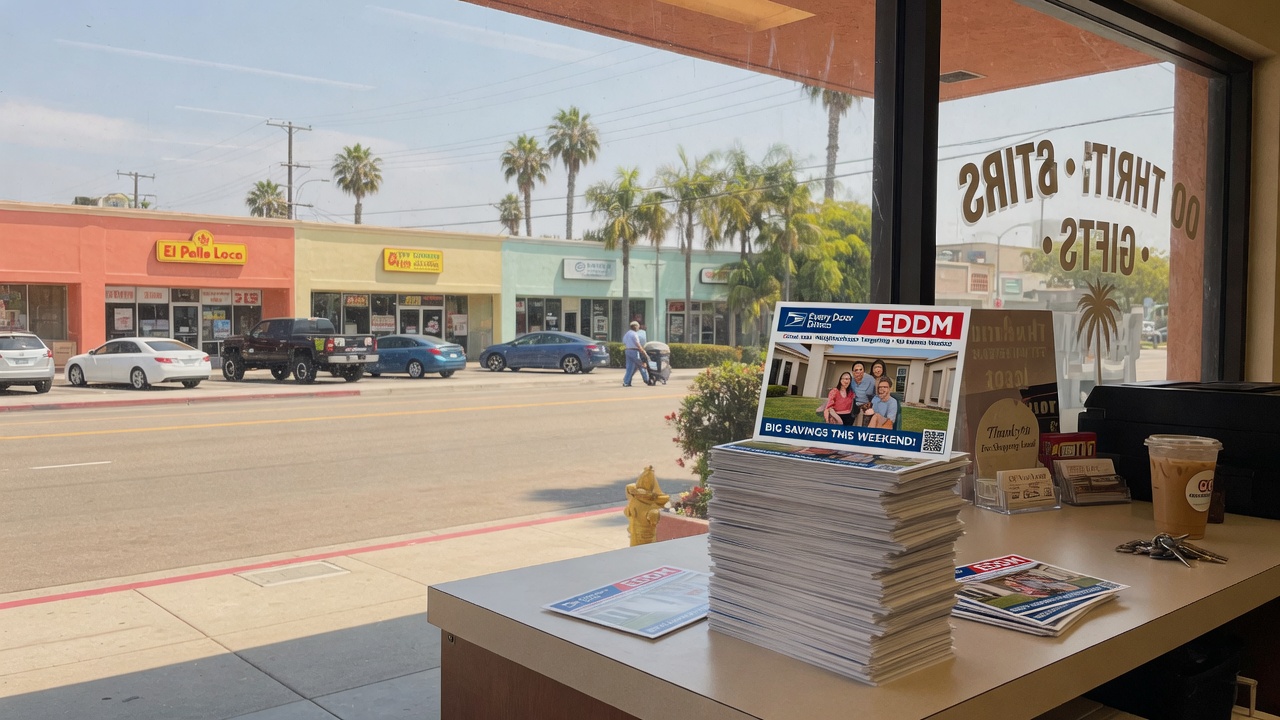
EDDM vs addressed mail in Orange County is a targeting decision, not a paper decision. Every Door Direct Mail sends a simplified-address flat to every delivery on the carrier routes you pick. Addressed mail uses a purchased list or your house file and prints a name and street. Routes saturate a map. Lists select records. Postage class, privacy, and finished size all follow that split.
I estimate print-and-mail jobs at Avanti Printing, 15321 Barranca Pkwy, Irvine, CA 92618. Retailers use EDDM when the offer is geographic: a new location, a radius around the register, a neighborhood that already drives past the store. B2B mailers usually need a name, a suite, and a reason the piece is not junk. Purchased lists sit in the middle. They look targeted in a spreadsheet and stale in a tray if nobody ran hygiene. Call (949) 387-0787 if you already have routes or a file. Quotes still confirm size, material, quantity, finish, and date. Postage is a separate USPS charge, and it moves when the Postal Service publishes a new list.
Read the current program rules on the Postal Service’s own page before you lock a deck: USPS Every Door Direct Mail. If a printer’s one-pager disagrees with that page or with the DMM, the Postal Service wins.
Who this is for in Irvine and Orange County
This page is for the person who has to pick a door list and a mailpiece on the same purchase order. A restaurant group with a second location in Tustin. A dental office that keeps mailing the same 4×6 to a rented occupant file. A home-services company that wants every box on a handful of Irvine carrier routes. A medical-device or software firm in the Irvine Business Complex that should never saturate apartments. A broker who was told to “hit 92618.” A marketing manager who mixed EDDM and a named list in the same week and then wondered why the same household got two different cards.
It is not a souvenir-postcard spec. It is not a ZIP-code product page. It is not a lecture on folding a brochure into panels. The plant is in Irvine. The mail is Orange County mail that happens to start on Barranca Parkway and then has to be accepted at the Post Office that actually delivers those routes. That last sentence is where DIY EDDM jobs die. You do not drop a Santa Ana route at an Irvine retail window because the printer is in Irvine.
You should read this if any of the following is true. You think a ZIP Code is a neighborhood. You think EDDM lets you skip apartments. You bought a consumer list and still want “every door” postage. You run B2B in Spectrum offices and someone recommended saturation because the postage number was low. You have a house file in a CRM and a salesperson who wants to rent names you already own. You designed a 6×9 card for EDDM. You need the in-home window to match a grand opening, an enrollment deadline, or a sale, and you have not asked which office takes the bundles.
If the piece is a jumbo card that will be addressed to a person, start with commercial postcard printing and mail prep from Irvine and bring the list class with you. If the piece is an 8.5 by 11 flat that must qualify as EDDM, you are closer to a large flyer printed to USPS flat sizes than you are to a retail 4×6. If the mail is only the first touch and the close happens in a folder on a desk, we also print brochures and leave-behinds for the follow-up visit. Do not force a brochure’s worth of copy onto a saturation card and then blame the route.
Three ways to pick doors: EDDM, purchased lists, house lists
Orange County buyers talk as if there were two products, EDDM and “regular mail.” There are three sourcing methods, and they do not share a postage class. EDDM is a USPS program for saturation flats with a simplified address. Purchased lists are rented or bought records. House lists are names you already have a relationship with. You can mail a purchased list or a house list as letters, cards, or flats. You cannot turn a named letter into EDDM by printing “or current resident” in the corner and hoping.
Use this as the decision frame before anyone opens InDesign.
| Method | How doors are chosen | What prints in the address | List you must own or rent | Permit / entry | When it is the right OC buy |
|---|---|---|---|---|---|
| EDDM (simplified-address saturation flats) | Carrier routes you select in the USPS EDDM tool. Census-style filters (age, income, household size) are route averages, not people. | Postal Customer, Local Postal Customer, Residential Customer, or Business Customer. No name. | None. Delivery statistics come from USPS. | EDDM Retail: no permit, 200 to 5,000 pieces per ZIP per day, drop at the delivering office. EDDM BMEU: permit, no Retail cap, enter at a business mail unit. | A geographic offer: grand opening, menu, home-service radius, neighborhood sale, civic notice. You accept waste on vacant units, competitors, and the studio next to the house. |
| Purchased / rented list (consumer or B2B) | Selects on compiled or response data: new mover, homeowner, occupancy, SIC/NAICS, title, modeled income, radius around a store, suppressions. | Name and street, or Occupant / Current Resident if you choose occupant style. | Yes. You pay for use. Usage rights and the freshness date matter more than the row count. | Usually a Marketing Mail or First-Class permit mailing. Needs CASS, move-update, and a real address block. | You need to skip doors. New rooftops in Tustin Legacy, homeowners only, medical buildings, auto dealers, offices over a headcount. You will pay list money to avoid postage on the wrong box. |
| House list | Your CRM, POS, warranty, patients, members, invoices, event scans. You already have a reason to write to them. | The name you store, plus a standardized address. Personalized offer if the data supports it. | You own the relationship. You still owe hygiene, opt-out handling, and a current file. | Often First-Class because the record is valuable and undeliverable-as-addressed treatment is better. Volume jobs can still be Marketing Mail. | Recalls, renewals, B2B account mail, loyalty, “we already did work at this address.” Highest intent. Worst idea to replace with a saturation map. |
| Addressed saturation (not EDDM) | A walk-sequence file covering enough of the route to hit saturation density (typically 90 percent of residential addresses or 75 percent of total addresses on the route, whichever the current DMM requires for the price you claim). | Name, Occupant, or Current Resident. Still an addressed piece. | Yes. You need every address, even if you print Occupant. | Permit mailing, carrier-route preparation, usually letters or flats at saturation prices. | You want saturation postage but a letter-size card, a name, or a suppression the EDDM tool cannot do. More work than Retail EDDM. Sometimes cheaper than EDDM once you are in a permit shop. |
Two footnotes belong under that table. First, EDDM is not “cheap postcards.” It is cheap coverage of a route if the offer is truly every-door. If half the boxes cannot use you, you did not save postage. You bought waste at a low unit price. Second, a house list is not a purchased list with a sentimental story. If a patient, a member, or a B2B buyer gave you the address, that file carries privacy and accuracy duties a saturation map never had.
Typical industry pattern — and it is a pattern, not a promise — is that house files outperform rented names, and rented names outperform raw saturation when the product is selective. Restaurants, gyms, and home services often reverse that ranking because the offer is the neighborhood. I will not invent response rates for your category. I will insist you pick the sourcing method before you pick a coating.

Carrier routes are not ZIP Codes
This is the map mistake that wastes the most Orange County postage. A ZIP Code is a sorting and pricing bucket. A carrier route is a walking or driving assignment: a person with a satchel or a vehicle, a sequence of boxes, a mix of houses, apartments, PO Boxes, and businesses that USPS already decided belong together. EDDM is sold by route. You can select every route in a ZIP, but that is a choice, not the default meaning of the ZIP.
Irvine makes this obvious if you look at the tool instead of the city name. One five-digit ZIP can hold Irvine Company apartments, a business park, a school, and detached houses that do not share a driveway type, a gate, or a buyer. Costa Mesa’s South Coast Metro routes do not behave like the residential streets west of them. Anaheim Resort deliveries are not Anaheim Canyon industrial parks. Huntington Beach coastal routes are not Fountain Valley interiors. If you “mail the ZIP,” you mail all of that on purpose or you mail it by accident. Accident is the usual case.
The USPS EDDM Online Tool is the planning surface for Retail jobs. You search an address, a city, or a ZIP. You open the table. You see routes with residential counts, total deliveries, and coarse Census-derived averages for age, household size, and income. Those averages are about the route, not about the person who opens the box. The mansion and the studio can share a carrier. A high average income on an Irvine route does not mean every door can buy a $12,000 remodel. It means the route’s Census mix looks affluent from 30,000 feet. If you need homeowners with a pool, that is a list select, not a Census slider.
Route counts also change. New villages, apartment deliveries, and business-park restacks revise the number of active deliveries. Do not reuse last year’s route list because the creative is the same. Pull current delivery statistics when you build the order. If the route grew, you will be short. If it shrank, you will show up with extra bundles and a facing slip that no longer matches the office’s expectation.
PO Boxes are their own problem. Some simplified-address programs can include box sections. Some buyers think “every door” includes every box in the ZIP. It does not, unless you selected those sections. A medical office that wants residential houses should not pay to fill PO Boxes behind a UPS Store. A B2B mailer that wants office parks should not congratulate itself for saturating a residential loop two streets over.
Business-only routes exist. Residential-only routes exist. Mixed routes are the Orange County default: a strip of storefronts, a HOA cluster of boxes, a few live-work units, then a street of houses. EDDM to a mixed route means the dry cleaner, the competitor, and the condo all get the same card if they are on that assignment. “Residential Customer” as the simplified address is how you tell the carrier you want residential deliveries, not how you surgically delete apartments. Read the current DMM language for simplified addresses if the job is business-only. Do not invent a hybrid where you highlight houses on a Google map and still call it EDDM.
Drop location follows the route, not the printer. The serving Post Office for those carrier routes is where Retail EDDM belongs. We can print in Irvine and still have to stage bundles for Tustin, Santa Ana, Newport Beach, Costa Mesa, Lake Forest, or Anaheim. If you planned one heroic drop at the plant’s nearest lobby, you planned a refusal. BMEU entry is a different dock with different paperwork. Either way, the map is routes. The ZIP is just how the tool groups the rows.
Saturation, simplified addresses, and what “every door” actually means
Saturation is a density claim. Simplified addressing is a format. EDDM is the Postal Service product that combines them for flats so you do not have to buy a walk-sequence list. People mash those three ideas into the phrase “every door” and then get surprised at the vacant unit, the DO NOT MAIL household, and the apartment they wanted to skip.
On EDDM, the carrier is instructed to deliver a piece to each active delivery on the selected route (or to the residential or business subset the simplified address calls for). You do not print 142 different names. You print one address line the program allows — commonly LOCAL POSTAL CUSTOMER or POSTAL CUSTOMER — plus the required saturation marking. The Retail indicia includes ECRWSS. That string is a class of saturation mail, not a decoration. Leave it in. Do not redraw it in a script font to match the brand.
USPS treats EDDM Retail pieces as Marketing Mail flats. A Retail mailpiece must be a flat, weigh no more than 3.3 ounces, and meet at least one of these: length greater than 10.5 inches, height greater than 6.125 inches, or thickness greater than 0.25 inch, while staying within the flat maximums (15 inches long, 12 inches high, 0.75 inch thick). Pieces are addressed to a simplified line such as Postal Customer. Confirm the live numbers on the USPS EDDM page and in the Postal Service’s DMM physical standards for flats before you lock trim.
Addressed saturation is the older, list-based cousin. To claim saturation prices on a named or occupant mailing, you generally must cover at least 90 percent of the residential addresses on the route or 75 percent of all addresses on the route — the 90/75 density rule as published for carrier-route saturation. You need the addresses. You need walk sequence. You can suppress a handful of doors and still qualify if you remain above the density line. That suppression is exactly what EDDM Retail cannot do inside the online tool, aside from a facing-slip “Do Not Deliver” list you build by hand for people who already asked you to stop.
High-density and high-density-plus prices live on the addressed side of the family. They are not EDDM. They are for mailers who hit a lot of a route but not saturation. If a list shop starts talking high-density, you have left the Retail EDDM counter. That can be the right move. It is a different estimate.
“Every door” also does not mean every adult, every decision-maker, or every unit occupant. One piece per delivery. A four-person household gets one card. A medical building with a shared receiving room gets what the carrier can deliver to that stop, not a named suite-by-suite campaign unless you bought a B2B file. Cluster-box units in Irvine Company communities still get saturation pieces; the HOA does not get a veto at the mailbox the way it might on a yard sign. Do not confuse an HOA sign rule with a USPS delivery rule.
Saturation waste is not a moral failing. It is the price of skipping list work. If your offer is a pizza special, waste is cheap. If your offer is a $40,000 equipment lease, waste is the whole budget. Orange County has enough mixed-use streets that I want to see the route table, not a radius drawn on a mapping app. A two-mile circle around a Spectrum restaurant is not a set of carrier routes. Convert the circle to routes, look at residential versus business counts, and only then print.
EDDM Retail versus BMEU, and why the Irvine plant is not the Post Office
USPS sells two entry paths. EDDM Retail is the no-permit path. You make a USPS.com order, print PS Form 3587, bundle 50 to 100 pieces with facing slips, and take the mailing to the Post Office that delivers those routes. Minimum is generally 200 pieces (or 50 pounds), with an exception when the entire 5-digit ZIP has fewer than 200 deliveries. Maximum is 5,000 pieces per ZIP per day. Pay online or at the counter. That cap is why a county-wide restaurant drop is not one Retail order. It is a set of ZIPs, a set of offices, and a calendar.
EDDM BMEU is the bulk path. You need a Business Customer Gateway account and a mailing permit. You enter at a Business Mail Entry Unit. There is no Retail 5,000-piece cap. Multiple ZIPs can sit in one mailing. Postage is still Marketing Mail flats. On the current USPS EDDM page, Retail is listed at $0.26 per piece for flats up to 3.3 oz, and BMEU as low as $0.259. Those are Postal Service prices, not a print quote, and they move. Confirm them on the Postal Service site for the week you drop.
Which path Orange County jobs actually use:
- A single-store radius of a few routes, a few hundred to a couple of thousand pieces: Retail is often enough if you can staff the drop at the right offices.
- A multi-city home-services drop across Irvine, Tustin, Lake Forest, and Mission Viejo: you will blow past a casual Retail plan. BMEU or a permit shop should be in the estimate from day one.
- A monthly cadence: get a permit. Paying Retail friction every month is how small programs stall.
- A political or civic saturation with a hard in-home window: talk entry and office appointments early. The print is the easy part.
Bundling is part of the print spec, not a warehouse afterthought. Bundles of 50 to 100, stacks not higher than 6 inches, facing slip on top, piece count written on the slip, all faces the same way, indicia up. If the card is 16 pt plus UV, 100-piece bundles can exceed 6 inches. Then you print 50-piece slips and you do not argue with the clerk. Rubber bands that cut coated stock in July heat are a scuff complaint waiting to happen. We would rather change the bundle count than reprint because the face of every fiftieth card has a band burn.
Avanti can print, coat, cut, count, and slip. We cannot pretend the Barranca Parkway dock is a substitute BMEU for routes we do not enter there. If you want us to handle entry, say so on the quote and we will plan the offices. If you want print-only, you still need legal flats, correct indicia, and bundle math. “We’ll take them to the post office ourselves” is fine. “We’ll take them to whichever lobby is open Saturday” is how those bundles come back.
Privacy, named data, and occupant mail
EDDM vs addressed mail in Orange County is also a privacy decision, even when nobody in the meeting wants to say the word. Named mail uses personal information: a person’s name tied to a deliverable address, often with selects that imply income, move date, family status, or a medical or financial interest. EDDM uses no name. Occupant mail sits in between: a street address without a person.
What that means in practice:
- There is no national “EDDM opt-out list” equivalent to pulling a name off a compiled file. Recipients who hate saturation mail still receive it if their box is on the route. DMA-style preference services that suppress named lists do not automatically suppress simplified-address saturation. If someone asked you to stop, USPS lets you put that address in the Do Not Deliver column on the facing slip for that drop. That is a per-mailing courtesy, not a permanent Postal Service suppression.
- Purchased consumer lists should arrive with usage rights, a freshness date, and a suppression story. Ask what was run: deceased, prison, DMA Mail Preference if they offer it, your own customer suppression, and California records you are not allowed to use for the purpose you have. “We bought 20,000 Irvine names” is not a spec.
- House lists are yours, which means the mistake is yours. Honor unsubscribe and do-not-mail flags you already stored. Do not append a sensitive condition to a postcard. A dental recall with a named patient on a 6×11 that anyone in the cluster box can read is a clinical-communications problem, not a coating problem. If the information is sensitive, use an envelope and a class that matches the relationship.
- B2B files still have people on them. A title at a firm is not an excuse to mail a home address you scraped. Office parks around the Spectrum, University Research Park, and South Coast Metro need suite lines. A named piece without a suite is a receiving-room lottery.
- California privacy law is mostly about how you collect, sell, and disclose personal information, not a ban on paper mail. I am not your counsel. I am the plant that will not print a file you cannot explain. If the list vendor cannot tell you the source, we will not pretend the tray is clean.
- HIPAA, financial privacy, and student records are not “print issues” you solve with a smaller font. If you should not put it on a saturation card, you should not put it on a named card either. Change the format to an envelope or change the copy.
Occupant / Current Resident is the compromise Orange County retail should use more often than it does. You keep a deliverable street, you skip the wrong first name on a file that has not been NCOA’d, and you still avoid mailing the dry cleaner if your list is residential occupancy. You do not get EDDM Retail postage just because the first line says Occupant. Occupant mail is still addressed mail. It needs a list, a barcode plan, and a class.
Do not mix a house-file offer and a saturation offer in a way that leaks the relationship. “Welcome back, [First Name]” on the named card and “Neighbors love us” on the EDDM card in the same week is fine. Printing a loyalty balance, an account number, or a service history on a piece that also says Postal Customer is how you invent a privacy incident in a cluster box. Keep the saturation creative generic. Keep the personal data on the house-list version, and preferably under a flap or in an envelope if it is none of the hallway’s business.
Informed Delivery can show a scan of the mailpiece to the recipient. Design the address side knowing a JPEG of it may appear on a phone. Do not put a surprise you would not put on a website thumbnail.
Print specs that still fail at the dock
EDDM removed the name. It did not remove the ruler. The piece still has to be a flat, in the weight cap, with a legal indicia and a simplified address the clerk recognizes. Addressed mail still has to be a card, a letter, or a flat you intended. Most reprints I see are not creative failures. They are trim failures, coating failures, and “we copied a 6×9 from last year’s named drop” failures.
The OR rule: why a 6×9 is not EDDM
To qualify as an EDDM flat, the finished piece must beat at least one letter-size ceiling: longer than 10.5 inches, or taller than 6.125 inches, or thicker than 0.25 inch. Then it must stay inside the flat maximums. A 6.00 by 9.00 card fails all three tests unless you built a slab a quarter inch thick, which you will not, because it will also fail weight, bundling, and common sense. That size is a workhorse for named cards. It is not an EDDM size. Do not take a 6×9 named campaign, delete the names, and call the reprint a saturation program.
Sizes that actually show up on Orange County EDDM jobs:
| Finished trim (inches) | EDDM flat? | Why | If you instead mail it addressed |
|---|---|---|---|
| 4 x 6 | No | Too small on every axis | Retail or commercial card path, if caliper and layout pass |
| 6 x 9 | No | 6.00 high and 9.00 long, both inside letter ceilings | Commercial First-Class card or a letter, depending on class and thickness |
| 6.25 x 9 | Yes | Height 6.25 is greater than 6.125 | A flat, because height is over 6.125. Do not assume letter postage. |
| 6.5 x 9 / 6.25 x 11 | Yes | Height and/or length clear the OR rule | Still flats if height stays over 6.125; a 6.00 x 11 named piece can be a letter |
| 6 x 11 | Yes as EDDM | Length 11 is greater than 10.5 | Named, with height at 6.00, this is a letter-size card. Same trim, different product. |
| 8.5 x 11 | Yes | Height 8.5 is well over 6.125 | A flat. Budget flat postage, not letter postage. |
| 9 x 12 / 11 x 12 | Yes, if under max | Comfortable flats; watch the 12-inch height and 15-inch length caps | Flats either way |
| 12 x 15 | Maximum envelope | Do not “add bleed” past this after trim | Still a flat, and an expensive one to print and coat |
The 6 x 11 row is the one that pays for this table. Mail that trim as EDDM and you have a flat because length clears 10.5 inches. Mail that trim as a named letter-size card, keep height at 6.00, and you are in letter equipment. Same paper, same press form if you are not careful, two postage buckets. Say which product you are buying on the PO. We will not silently build a 6.25-inch-high “safety” trim that throws a named letter into flats, and we will not silently build a 6.00-inch EDDM that misses the 6.125 height test unless length already clears 10.5.
8.5 x 11 is a flyer to the art department and a flat to USPS. It is a legitimate EDDM size. It is also how people blow the 3.3 ounce cap if they pick a board stock and flood UV both sides, then add a magnet or a packet. Weigh a dummy. Do not weigh a hope.
Folded pieces can be EDDM if the finished piece is still a flat under the OR rule and the maximums. Fold an 8.5 x 11 to 5.5 x 8.5 and you have probably built a letter. That letter is not Retail EDDM, no matter what the unfolded PDF looked like. If you need panels, design the finished rectangle first. I will not run a binding-style comparison here. I will measure the dummy you intend to drop.
Caliper, weight, and stock that survive a bundle
Minimum thickness for a flat is 0.007 inch. Maximum is 0.75 inch. The interesting number for EDDM Retail is weight: 3.3 ounces. Standard 14 pt and 16 pt coated cover in 6.25 x 9 or 6.25 x 11 almost always sits in a comfortable range. 9 x 12 on 16 pt plus two-sided UV plus a heavy ink load is where I want a scale, not a mill swatch. Uncoated cover bulks more; it can help a thin sheet feel like a card and it can help inkjet, but it scuffs in bundles and shows fingerprints in a cluster box.
14 pt C2S is the default conversation for jumbo EDDM cards. 16 pt is a tactile upgrade when the extra caliper does not threaten weight or the 6-inch bundle cap. 100 lb text is a flyer, not a card; it can mail as an 8.5 x 11 flat if it stays flat and does not drape into a crumpled mess in the satchel. Do not spec 80 lb text for a saturation piece you want taken seriously on a granite kitchen island. Do not spec 24 pt board unless you like rigidity problems and overweight samples.
Coatings still matter after you remove the name. Flood UV on both sides of a large flat will scuff in bundles, block in a hot Orange County gaylord, and turn facing-slip adhesive into a peel that skins the ink. Aqueous on both sides, or UV on the image face and aqueous on the address face, is the adult stack. Silk and soft-touch on a saturation flyer feel expensive and then fingerprint. If the job is a named letter with inkjet addresses, you still need a receptive panel; that is a different collision than EDDM, which has a static simplified line you can print in the same pass as the rest of the ink. Static is the one gift EDDM gives production. Use it. Print the indicia and POSTAL CUSTOMER on press. Do not plan to inkjet a simplified address onto UV because someone reused a named-mail template.
Indicia, simplified address, and the panel designers keep crowding
Every EDDM piece needs the correct postage mark and a simplified address. For Retail, USPS wants the EDDM Retail indicia above and to the right of the address block. Their published notes: larger than 0.5 by 0.5 inch, all caps, at least 4-point type, sitting in the area about 1.625 inches from the right edge and 1.375 inches from the top edge, with 1/8 inch clearance at the top and right. Download their artwork. Do not redraw “PRSRT STD / ECRWSS / U.S. POSTAGE PAID / EDDM RETAIL” from memory in the brand typeface.
The address line is not a slogan. POSTAL CUSTOMER or LOCAL POSTAL CUSTOMER is enough. RESIDENTIAL CUSTOMER when you mean residential deliveries. BUSINESS CUSTOMER when the route and the DMM allow a business-only simplified address. Put it on a light panel with dark type. A navy full-bleed photo with knocked-out white script is how a clerk squints and a carrier guesses. Leave room. The marketing copy can lose a sentence. The indicia cannot.
Return address is still a good idea even though the piece is not coming back like First-Class named mail. If you want a phone number or a site on the address side, keep it out of the indicia box. Permit mailings on the BMEU path use a permit imprint, not the Retail EDDM bug. Mixing those two marks is a reject. Tell us which path you are buying before we proof.
Addressed mail keeps the whole Intelligent Mail barcode world: CASS, ZIP+4, IMb, clear zones, optional endorsement lines. That is a different layout. Do not put an IMb on an EDDM Retail piece because a designer copied a named 6×11. Fake bars next to POSTAL CUSTOMER look like a mailer who does not know which product they bought. We will strip them.
Files, bleeds, and the dummy
Send a print-ready PDF, fonts outlined or embedded, 0.125 inch bleed, live matter off trim. For EDDM, also show the indicia and the simplified-address panel at final size on a light field. For named mail, show the OCR band, coating knock-out, and a dummy record. Color is CMYK. The address panel is not the place for a 5 percent warm gray that looked cinematic on a monitor.
Trim means trim. A 6.25 x 9 EDDM card that ships at 6.12 x 9.00 because someone was nervous about the 6.125 floor is not “safe.” It is under height if length is also under 10.5. We would rather you have a hard 6.25 with clean bleed than a nervous 6.13 that a micrometer and a ruler can argue about at 7 a.m. in a back office. On the other wall, a named 6.00-high letter that “gains” 0.20 inch of safety becomes a flat. Measure the dummy, not the artboard.
If you also need a non-mailed flyer for the counter, say so. Handouts can flood UV both sides. Saturation flats still have to bundle. Mixing those specs on one PO is how the wrong pile gets banded.
Request an EDDM or list-mail quote
Orange County retailers versus B2B mailers
The same plant prints both. The same program names confuse both. The right sourcing method is usually obvious if you describe the buyer instead of the paper.
Retail and local services
Restaurants, gyms, dental and vet offices, auto service, med-spa, tutors, places of worship, home services, independent retail in a center: EDDM is often the honest tool when the next customer is whoever lives inside a short drive. Pull routes around the door, look at residential counts, drop the business-heavy routes if the offer is a family meal, keep mixed routes if the lunch crowd is the point. A Spectrum-adjacent restaurant that saturates a pure office route will feed dumpsters at 6 p.m. A plumber who saturates a high-rise of renters will educate people who cannot authorize a slab repair.
Grand openings and “under new ownership” are saturation work. So is a menu change if you already own the neighborhood. So is a seasonal service: HVAC before the first real heat, roofing after a wind event, tax prep in the ZIPs you can actually serve. Use the Census sliders only as a veto (“this route is almost all student housing and we sell cribs”), not as a targeting fantasy.
When retail should buy a list instead: new-mover files in Tustin Legacy, Irvine villages, and apartment turns; homeowner-only selects for roof, solar, paint, and pools; radius plus dwelling type when apartments will never convert; suppression of current customers so you do not pay to tell last week’s client that you exist. When retail should use the house file: recall, refill, membership, warranty, abandoned quote. Do not rent those people back from a compiler. You already paid to acquire them.
Creative on retail EDDM should survive a cluster box. One offer, one date, one map or QR, one phone number. Bilingual copy is useful in a lot of Orange County routes. Keep one clean simplified-address panel. Do not interleave Spanish marketing lines into the indicia block.
B2B
If the buyer is a title at a firm, EDDM is usually the wrong first conversation. Offices in the Irvine Business Complex, University Research Park, Spectrum towers, South Coast Metro, Anaheim Canyon, and medical clusters around hospitals do not open “LOCAL POSTAL CUSTOMER” mail the way a kitchen island opens a pizza coupon. Receiving rooms bundle saturation flats. Assistants throw them out. The decision-maker you wanted was never the box.
B2B exceptions: a true all-business carrier route where you mean every tenant, and the DMM allows a BUSINESS CUSTOMER simplified address; a restaurant or coffee operator feeding a business park at lunch; a janitorial or landscaping offer that really is every suite. Even then, a compiled list of suites with a contact often beats saturation because you can put the suite number on the piece and skip the building that already contracted with you.
Purchased B2B lists need NAICS, employee size, and a title you can defend. They also need suite data. Orange County business parks are suite data. House lists of customers, quotes, and trade-show scans are the core. Mail those First-Class when the record is worth a conversation. Use an envelope when the contents are pricing, a patient-adjacent device, or anything you would not pin to a lobby wall.
Do not “EDDM the ZIP around our office” as a thought-leadership campaign. You will hit apartments, hotels, and the competitor. Pay for the named file or do not mail.
Local conditions that change the spec, not the slogan
Mail we produce for this site originates at Avanti Printing in Irvine, not from a fictional counter in every ZIP a search engine likes. The plant address is 15321 Barranca Pkwy, Irvine, CA 92618. Phone (949) 387-0787. Trays and bundles still have to enter the network the way USPS requires for the product you bought.
- Apartment-heavy routes. Irvine Company communities, student housing near UCI, high-rises around the Spectrum, mixed-use in Santa Ana. EDDM will hit them. Lists can skip them. House files go stale in them. Pick on purpose.
- Cluster boxes and gates. Saturation still delivers to the unit’s box when USPS serves it. Your photo of a door hanger on a porch is a different product with HOA rules. Mail is mail.
- Business parks. Spectrum, the Irvine business complex, South Coast Metro, Anaheim Canyon. Mixed routes will leak retail creative into office buildings and office creative into houses. Read the residential versus business counts on each route.
- Turnover. UCI-adjacent rentals and new villages change occupants. Named files need move-update. EDDM does not care who moved in last Tuesday, which is either the point or the bug.
- Heat. Summer bundles cook in trucks and on docks. Flood UV against flood UV will offset. Design the coating stack for Orange County logistics.
- Bilingual creative. Useful. Still keep the simplified address and indicia in the format USPS expects, not in a dual-language stack the clerk has to decode.
- Multi-office drops. A campaign that looks like “Orange County” on a slide is ten Post Offices on a Tuesday. Build the calendar around the offices, not around the press slot alone.
- Anaheim Convention Center, Disneyland-area hotels, and resort deliveries are not “households” for a roofing offer. They are beds and desks. Look at the route mix before you congratulate the radius.
Entry discounts for permit mail, SCF versus local entry, and BMEU appointments are real and they depend on the current price list and how the mailing is prepared. I will not invent a per-piece postage here. Bring the route table or the ZIP histogram and the class.
If you need postcard printing for a named Orange County drop, we will ask whether the card is a letter, a card-price piece, or an EDDM flat. Those three are not synonyms. If you need 8.5 by 11 flyers that must survive as saturation flats, say EDDM on the request so we do not build a letter-fold. The same plant also handles commercial printing for California campaigns that never go near a mailbox. Tell us which pile is which.
Mistakes that force a reprint, a re-rate, or a wasted drop
These are repeats. They come from good agencies as often as from a file built in a word processor.
- Designing a 6×9 named card, then converting the job to EDDM without changing trim. The 6×9 still is not a flat.
- Building a 6.00-inch-high EDDM card that needed 6.25 inches of height because length was only 9 inches. The OR rule is not a vibe.
- Adding “a little extra” to a named 6.00-inch letter so it becomes 6.25 and a flat.
- Selecting an entire ZIP because the store sits in it, including the industrial park and the student housing.
- Trusting Census income sliders as if they were individual selects. They are route averages.
- Dropping Retail bundles at the wrong Post Office because the printer is in Irvine.
- Exceeding 5,000 pieces per ZIP per day on a Retail order and finding out at the dock.
- Printing a permit imprint on a Retail EDDM card, or the Retail bug on a BMEU job.
- Redrawing the indicia, dropping ECRWSS, or setting POSTAL CUSTOMER in script on a photograph.
- 100-piece bundles of 16 pt UV that stand taller than 6 inches.
- Two-sided flood UV that blocks in the truck and skins under the facing slip.
- Mailing a house-file offer on a saturation card with an account number visible in a cluster box.
- Buying a consumer list of “patients with X” or any file the vendor will not source.
- Using last year’s route counts or last year’s NCOA date.
- Scheduling one in-home date for six cities without six office plans.
- Folding an 8.5 x 11 to a letter and still calling it EDDM.
- Putting an Intelligent Mail barcode on a simplified-address piece, or omitting it on a named automation mailing.
- Saturating a B2B office park with a residential coupon, or saturating apartments with a roofing offer.
Reprints are worse than a stock or trim change on the first pass. Once you have 8,000 6.00 x 9.00 cards labeled EDDM, you do not have a saturation mailing. You have inventory. Send the dummy. Send the route table or the list sample. Send the entry path. That is slower than approving a PDF. It is faster than reprinting.
What to send for a quote
Write one email or use the quote form with the facts a plant estimates from. Adjectives do not change caliper or carrier routes.
- Product: EDDM Retail, EDDM BMEU, named Marketing Mail, named First-Class, occupant saturation, or “recommend.”
- Geography: city list, store address plus radius, or a USPS route export. Not “Orange County” as a feeling.
- Finished size: 6.25 x 9, 6.25 x 11, 8.5 x 11, 9 x 12, 6 x 11 named letter-card, 4 x 6 named card, or a measured custom. Height and length labeled.
- Quantity, including whether you will split by office or by week because of the Retail cap.
- Stock and finish: 14 pt C2S, 16 pt, 100 lb text, aqueous, UV which sides, uncoated address panel if named inkjet.
- Addressing: on-press simplified line, inkjet names, labels, or print only.
- List status if named: record count, last CASS/move-update date, consumer versus B2B, suppressions.
- In-home or drop date, and whether that date is a wish or a contract.
- Who enters the mail: Avanti, your permit, or you at a Retail counter.
- Files: PDF of both sides, or a note that layout is still open.
- Anything attached: magnets, packets, stickers. These change weight and shape.
We confirm size, material, quantity, finish, and date on every quote. If postage is included, it is shown as postage, not hidden in a blended “per piece” that pretends USPS does not change prices. If postage is yours, we still need the piece to be legal for the program you claim. Avanti Printing, 15321 Barranca Pkwy, Irvine, CA 92618. (949) 387-0787.
FAQ: EDDM vs addressed mail in Orange County
Can I EDDM only the houses around my store and skip apartments?
Not with surgical precision. You can pick residential-heavy routes, use RESIDENTIAL CUSTOMER where the program allows, and avoid business-only routes. You cannot, inside Retail EDDM, uncheck the apartment stops on a mixed route the way you uncheck rows on a purchased file. If apartments will never convert, rent a dwelling-type list or an occupant file of single-family deliveries and mail it as addressed mail. That is list money spent to avoid postage waste, which is the correct math when the offer is a roof, a pool, or a three-car garage.
Does a 6×9 postcard qualify for EDDM?
No. A 6.00 by 9.00 piece is under 6.125 inches high and under 10.5 inches long, and it is not 0.25 inch thick. It is a named-mail size. For EDDM, step to 6.25 x 9 (height clears) or to a 6 x 11 / 6.25 x 11 (length and/or height clear). Do not trim a 6×9 “a hair over” in the PDF and hope. Measure a cut dummy.
Is purchased-list mail cheaper than EDDM in Orange County?
Sometimes the postage is higher and the total is lower, because you skipped doors. Sometimes EDDM wins because list rental, CASS, and addressing cost more than the waste you would have bought. I will not invent a ratio. Count residential deliveries on the routes you actually want, count the records a list would return for the same geography and selects, add print, add postage from the current USPS list, add list rental, and compare. Include the cost of hitting the competitor and the vacant unit on the saturation side. Include the cost of stale names on the list side.
Should a B2B company in Irvine Spectrum use EDDM?
Usually no. Spectrum deliveries are a mix of towers, retail, hotels, and apartments depending on the route. A named file with suites and titles is the default. Use EDDM only if the offer is truly every stop on a business route — food service, facilities, a lunch special — or if you have confirmed business-only routes and a BUSINESS CUSTOMER simplified address the DMM allows. Thought leadership, software, and capital equipment do not belong on LOCAL POSTAL CUSTOMER stock.
Do I need a mailing permit?
Not for EDDM Retail if you stay inside the 200 to 5,000 piece rules and drop at the delivering offices. Yes for EDDM BMEU. Yes for almost any serious named mailing at commercial prices. If you are going to mail monthly, get the permit and stop living on Retail paperwork. The permit is a USPS relationship, not a print upgrade.
What stock and coating should I spec for an EDDM jumbo card?
14 pt coated cover with aqueous both sides is the boring, correct default for 6.25 x 9 and 6.25 x 11. 16 pt if you want stiffness and the dummy still weighs under 3.3 ounces and still bundles under 6 inches at 50 or 100. UV on the image face only if you must. Leave the address/indicia face less slick. Uncoated is readable and inkjet-friendly; it scuffs. We will recommend from a dummy, not from a brand deck that says “high gloss like a magazine.” Magazines do not sit in July bundles with a facing slip glued to the top card.
How do house lists, purchased lists, and EDDM work together?
A common Orange County stack: First-Class or Marketing Mail to the house file (customers, quotes, patients), a purchased new-mover or homeowner layer where the house file is thin, and EDDM only on routes where you want leftover coverage and the offer is geographic. Suppress the house file from the purchased layer so you do not pay twice. Do not drop EDDM on top of a named offer in the same week unless you intend the double hit. Stagger in-homes. Keep personal data off the saturation creative.
How do I get a quote from Avanti for EDDM or named mail?
Send product (EDDM or named), size, stock, quantity, finish, route list or record count, entry path, and date. Use the quote form or call (949) 387-0787. We will confirm size, material, quantity, finish, and date in writing. Postage is quoted from current USPS prices for the program you choose, or omitted if you are using your own permit and your own drop. A 400-piece Retail EDDM and a 40,000-piece BMEU job are not the same estimate.
Pick the doors, then print the flat that fits them
EDDM vs addressed mail in Orange County is a map problem first. Carrier routes saturate. Purchased lists select. House lists talk to people you already know. Privacy, postage, and the ruler all hang off that choice. 6×9 is not EDDM. A ZIP is not a neighborhood. Census income is not a person. The Irvine plant will print the piece; the delivering Post Office still has to accept it.
Khalid, Avanti Printing, Irvine. Bring the route table or the file date. Bring a dummy if you have one. We will tell you whether the job is simplified-address flats, named letters, or a mix you should not drop on the same Tuesday. Then we will print the version that actually leaves a dock.